
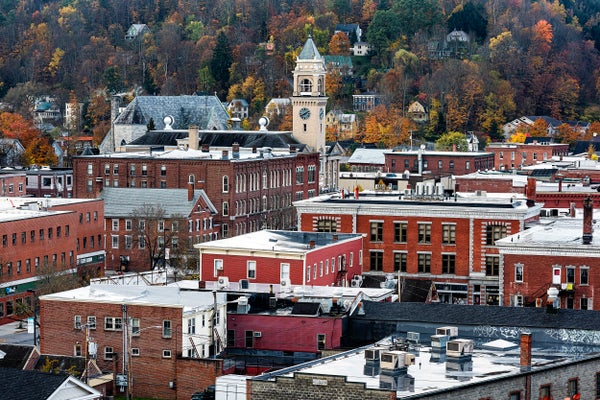
States have tried with limited success to get covid vaccines to people of color, who have been disproportionately killed and hospitalized by the virus.
Starting Thursday, Vermont explicitly gave Black adults and people from other minority communities priority status for vaccinations. It follows Montana, which in January announced that Native Americans and other people of color, because they are at higher risk of complications from covid-19, would be allowed to receive the vaccine.
All Black, Indigenous residents and other people of color who are permanent Vermont residents and 16 or older are eligible for the vaccine.
On supporting science journalism
If you're enjoying this article, consider supporting our award-winning journalism by subscribing. By purchasing a subscription you are helping to ensure the future of impactful stories about the discoveries and ideas shaping our world today.
It will be a short-term advantage, since Vermont opens covid inoculations to all adults April 19.
Still, Vermont health officials say they hope the change will lower the risk for people of color, who are nearly twice as likely as whites to end up in the hospital with covid-19. “It is unacceptable that this disparity remains for this population,” Dr. Mark Levine, Vermont’s health commissioner, said at a recent news conference.
But providing priority may not be enough to get more minority residents vaccinated—and could send the wrong message, some health experts say.
“Giving people of color priority eligibility may assuage liberal guilt, but it doesn’t address the real barriers to vaccination,” said Dr. Céline Gounder, an infectious diseases specialist at NYU Langone Health and a former member of President Joe Biden’s covid advisory board. “The reason for lower vaccination coverage in communities of color isn’t just because of where they are ‘in line’ for the vaccine. It’s also very much a question of access.”
Vaccination sites need to be more convenient to where these targeted populations live and work, and more education efforts are necessary so people know the shots are free and safe, she said.
“Explicitly giving people of color priority for vaccination could backfire,” Gounder said. “It could give some the impression that the vaccine is being rolled out to them first as a test. It could reinforce the fear that people of color are being used as guinea pigs for something new.”
Dr. Georges Benjamin, executive director of the American Public Health Association, said that’s why he has opposed using race as a risk factor to determine covid vaccine eligibility.
But he sees signs that vaccine hesitancy is improving nationally and called Vermont’s new approach “admirable.” Still, he said, states should continue to use a range of options to get vaccines to minority communities, such as providing vaccination sites in Black neighborhoods and places that residents trust, like churches.
No state is achieving equity in its vaccine distribution, said Jen Kates, director of global health and HIV policy at KFF. (KHN is an editorially independent program of KFF.)
“People of color, whether they be Black or brown, are being vaccinated at lower rates compared to their representation among covid cases and deaths, and often their population overall,” she said.
Blacks make up about 2% of Vermont’s population and 4% of its covid infections, but they have received 1% of the state’s vaccines, according to KFF.
“Since states are really not doing well on equity, other strategies are welcome at this point,” said Kates.
Yet, there’s another reason public health officials have balked at explicitly giving people of color vaccine priority. “It could be politically sensitive,” she said.
KHN (Kaiser Health News) is a nonprofit news service covering health issues. It is an editorially independent program of KFF (Kaiser Family Foundation) that is not affiliated with Kaiser Permanente.