
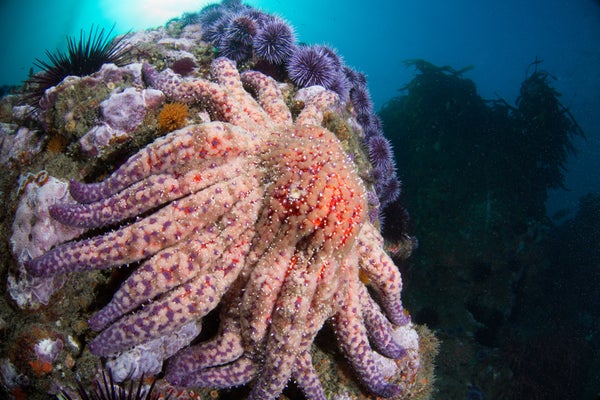
A mysterious illness has killed billions of sea stars in the past decade. After a four-year search, scientists have uncovered the culprit: a bacterium known as Vibrio pectenicida. The team reported its findings this week in Nature Ecology & Evolution.
The strange illness is known as sea star wasting disease, and it causes starfish to disintegrate to death. It is the largest marine epidemic among noncommercial species that has ever been documented, and it has affected more than 20 species of sea stars along the Pacific Coast of North America. Approximately 90 percent of sunflower sea stars (Pycnopodia helianthoides) have died from the ailment, so many that they are now a critically endangered species.
On supporting science journalism
If you're enjoying this article, consider supporting our award-winning journalism by subscribing. By purchasing a subscription you are helping to ensure the future of impactful stories about the discoveries and ideas shaping our world today.
Researchers are unsure of where this bacterium came from and why it broke out. But there is evidence that warmer ocean temperatures are linked to bigger outbreaks. In British Columbia, the most severe outbreaks happen late in the summer, says study co-author Alyssa Gehman, a marine disease ecologist at the province’s Hakai Institute and the University of British Columbia. And that suggests that temperature and possibly even climate change might affect this disease.
“Sea stars [such as] sunflower stars are really important members of their communities,” Gehman says. When the sunflower sea stars lost about 90 percent of their population, there were huge increases in sea urchins (a prey of sea stars) off the coast of California. The spiny creatures are massive grazers of kelp forests, which are crucial members of marine ecosystems, Gehman says. Underwater kelp forests store carbon and are homes for thousands of species. But once sea urchin populations boomed, there was a widespread loss of kelp forests.
To identify the disease, researchers ran more than 20 experiments from 2021 to 2024. In one experiment, they analyzed the genes of eight healthy sea stars and eight infected ones. While sitting in her office and comparing the genetics of the two groups, Melanie Prentice, a research scientist now at the Hakai Institute, thought, “Gosh, there’s so much Vibrio in these wasting sea stars, and there’s really not much happening in these healthy sea stars in terms of Vibrio.” After toggling the data to see the specific Vibrio species, she found V. pectenicida in every single one of the wasting sea star samples. To validate the finding, Prentice and her team exposed healthy sea stars to V. pectenicida. From the 20 sunflower stars that the researchers exposed to V. pectenicida at varying doses, only one survived (this sea star was exposed to the lowest dose of the bacteria tested). The rest died from sea star wasting disease, providing the conclusive evidence the team needed, Prentice says.

A sunflower sea star is reduced to goo on British Columbia’s Calvert Island in 2015. SSWD has killed billions of sea stars—representing over 20 different species from Alaska to Mexico—since 2013.
Grant Callegari/Hakai Institute
“If you don’t know what it is that’s killing them, there’s only so much you can do to try and save them,” Gehman says. “So, there’s a bunch of work that we can do now.”
One next step is to determine if the pathogen is unique to the sunflower sea star because there are still many other species affected by the disease, says Oregon State University marine ecologist Bruce Menge, who wasn’t involved in the study. Prentice and her colleagues hope to breed sea stars that are resistant to the pathogen so they can survive in the wild.