
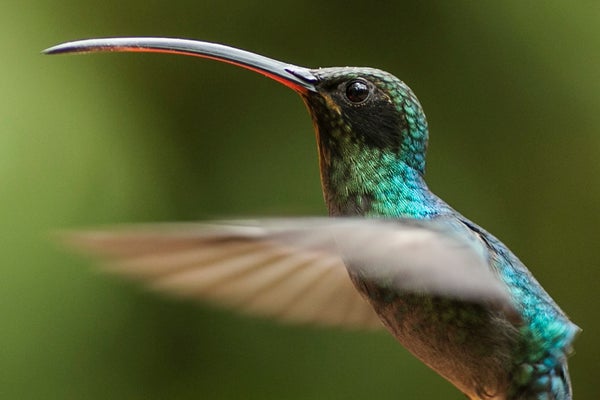
The iridescent green hermit hummingbird is known for its elongated bill, which is fine-tuned for feasting on a particular tropical flower in the rainforests of Central and South America.
But once mating season begins, its distinctive needle-pointed bill also becomes a weapon of war. According to new research published in the Journal of Experimental Biology, male green hermit hummingbirds use their bill—which is straighter and sharper than females’—to joust in a sparring match that can sometimes end in death.
“We used to think that males and females had different bill curvature because they feed on different flowers, but now we see that the evolutionary purpose that shapes their beaks is also about fighting,” says lead study author Alejandro Rico-Guevara, an evolutionary biologist at the University of Washington.
On supporting science journalism
If you're enjoying this article, consider supporting our award-winning journalism by subscribing. By purchasing a subscription you are helping to ensure the future of impactful stories about the discoveries and ideas shaping our world today.
Using three-dimensional modeling of the bills of museum specimens, the researchers showed that the males bill is 3 percent straighter and 69 percent more pointed than the females’, and the former has a dagger-tipped end that can strike at competition with surprising ferocity, Rico-Guevara says.
Hummingbirds from a species related to green hermit hummingbirds fighting in a similar way.
During breeding season in early May, the male birds gather in a group called a lek, where they begin singing a yippy chirp that tells breeding females to come hither. They fight for a position in the lek because males who are not part of the chorus are less likely to be heard by females. And if another hummingbird tries to perch on a branch that’s already occupied, the fight can escalate. “The birds fly bill-first at the other bird and poke them with their entire force,” Rico-Guevara says.
Marcelo Araya-Salas, a biologist studying hermit hummingbirds at the University of Costa Rica, who was not involved in the study, says that this research does an elegant job of showing the difference in the bills using 3D modeling but that the conduct of the birds isn’t at all surprising.
“They’re crazy aggressive,” he says, so much so that the term Huitzilopochtli which is the Aztec sun and war god, “is a hummingbird.”