
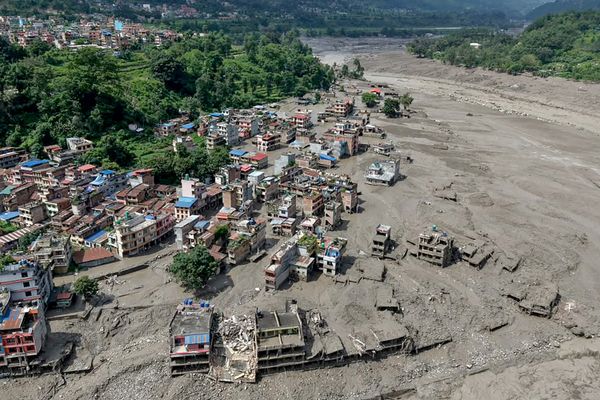
A huge flood, thought to be triggered when a large chunk of ice broke off a high mountain glacier, has swept through settlements in Nepal and Tibet, an autonomous region of China. The waters—seen with people trying to run away on surveillance footage—crashed through buildings. And they have killed at least 160 people, with hundreds more missing, including foreign tourists, according to officials in Nepal and China.
Kristen Cook, a geomorphologist at the Institute of Earth Sciences at Grenoble Alpes University in France, says that seismic data indicated the cause was not an earthquake. Rather the data suggest “that there was some type of large mass wasting event,” she says. “Mass wasting is what we use when we don’t know if it’s a landslide or an avalanche or rock avalanche or what type of of mass fell down a hill, but some type of mass fell down a mountain.”
Satellite imagery and further data allowed researchers to pinpoint the mountain, she says: Langtang Lirung. It is the 99th highest mountain in the world.
On supporting science journalism
If you're enjoying this article, consider supporting our award-winning journalism by subscribing. By purchasing a subscription you are helping to ensure the future of impactful stories about the discoveries and ideas shaping our world today.
Daniel Shugar, a geologist at the University of Calgary in Alberta, found satellite imagery that appears to show a chunk of glacier about 2,000 feet wide that broke off and caused what is called an ice avalanche as it dropped almost 4,000 feet. “The bottom looks like a bomb exploded—it’s just deposits from the broken-up glacier,” he told the New York Times. The flow of the pulverized ice moved down a valley toward the Bhotekoshi River at the border between Nepal and Tibet.
“It’s a very large event. It’s really shocking, the magnitude,” Cook says. Based on the seismic data, researchers estimate that hundreds of millions of tons of material, probably a “significant amount of rock,” as well as ice, might have collapsed, she says. But, she cautions, this is “a very back-of-the-envelope estimate that needs to be confirmed.”

Houses in Nuwakot on August 26.
A similar event happened in India in 2021, destroying a hydroelectric dam project and killing 42 people.
The role of global warming in destabilizing the glacier still needs to be investigated, but glaciers in the Himalayas, as everywhere, have seen significant melt and retreat. This decrease is causing some glaciers to destabilize, along with cliffs they once buttressed. It is also causing sudden outbursts of glacial lakes. More than a third of the glacial ice in the region could disappear by the end of the century, according to some estimates, taking with it a crucial source of water for hundreds of millions of people.

Rescue personnel use an excavator to carry a person affected by flash floods at Devghat in Nuwakot on August 26.
“It’s difficult to conclusively link a single event directly to climate change,” Cook says. But, she adds, “we know it’s getting warmer in the Himalaya. Permafrost is melting. Things are becoming unstable.”
There could be other contributing factors to the flooding as well, Shugar said, because overcast conditions have hampered satellite analysis.
Nepal’s army is carrying out search-and-rescue operations.
Additional reporting by Jackie Flynn Mogensen.
Editor’s Note (8/26/26): This story was updated with quotes from Kristen Cook and may be updated further.