
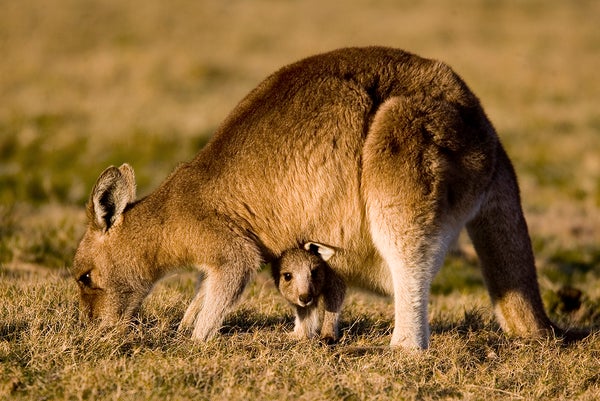
Wallabies are kicking over scientific conventions surrounding mammalian placentas, the organ responsible for protecting and nourishing a developing fetus. A study1 finds that contrary to what scientists thought previously, mother tammar wallabies (Macropus eugenii) have both a functioning internal placenta and milk that performs some of the organ’s usual roles.
Taxonomists usually separate marsupials — including kangaroos, wallabies and wombats — from placental mammals, also known as eutherians, such as mice and people. The separation is based partly on a supposed lack of a placenta in marsupials. But many researchers think that this distinction is incorrect, noting that marsupials develop simple, placenta-like structures during the end of pregnancy, just before the underdeveloped baby crawls from the uterus into the mother’s pouch. These placental structures, just two cell layers thick, provide oxygen, nutrients and molecular signals that drive development to the fetus while protecting it from the mother’s immune system.
It shouldn't be surprising that marsupial placentas look different from those of other animals since even closely related species can have very different-looking placentas that perform the same functions, says Derek Wildman, an evolutionary biologist at the University of Illinois in Urbana-Champaign. “It is the most variable organ in mammals in terms of anatomy and physiology,” he says.
On supporting science journalism
If you're enjoying this article, consider supporting our award-winning journalism by subscribing. By purchasing a subscription you are helping to ensure the future of impactful stories about the discoveries and ideas shaping our world today.
Mother's milk
Marsupial pregnancy is remarkably short for mammals of their size. Tammar wallabies, which can grow to between 6 and 9 kilograms, are pregnant for just 26.5 days — barely longer than rats. Yet the baby, or joey, spends nearly a year continuing to develop and nurse inside the mother’s pouch: a long time compared to other mammals. This developmental mismatch led researchers to suspect that the majority of a joey’s development is driven by specialized features of the mother’s milk.
To determine whether the marsupial placenta functions similarly to a eutherian mammal placenta before birth, evolutionary biologist Julie Baker and evolutionary developmental biologist Michael Guernsey of Stanford University in California analysed the collection of genes expressed in the tammar wallaby’s placenta. When they compared the expression patterns to those of mouse and human placentas, they found that in the final days before the fetus is born, the tissue expressed the same genes as eutherian placentas do in the early stages of fetal development.
The researchers then analysed the genes expressed in the mammary glands of tammar wallabies that were nursing joeys. They found that this glandular tissue expressed the same genes as eutherian placentas do in late fetal development.
“This is beautiful work,” says Anthony Carter, a developmental biologist at the University of Southern Denmark in Odense. He says the genetic analysis provides a persuasive argument that marsupials, contrary to common belief, have fully functioning placentas — they just take different forms.
Diverse development
The finding suggests that placentas across the animal kingdom could express the same suite of genes, regardless of any anatomical differences, says Guernsey. And those differences could occur because the placenta evolves rapidly compared with other organs.
Baker thinks that the rapid evolution could be necessary for the placenta to effectively shield the fetus from the mother’s immune system, which treats the offspring as a foreign invader. “The placenta is evolving, trying to evade the mom, and comes up with these really bizarre strategies” — including taking liquid form in the mother marsupial’s milk, she says.
Wildman says that the finding suggests that lactation may have evolved before eutherian placentas, as egg-laying mammals such as platypuses and echidnas lactate but do not have placentas. The egg-laying group came before marsupials and eutherians. He praises the paper, but says that the researchers could compare gene expresssion across more species than just mice and humans. A paper he published of 14 animals found that placentas did express different genes depending on the species.2
Knowing more about placenta development could help researchers to understand not only animal evolution, but also the possible functions of the human placenta, which is impossible to study in real time given that the work could harm the fetus, says Baker.
This article is reproduced with permission and was first published on September 12, 2017.