
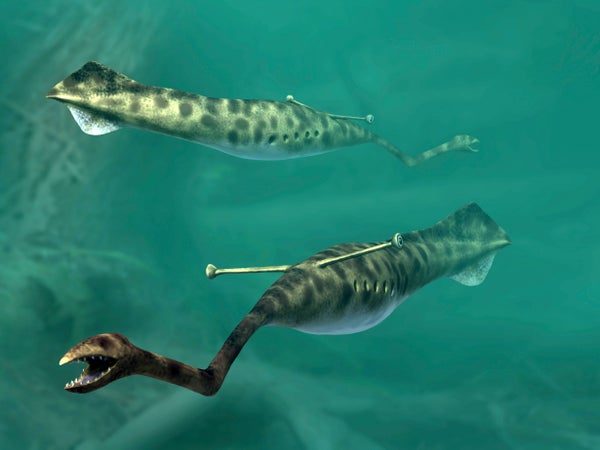
Few creatures in the fossil record have perplexed paleontologists more than the Tully Monster. The curious sea creature—which sported a toothy, trunklike snout and eyes that were splayed out on a rigid rod—has been impossible to classify. Researchers have lumped it in with a variety of organisms such as segmented worms, swimming slugs and primitive eel-like critters since it was first described in 1966. In recent years paleontologists have even connected the Tully Monster to jawless fish such as lampreys, which have a backbonelike structure.
Now a team of scientists in Japan has used high-resolution laser scanners to analyze the anatomy of Tully Monster fossils in three dimensions. Their findings, published this week in the journal Palaeontology,propose that this enigmatic fossil is an invertebrate after all, although its true identity remains elusive.
In the 1950s amateur fossil hunter Francis Tully discovered the ghostly imprint of a torpedo-shaped organism with a large tail fin in the Mazon Creek fossil beds of northeastern Illinois. There the ancient inhabitants of a balmy estuary that covered the area more than 300 million years ago, during the Carboniferous period, are entombed in ironstone nodules. This deposit is famed for its incredible preservation: in addition to standard shell-clad fair such as shrimp, horseshoe crabs and sea scorpions are the remnants of organisms such as worms and jellyfish, whose soft bodies seldom fossilize.
On supporting science journalism
If you're enjoying this article, consider supporting our award-winning journalism by subscribing. By purchasing a subscription you are helping to ensure the future of impactful stories about the discoveries and ideas shaping our world today.
Tully had never seen anything like the “torpedo” fossil. He brought the find to Chicago’s Field Museum of Natural History, where paleontologists were similarly stumped. A curator at the museum christened the fossil Tullimonstrum gregarium when he formally described it in a 1966 paper. Since then scientists have not been able to determine with certainty whether Tully’s Monster had something like a backbone or where the creature fits on the phylogenetic family tree.
In 2016 a team of researchers proposed a potential solution. Victoria McCoy, a paleontologist now at the University of Wisconsin–Milwaukee, and her colleagues posited that a structure that was previously identified as the animal’s gut was a notochord—a primitive backbonelike structure that supported the Tully Monster as it swam. “It was a little hard to wrap my head around because of how different it looks from a lamprey or hagfish,” says McCoy, who was not involved in the new study. “But they have a number of features that are very similar to jawless fish, like complex eyes and cartilaginous vertebrae.”
Not all researchers were sold on the Tully Monster’s vertebrate status, however. To reanalyze the puzzling creature’s traits in the new study, the scientists applied a data-driven approach to a cache of Tully Monster fossils deposited in Japanese museum collections. “Subjective observations can lead to biases, so we adopted detailed measurement and data science approaches to give some objective conclusions,” says study co-author Wataru Iwasaki, an evolutionary biologist at the University of Tokyo.
Tomoyuki Mikami, then Iwasaki’s doctoral student, noticed that the surfaces of the flattened Tully Monster fossils each had subtle anomalies. “When I saw the specimens in the museum, I realized that there are minute surface irregularities that have never been studied in detail,” says Mikami, now a researcher at Tokyo’s National Museum of Nature and Science and lead author of the new study. “I thought these could probably be a clue to understanding the Tully Monster.”
Utilizing a technique similar to one used to study dinosaur footprints, the team employed a 3-D laser scanner to create color-coded digital maps of the surfaces of more than 150 of these fossils. They then statistically investigated the subtle three-dimensional structures to flesh out the animal’s anatomy.
The team concluded that several traits that were linked to vertebrates in previous studies—such as gill pouches, a trilobed brain and fin rays—were either missing from the fossils or were not structurally similar to the traits seen in vertebrates. The researchers also used x-ray microcomputed tomography scans to analyze the clawlike nozzle at the end of the Tully Monster’s fossilized “trunk” and determined that the nozzle’s prickly fangs were not similar to the teeth of modern jawless fish such as lampreys.
According to Mikami, the Tully Monster’s segmentation is another key difference. “I think the most important thing is that we found the segmentation in the head region,” he says. The Tully Monster’s segmentation extends in front of its eyes, an arrangement that is not seen in any vertebrate lineage, Mikami says. He stresses that it remains difficult to confidently place the Tully Monster in any particular group of invertebrates, however.
While McCoy still thinks the Tully Monster was related to jawless fish, she is intrigued by the new study’s findings. “The evidence of segmentation in front of the eye bar does make a stronger case that the Tully monster might be an invertebrate chordate,” a category that includes organisms such as the eellike lancelets, she says.
Everyone agrees that more research is needed to help the Tully Monster finally find a taxonomic home. Iwasaki believes some crucial data points may be waiting for a closer look. “There are many specimens that are sleeping in museum collections,” he says, “and now we have really good sensors and tools to study them in detail.”
