
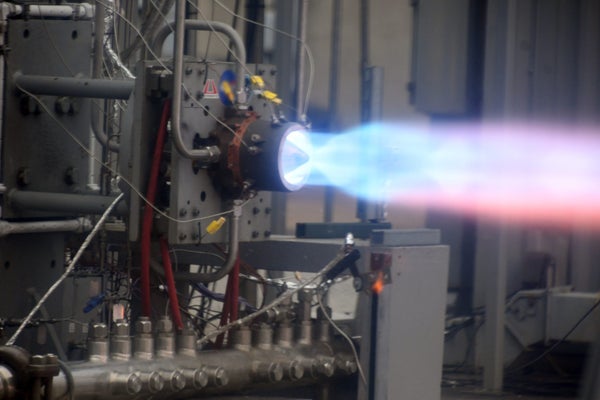
A new generation of space rockets is inching closer to launch. Private space company Astrobotic recently revealed it carried out a successful test of two of its rotating detonation rocket engines (RDREs), firing the two engines for more than 470 seconds, including a 300-second-long continuous burn that the company believes sets a record for RDRE designs.
Like conventional rocket engines, RDREs use liquid fuel, but the difference lies in how the engines employ the liquid to produce thrust. Traditional engines work by pumping propellant and oxidant into a combustion chamber, where they combine and burn to produce exhaust gases that spur the rocket forward. In RDREs, on the other hand, fuel is compressed and heated by a supersonic shock wave, resulting in an explosion—hence the “detonation” in the rocket name—that produces a more powerful thrust. The promise of RDREs is that they can move a spacecraft faster and more efficiently, allowing them to carry heavier payloads and travel farther distances than conventional rockets.
The test run took place at NASA’s Marshall Space Flight Center. In a video, the company’s twin engines, which Astrobotic calls Chakram engines, can be seen firing up with a bright blue flame—the achievement brings RDREs one step closer to an actual launch test.
On supporting science journalism
If you're enjoying this article, consider supporting our award-winning journalism by subscribing. By purchasing a subscription you are helping to ensure the future of impactful stories about the discoveries and ideas shaping our world today.
A hot fire test of an Astrobotic Chakram rotating detonation rocket engine.
“Chakram more than exceeded our expectations,” said Bryant Avalos, Astrobotic’s principal investigator for the Chakram program, in a statement. “With any cutting-edge technology like an RDRE, moving from design into testing, you’re always worried about unknown factors that could be critical to performance. But the engine performed even better than expected. The 300-second burn was the cherry on top.”
Ultimately, Astrobotic wants to hone the rocket design for future missions to the moon, Avalos said. That could include incorporating the engines into its Griffin lunar landers; the first Griffin mission to the moon is slated to launch no earlier than July using a SpaceX Falcon Heavy rocket.
“Demonstrations like this show how RDRE technology could support a wide range of Astrobotic missions, from propulsion on future lunar landers to in-space orbital transfer vehicles, and other capabilities that will help expand operations throughout cislunar space,” Avalos said.
Still, the engines aren’t quite ready for liftoff. During the tests, the Chakram engines each generated more than 4,000 pounds of thrust—that pales in comparison to SpaceX’s Falcon Heavy rocket, which uses 27 engines to generate more than five million pounds of thrust at launch. Many more tests will be needed before the company is ready to try to get its engines off a launchpad, but the data from these tryouts are encouraging.
Astrobotic isn’t the only company tinkering with rotating detonation engines. For example, Venus Aerospace, which has touted the applications of its in-development engine for potential use in both rockets and commercial and military planes, completed the first U.S.-based flight test of an RDRE in May 2025. And in 2021 the Japan Aerospace Exploration Agency (JAXA) tested a rotating detonation engine in space, successfully firing it for six seconds.