
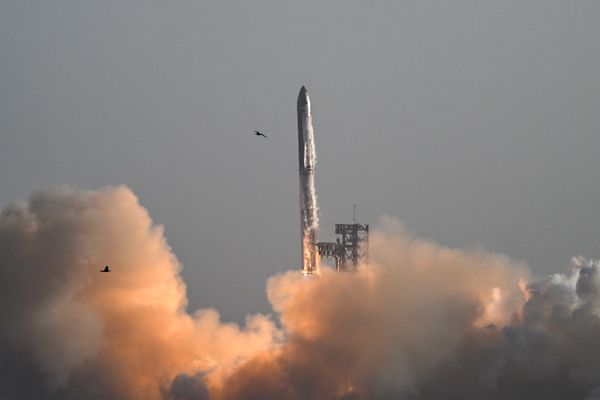
SpaceX is gearing up to launch the latest and largest version of its Starship megarocket. Lifting off from the company’s Starbase compound in Texas no earlier than 6:30 P.M. EDT tonight, the launch marks the 12th test of Starship and the first demonstration of its V3 design. Lift off was originally slated for Thursday, however a problem with the hydraulic pin holding the launch tower arm in place; SpaceX scrubbed the attempt with just seconds to go.
“For those who think this is simply another repeat test flight, the engineering changes under the rocket ‘hood’ are substantial,” says Joseph Gonzalez, an associate professor of practice in aerospace engineering at the University of Illinois Urbana-Champaign and a former engineer for NASA’s Artemis program. “V3 is taller, exceeds 18 million pounds of total thrust and introduces the new Raptor 3 engines,” he explains.
Fully stacked on top of SpaceX’s Super Heavy booster, the vehicle stands some 408 feet (124 meters) tall and is designed to loft about 100 metric tons of cargo into orbit. Like all SpaceX rockets, it’s meant to come back down to Earth to be reused again and again.
On supporting science journalism
If you're enjoying this article, consider supporting our award-winning journalism by subscribing. By purchasing a subscription you are helping to ensure the future of impactful stories about the discoveries and ideas shaping our world today.
“The booster architecture has also evolved significantly,” Gonzalez says. “The vehicle moves from four steering grid fins to three much larger and structurally reinforced fins positioned lower on the booster for improved control authority and thermal robustness.” All of these features and more changes to the rocket’s internal and external design will be tested on this flight, he says.
SpaceX’s livestream of the liftoff will begin approximately 45 minutes before the launch window opens at 6:30 P.M. on Friday, May 22. You can watch it on SpaceX’s site or on X.
The suborbital test is aimed at showing that Starship V3 can successfully launch, separate from its booster and then splash down in the Indian Ocean—it is not going to assess the vehicle’s reusability, although SpaceX hopes Starship will eventually be reusable. Along the way, the spacecraft will release 20 dummy Starlink Internet satellites, as well as two operational Starlink satellites that will test hardware for an upcoming Starlink model. These working satellites will scan Starship’s heat shield and beam images back to Earth. The company also hopes to relight one of the Starship’s Raptor engines while in space.
On reentry, the spacecraft will perform a series of maneuvers, including a flip, on its way to splash down into the Indian Ocean (the booster, meanwhile, will drop into the Gulf of Mexico).
It’s a critical moment for SpaceX. Elon Musk’s company could go public in the next month, and a successful test flight of what Musk says will be its most powerful rocket ever will almost certainly buoy investors’ interest in SpaceX—and NASA’s ambitions of using Starship to get astronauts back on the moon by 2028.
“Whether the mission achieves every objective or not, flights like this continue to push the aerospace industry forward and provide invaluable lessons for the next generation of engineers entering the field,” Gonzalez says.
During SpaceX’s livestream of Thursday’s abortive launch attempt, the company also announced another hope pinned to Starship’s success: The dream of a Chinese-born cryptocurrency billionaire, Chun Wang, to ride the vehicle on a two-year interplanetary voyage to fly by Mars. Wang previously flew with SpaceX last year alongside three other crew members on his privately funded Fram2 mission, the first-ever spaceflight to send humans into polar orbit around Earth.
The announcement didn’t disclose the timeline for that launch or other details, but did reveal that the prospective mission would be preceded by another Starship flight carrying Wang around the moon. Wang would be accompanied by others, including pioneering “space tourist” Dennis Tito and his spouse, Akiko Tito, who purchased tickets for the flight in 2022.
A previously planned private lunar mission for Starship, called Dear Moon, had been targeted to launch as early as 2023. The project was cancelled when its backer, the Japanese billionaire Yusaku Maezawa, grew tired of waiting for SpaceX to sort out technical difficulties with its audacious rocket.
Editor’s Note (5/22/2026): This story has been updated.