
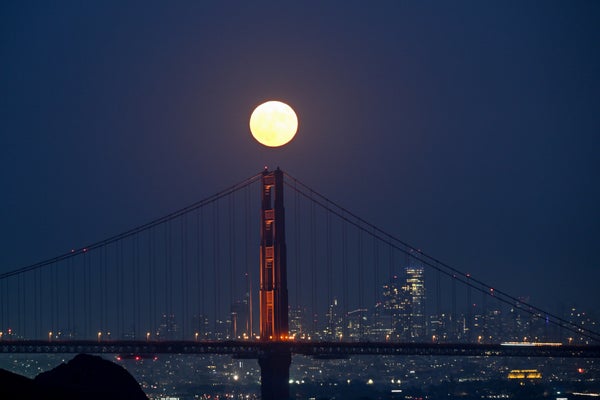
The next full moon will officially be 100% illuminated at 2:26 p.m. EDT (1826 GMT) on Monday, Aug. 19, 2024. But it won't be just any old full moon, it will be a Supermoon Blue Moon! The exact moonrise time will depend on your location.
Sounds pretty cool, but what exactly does that mean? Let's take a look at what makes a "supermoon" and a "Blue Moon" (and what makes a two-in-one Supermoon Blue Moon, of course).
You can watch the Supermoon Blue Moon rise today in a free livestream on Space.com, courtesy of astronomer Gianluca Masi of the Virtual Telescope Project.
On supporting science journalism
If you're enjoying this article, consider supporting our award-winning journalism by subscribing. By purchasing a subscription you are helping to ensure the future of impactful stories about the discoveries and ideas shaping our world today.
To find out what time the moon rises and sets in your area check out Time and Date's moonrise calculator.
The term "supermoon" was first coined by astrologer Richard Nolle in 1979, as "either a new or full moon that occurs when the moon is within 90% of its closest approach to Earth" according to NASA. Full supermoons are the biggest and brightest full moons of the year, appearing approximately 30% brighter and 14% larger than usual. Though this may sound like a lot, it's quite hard to spot the difference with the unaided eye, unless you're a seasoned moon-watcher.
However, in some instances, a supermoon (or even a "regular" full moon, for that matter) can appear huge. Most of the time, though, this has nothing to do with astronomy and everything to do with how the human brain works; this is known as a "moon illusion." The moon illusion is a trick of perception where the moon looks much larger near the horizon than it looks high in the sky.
This illusion occurs because of how our brain interprets distance and size. When the moon is near the horizon, we see it alongside trees, buildings and other objects. That gives us a sense of scale, so our brain compares the moon to these nearby objects, making it appear larger. When the moon is higher up in the sky, there's nothing to compare it to, so it looks smaller. Photographers sometimes use this effect to capture stunning images of distant objects with the moon appearing extremely large behind them.
August's supermoon will be the first of four this year, with the others occurring on Sept. 17, Oct. 17 and Nov. 15. The closest supermoon will be October's Hunter's Moon, rising at 7:26 a.m. ET (1126 GMT) on Oct. 17.
Will August's moon actually be blue?
Unfortunately not. There are two types of "Blue Moon," but neither has anything to do with the color. A seasonal Blue Moon refers to the third full moon in a season that has four full moons. This is the traditional definition of a Blue Moon and the type we will see rise on Aug. 19.
The second type of Blue Moon — which arose from a misunderstanding of the original definition — simply refers to the second full moon in a single calendar month. Today, this monthly "Blue Moon" concept is accepted as an alternative definition rather than a mistake, according to Time and Date.
When can I see the supermoon Blue Moon?
Though the full moon officially rises at 2:26 p.m. EDT (1826 GMT) on Monday, Aug. 19, 2024, it will still appear nearly full on the nights surrounding Aug. 19.
If you're inspired by some of the photographs featured in this article and want to use August's supermoon Blue Moon as a great excuse to get outside and dust off your camera, our comprehensive guide on how to photograph a supermoon may help. If you fancy taking a more in-depth tour of our rocky companion, our moon viewing guide will help you identify key lunar targets and our Apollo sites viewing guide will help you see where humans, rovers and landers have stepped onto another world.
Copyright 2024 Space.com, a Future company. All rights reserved. This material may not be published, broadcast, rewritten or redistributed.