
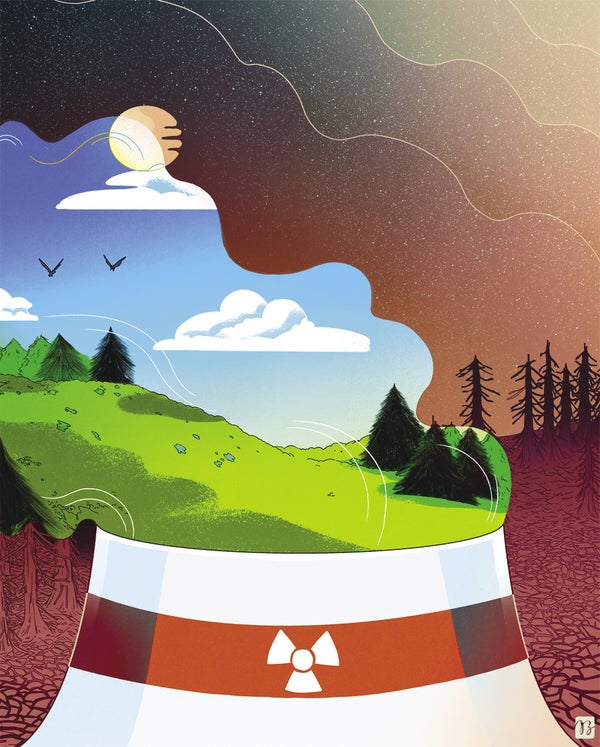
Fifty-four percent of Americans are opponents of nuclear power, according to a 2016 Gallup poll. I can certainly understand why. I used to be one of them. Back in the 1990s, I wrote an entire Ph.D. dissertation about the errors that led to disasters such as Three Mile Island and Chernobyl, and it didn’t leave me with much faith in our ability to safely tap fission energy.
But in recent years I’ve swung around to a different point of view. Today the specter of climate change scares me way more than the risk of future meltdowns. It’s time to find ways to enable the nuclear industry’s rebirth in the U.S.
The virtue of nuclear plants is that they plug into the existing electrical grid and provide continuous power while emitting zero carbon. Wind and solar are great, too, but we don’t yet have the battery technology needed to make them useful as “base-load” power sources.
On supporting science journalism
If you're enjoying this article, consider supporting our award-winning journalism by subscribing. By purchasing a subscription you are helping to ensure the future of impactful stories about the discoveries and ideas shaping our world today.
Without nuclear, it would be much harder to meet the world’s growing power needs while limiting the average global temperature increase to 1.5 degrees Celsius, the goal of the 2015 Paris Agreement.
Fortunately, engineers have been rethinking every aspect of reactor design, from the way fuel is packaged [see “Reactor Redo,” by Rod McCullum; May 2019] to the way cores are cooled. All three active reactors at Japan’s Fukushima Daiichi plant melted down in 2011 because an earthquake and the resulting tsunami destroyed the backup diesel generators meant to power cooling pumps. Several companies, including Washington State-based TerraPower, are working on passive designs that would use plain old convection rather than electric pumps to carry away decay heat.
But TerraPower will likely build its first full-scale reactors outside the U.S., vice chairman of the board Nathan Myhrvold told me in a 2017 interview for Xconomy. “Frankly, if the whole world was like the United States, we might not have ever done this, because [the U.S. has] gotten so risk-averse that we don’t want to try anything new,” Myhrvold said.
Today the main obstacle to new nuclear power investment in the U.S. isn’t safety, it’s cost. Two new Westinghouse Electric Company reactors under construction at Georgia’s Vogtle nuclear plant are five years behind schedule and $14 billion over budget.
Builders of traditional reactors have failed to follow basic design, fabrication and supply-chain principles proven in other capital-intensive businesses such as pharmaceuticals and jet engine manufacturing, a 2018 report from the M.I.T. Energy Initiative found.
Then there’s the energy marketplace, which was turned upside down by the fracking revolution of the 1990s. In the U.S., natural gas is so cheap and abundant that even well-run nuclear plants can’t compete.
They can’t, that is, unless one accounts for the social cost of carbon, a measure representing the economic damage that will inevitably result from sea-level rise, wildfires and other consequences of carbon dioxide emissions. If electricity from fossil-fuel plants were taxed to reflect this cost, nuclear would suddenly become the more economical option, the M.I.T. report argues.
Because carbon taxes are a political nonstarter, the states of New York and Illinois are going at it from the other direction, forcing coal- and gas-burning utilities to purchase zero-emissions credits from nuclear plant owners. In both states, courts have turned back power generators’ legal challenges to zero-emissions credits, and the new revenue has kept open five plants that faced early closure.
We need to scale up these credits nationally to keep our existing nuclear plants operating while removing obstacles to the construction of safer new designs. If we allow ourselves to be unnerved by the nuclear mistakes of the past, we’ll never win the paramount race against global warming.