
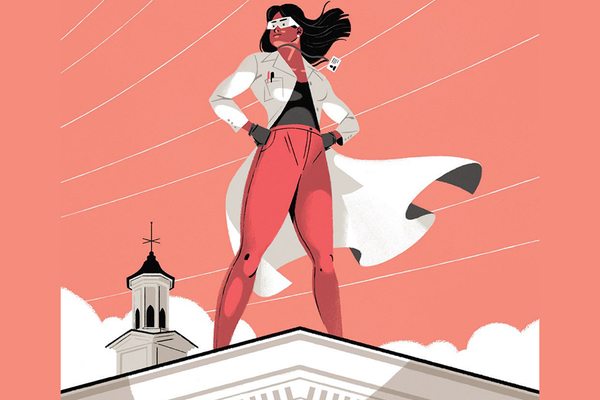
If knowledge is power, scientists should easily be able to influence the behavior of others and world events. Researchers spend their entire careers discovering new knowledge—from a single cell to the whole human, from an atom to the universe.
Issues such as climate change illustrate that scientists, even if armed with overwhelming evidence, are at times powerless to change minds or motivate action. According to a 2015 Pew Research Center survey, people in the U.S., one of the countries that emits the most carbon, were among the least concerned about the potential impact of climate change. Why are so many Americans indifferent to this global threat? Yale University professor Dan M. Kahan and his colleagues reported in Nature Climate Change that people with the “highest degrees of science literacy and technical reasoning capacity were not the most concerned about climate change.”
For many, knowledge about the natural world is superseded by personal beliefs. Wisdom across disciplinary and political divides is needed to help bridge this gap. This is where institutions of higher education can provide vital support. Educating global citizens is one of the most important charges to universities, and the best way we can transcend ideology is to teach our students, regardless of their majors, to think like scientists. From American history to urban studies, we have an obligation to challenge them to be inquisitive about the world, to weigh the quality and objectivity of data presented to them, and to change their minds when confronted with contrary evidence.
On supporting science journalism
If you're enjoying this article, consider supporting our award-winning journalism by subscribing. By purchasing a subscription you are helping to ensure the future of impactful stories about the discoveries and ideas shaping our world today.
Likewise, STEM majors' college experience must be integrated into a broader model of liberal education to prepare them to think critically and imaginatively about the world and to understand different viewpoints. It is imperative for the next generation of leaders in science to be aware of the psychological, social and cultural factors that affect how people understand and use information.
Through higher education, students can gain the ability to recognize and remove themselves from echo chambers of ideologically-driven narratives and help others do the same. Students at Yale, the California Institute of Technology and the University of Waterloo, for instance, developed an Internet browser plug-in that helps users distinguish bias in their news feeds. Such innovative projects exemplify the power of universities in teaching students to use knowledge to fight disinformation.
For a scientific finding to find traction in society, multiple factors must be considered. Psychologists, for example, have found that people are sensitive to how information is framed. My research group discovered that messages focused on positive outcomes have more success in encouraging people to adopt illness-prevention measures, such as applying sunscreen to lower their risk for skin cancer, than loss-framed messages, which emphasize the downside of not engaging in such behaviors. Loss-framed messages are better at motivating early-detection behaviors such as mammography screening.
Scientists cannot work in silos and expect to improve the world, particularly when false narratives have become entrenched in communities. This is especially true in tackling issues such as public trust in vaccines, a topic that is flooded with misleading information, despite a lack of legitimate scientific evidence supporting the view that they are unsafe. Interdisciplinary research groups worldwide are investigating this global challenge. For example, computer scientists worked with a psychologist to understand people's attitudes in social media toward vaccination, and an international team tracked worldwide sentiments toward immunizations using data-driven methods. These findings inform community and policy discussions that are based on facts and understanding of one another's concerns, not on assumptions.
Universities are conveners of experts and leaders across disciplinary and political boundaries. Knowledge is power but only if individuals are able to analyze and compare information against their personal beliefs, are willing to champion data-driven decision making over ideology, and have access to a wealth of research findings to inform policy discussions and decisions.