
Airline passengers moving through security who meet certain criteria—such as having purchased a last-minute ticket—can expect to be taken aside for a pat-down body search, which some people find invasive.
Transportation Security Administration (TSA) officers at Sky Harbor airport in Phoenix now offer such passengers a body scan in lieu of a pat-down. So far, the agency reports, about 80 percent of passengers selected for secondary screening have chosen to step up to the machine. The TSA is now testing two competing body-scanning technologies, and the trial program will soon be extended to LAX in Los Angeles and JFK in New York.
One method is backscatter x-ray imaging. It senses low-intensity x-rays as they reflect back from the passenger’s body and any objects the person may be concealing. (The technique differs from conventional transmission x-ray imaging, which uses higher-energy beams.) Different materials reflect rays back to a detector in proportion to their density. Joe Reiss, vice president of marketing at manufacturer American Science and Engineering (AS&E) in Billerica, Mass., says low-atomic-number elements such as carbon, oxygen, hydrogen and nitrogen—common constituents of explosives—create a strong scattering effect visible in images that operators monitor on a screen yet discernible from the organic molecules in the human body.
On supporting science journalism
If you're enjoying this article, consider supporting our award-winning journalism by subscribing. By purchasing a subscription you are helping to ensure the future of impactful stories about the discoveries and ideas shaping our world today.
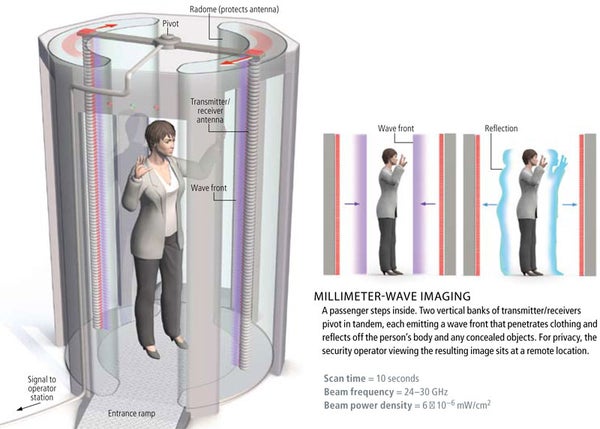
The second method TSA is testing is millimeter-wave imaging. The system, built by L-3 Communications in Woburn, Mass., emits beams of radio-frequency energy that are tuned to reflect well off human skin. Reflected radio energy is then used to construct a 360-degree model of the passenger and whatever he or she may be carrying.
TSA is not yet commenting on the relative performance of the two systems, because trials are still under way. Critics are voicing concerns about privacy, however. Barry Steinhardt, associate director of the American Civil Liberties Union, calls backscatter x-ray imaging “nothing more than an electronic strip search.” AS&E has added software that reduces the person’s body details to outlines, while highlighting objects of interest, such as a ceramic knife tucked into a sock. L-3 offers a similar feature. The workers who examine the images sit where they cannot see the person being scanned, and the images are deleted after being examined, TSA says.
Did You Know
PRIVATE EYES: In addition to understandable modesty about a stranger seeing through one’s clothes, travelers may have other reasons to keep private what is normally unseen: a body scanner can illuminate evidence of mastectomies, colostomy appliances, penile implants and catheter tubes.
RISK-FREE: The makers of scanners claim that the amount of energy imposed on the human body poses no health risk to travelers. L-3 Communications says the energy projected by its equipment is one ten-thousandth the energy in a cell phone transmission. AS&E says the radiation dose from a backscatter x-ray, less than 10 microrems, is the same received from natural sources during two minutes of an airplane flight at 30,000 feet.
DENIM TECH: Imaging technology has also been used for high fashion. Intellifit Corporation has a “virtual fitting room” in West Chester, Pa., where a millimeter-wave machine scans customers to determine sizing, and salespeople give advice about the perfect fit of clothing, such as blue jeans, sold by several national brands.