
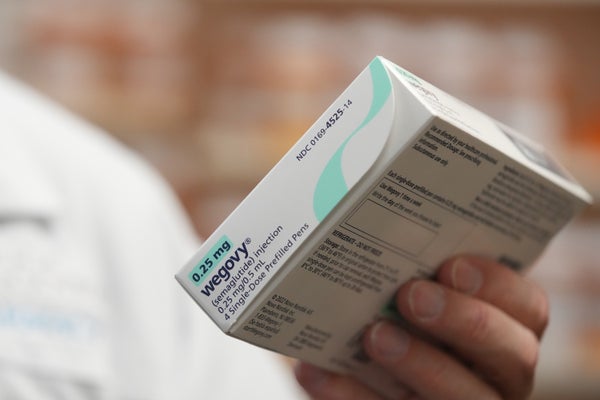
Weight-loss pills that harness the same mechanism as the wildly popular drugs Wegovy and Ozempic are coming to the U.S.
On Monday Novo Nordisk announced that the U.S. Food and Drug Administration approved its oral glucagonlike peptide 1 (GLP-1) medication for weight loss and obesity in adults.
It’s a milestone for the industry, which has struggled to make effective pill versions of the weight-loss injections for years. Most people are more comfortable taking a pill than regularly injecting themselves, says Daniel Drucker, an endocrinologist at the University of Toronto, who previously consulted for Novo Nordisk. “It’s just good to have more options for people,” he says. At the same time, the pills could greatly improve access to the medication by lowering costs—the injections can cost hundreds of dollars per month out of pocket.
On supporting science journalism
If you're enjoying this article, consider supporting our award-winning journalism by subscribing. By purchasing a subscription you are helping to ensure the future of impactful stories about the discoveries and ideas shaping our world today.
“Pills are also easier to transport and produce,” says Rozalina McCoy, an endocrinologist and internist at the University of Maryland, adding that she hopes the new FDA approval will increase access to the drugs.
Prior to that approval, Novo Nordisk, which also makes the injectable semaglutide drugs Ozempic and Wegovy, had seen promising results from its trials of the weight-loss pill, which will also be sold under the brand name Wegovy. In the company’s latest phase 3 clinical trial, the highest dose of the pill resulted in a 16.6 percent weight loss at 64 weeks compared with a 2.7 percent loss among those who took a placebo. For comparison, trials of 2.4 milligrams of Wegovy injections showed up to 17.4 percent weight reduction. (The injection and pill were not compared in a head-to-head trial.)
GLP-1 drugs have transformed the weight-loss industry and revolutionized the treatment of metabolic disease. But until now, they have largely been available in the U.S. only as injections. Novo Nordisk’s pill for type 2 diabetes, Rybelsus, was approved by the FDA in 2019. But oral versions of these drugs haven’t taken off in the same way as the injectables despite even early data showing weight loss and health benefits to be relatively comparable.
The Wegovy pill, taken once a day, works similarly to the weekly injections—mimicking the activity of a gut hormone that slows down the speed at which people’s stomach empties and that makes them feel fuller. People who take the pills tend to eat less overall. The side effects are pretty similar to those of injections of the drug, and they can include nausea, diarrhea and vomiting.
The pills must also be taken on an empty stomach to work effectively.
“Nothing else can be taken by mouth for at least 30 minutes to allow the medication to be absorbed into the bloodstream,” says John Buse, an endocrinologist at the University of North Carolina at Chapel Hill, who is a consultant and investigator for Novo Nordisk. “If patients take the medication with other medications, food or even more water or coffee, the effectiveness is dramatically reduced.”
The pill will be available in U.S. pharmacies and select telehealth providers in early January, a Novo Nordisk spokesperson told Scientific American. The starting dose of 1.5 mg is anticipated to cost $149 per month out of pocket but could be lower, depending on a person’s insurance.
Importantly, Novo Nordisk’s latest clinical trial success was based on the maximum daily dose of 25 mg, McCoy says. Unlike the injectables, which enter the bloodstream directly, the pills are broken down in the stomach, which means “the oral doses have to be much, much higher” than the Wegovy injections, which cap at 2.4 mg, McCoy explains.
“I expect that the effective doses of oral Wegovy will be much more expensive than the advertised $149, unfortunately. But I would love to see this medication be more affordable,” she says.
A spokesperson for Novo Nordisk told Scientific American that prices for higher doses will be shared in the new year. “We believe this is the most affordable self-pay price to date for a GLP-1 for weight loss,” the spokesperson said.
Other companies are working on their own weight-loss pills: Eli Lilly, which makes Zepbound, is developing a GLP-1 pill, orforglipron, for weight loss and type 2 diabetes, with FDA approval anticipated for March 2026. More pill options—combined with other effective versions of these drugs in the pipeline—will open up the market and hopefully drive prices down, Drucker says.
“I think we’re going to go in the next like 12 to 18 months from these two main [injection] options from Novo Nordisk and Eli Lilly to half a dozen options in this class of medicines,” Drucker says. “That’s only going to be good for people. They’ll have more choice.”