
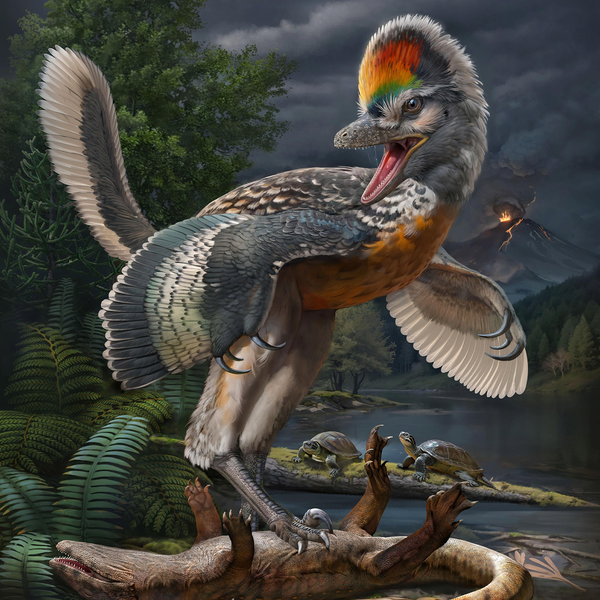
One hundred and fifty million years ago, a young, bantam-sized, bird-like dinosaur became mired in a swamp in what is now southeastern China, and succumbed. Its fossilized remains, unearthed in 2022 and named Fujianvenator prodigiosus, show it to be one of the earliest bird-like dinosaurs to date from the Jurassic period. The researchers describe their discovery in a paper published today in Nature.
“This is really a weird animal within the group of birds,” says Mark Loewen, a palaeontologist at the University of Utah in Salt Lake City, who was not involved in the discovery.
The creature had oddly lanky legs and might have lacked the ability to fly. It also doesn't seem to conform to the accepted bird-evolution story.
On supporting science journalism
If you're enjoying this article, consider supporting our award-winning journalism by subscribing. By purchasing a subscription you are helping to ensure the future of impactful stories about the discoveries and ideas shaping our world today.
Although dinosaurs were largely extinct by 66 million years ago, therapods, the three-clawed, hollow-boned group that included Velociraptor and Tyrannosaurus rex, had started to evolve into today’s birds. Many palaeontologists consider the first bird to be a 150-million-year-old feathered dinosaur called Archaeopteryx, fossils of which were found in Germany. But this study adds to mounting evidence that by the time of Archaeopteryx, dinosaurs had already diversified into different kinds of birds, Loewen says.
Hailu You, a palaeontologist at the Chinese Academy of Sciences in Beijing and one of the co-authors of the paper, says that in the Jurassic, bird-like dinosaurs might have been occupying different ecological niches. “Early bird evolution is complicated,” he says.
Fujianvenator’s fossil lacks a head or a complete tail, but its body and limbs show a medley of traits similar to those of other bird-like dinosaurs, such as the relative lengths of the fingers, and details of the pelvis and vertebrae.
But it didn’t have many modifications that would contribute to flight. For example, it had a shortened shoulder blade and fingers more specialized for grabbing. Strangest of all are the bird’s hyper-elongated hind legs, in which the lower leg bone — the tibia — is twice as long as the thigh bone. Such long legs indicate a highly skilled runner, perhaps similar to a roadrunner (Geococcyx spp.), says Bhart-Anjan Bhullar, a palaeontologist at Yale University in New Haven, Connecticut.
Alternatively, those stilts could have been used for wading. In the area where Fujianvenator was found, the researchers also uncovered a variety of swamp creatures, which they call the Zhenghe fauna. These fossils included fish, turtles and other aquatic reptiles. Swamps were a previously unknown habitat for early birds. To know whether the bird’s legginess was an adaptation to swamp life or high-speed running, researchers would need to examine the ends of its toes for signs of webbing — but those digits are poorly preserved. Either scenario is equally possible, the authors write.
The fact that the dinosaur was found at all was a stroke of luck. Researchers uncovered the fossil at a site near Nanping in Fujian province, where no dinosaurs have been found before. And examples of late-Jurassic bird-like dinosaurs are rare because their hollow bones are fragile and preserve less well. Fossilization requires ideal conditions such an absence of oxygen to prevent decay — conditions that lakes or swamps can provide.
Because of that scarcity of fossils, Fujianvenator helps to fill in some gaps in early bird evolution, says Bhullar. “Even at their earliest stages, the closest fossil relatives of birds were diversifying in interesting ways.”
“There are many, many such things left to be discovered,” he says. “We've only scratched the surface of the anatomical and lifestyle diversity of these animals.”
This article is reproduced with permission and was first published on September 6, 2023.