
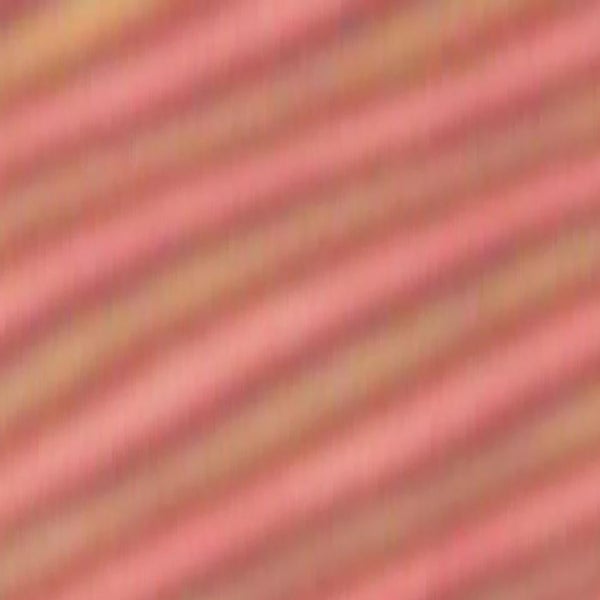
A time crystal is a form of matter that shows continuous, repeating patterns over time, much like how atoms in a normal crystal repeat in space. Examples once existed in only complex, quantum matter, but now physicists have found a way to make a time crystal that can be seen, under certain conditions, with the naked eye.
The feat, accomplished by physicists at the University of Colorado Boulder, and published in Nature Materials on 4 September, involved liquid crystals — bar-shaped molecules with properties between those of a liquid and those of a solid. Simply by shining a light on the liquid crystals, the team created ripples of twisting molecules through them. The ripples kept moving for hours, undulating with a distinct beat, even when the researchers changed the conditions. The rhythm was also out of sync with any incoming force — fulfilling the two defining criteria for a time crystal.
Although some of this behaviour of liquid crystals was already known, no one had previously considered whether it could be harnessed to make a time crystal, says Young-Ki Kim, a materials scientist at the Pohang University of Science and Technology in South Korea.
On supporting science journalism
If you're enjoying this article, consider supporting our award-winning journalism by subscribing. By purchasing a subscription you are helping to ensure the future of impactful stories about the discoveries and ideas shaping our world today.
The macroscopic scale of the time crystal — at millimetres to centimetres across — creates opportunities “to provide deeper understanding” of the phenomena, he says. The distinctive patterns in the crystals could also allow them to be used in anti-counterfeit devices, say the authors.
Impossible machines
Nobel-prizewinning physicist Frank Wilczek first proposed the idea of a time crystal in 2012. Wilczek’s version was almost like a perpetual-motion machine; something that cycled endlessly while in its natural resting state. A team later published a paper that mathematically proved this concept was impossible, but researchers soon found that other kinds of time crystal were possible. Ordered time crystals could exist, for example, in bizarre systems that were perpetually in flux, rather than at rest.
Time crystals have since been made in a variety of ways, using interacting nanoscale defects in diamonds, trapped ions and simulated on Google’s Sycamore quantum computer. But most examples have been at the microscopic scale.
The latest system involves shining a light, even that from a normal light bulb, on a liquid-crystal film trapped between two glass plates. When the light hits photosensitive dye molecules on the glass plates, they switch their orientation, which triggers molecules in the liquid crystal to begin twisting.
Intermolecular forces between rod-like liquid crystal molecules mean that they usually all point in the same direction. If some begin twisting, this sets off a domino effect: the molecules reorient themselves in a complex interaction that moves across the sample like a Mexican wave.
From this soup of molecules arise stable twisted formations that behave like particles. These particles interact with each other to create observable ripples. “We were surprised and excited to see that such time-crystalline order can be readily observed in soft matter systems,” says Ivan Smalyukh, a physicist at the University of Colorado Boulder, who led the work.
To observe the molecular dance in detail, the authors looked at the time-crystal system using a kind of microscope that transmits only polarized light. The amount of light that passes through depends on a molecule’s alignment, revealing the time crystal’s ripples as a series of dark and bright stripes.
The time crystal maintained its distinctive rhythm for hours, even when the researchers varied its temperature and the light intensity. Because the set-up can be tweaked to create patterns that are centimetres across, the effect can be seen by the naked eye, albeit with less contrast and resolution than with the microscope, says Smalyukh.
Because the pattern changes across both space and time, the system is technically a space-time crystal, say the authors. It unquestionably fits the definition of a time crystal, adds Smalyukh, but it does pose the question of whether other periodic effects also fit the bill.
The authors say that these time crystals are not just a curiosity. The thin layers of crystal could be embedded in bank notes as a way to verify their authenticity. Light passing through stacks of different crystals, each with a different characteristic pattern, would create not just a ripple in one direction, but a changing 2D barcode that would be extremely difficult to counterfeit and could also be used to store information, they say.
“We don’t want to put a limit on the applications right now,” added Smalyukh, in a statement. “I think there are opportunities to push this technology in all sorts of directions.”
This article is reproduced with permission and was first published on September 15, 2025.