
On June 25, 2012, particle physicist Sau Lan Wu was in Building 32 at CERN, the European particle physics laboratory near Geneva. Hundreds of feet below, the Large Hadron Collider (LHC)—the world’s biggest scientific instrument—had been conducting high-energy particle collisions for more than two years. The machine accelerates protons to near the speed of light and slams them into one another to produce sprays of fundamental particles and radiation. “Suddenly there’s a lot of noise,” Wu recalls. “We heard one of my students screaming.”
Wu had assigned one of her most capable statisticians, graduate student Haoshuang Ji, to the task of confirming whether the long-sought Higgs boson particle had briefly appeared among the collider’s showers of subatomic particles. Ji had worked through the night to combine two datasets tracking different potential signs of the Higgs.
The combined statistical significance of the datasets surpassed the threshold needed to claim a discovery. The Higgs boson was real. Celebratory cheers erupted down the corridor. “Everybody smiled more and more; our mouths became bigger and bigger,” Wu says. “This is what you call the joy of discovery.”
On supporting science journalism
If you're enjoying this article, consider supporting our award-winning journalism by subscribing. By purchasing a subscription you are helping to ensure the future of impactful stories about the discoveries and ideas shaping our world today.
The Higgs boson, announced to the world nine days later, brought the number of known elementary particles in the universe to 17. It was the last particle predicted by the Standard Model, theorists’ best description of nature’s fundamental bits. The model groups particles into fermions (the building blocks of matter, such as quarks) and bosons (force-carrying particles such as photons).
These particles are the smallest bits of nature known. But can they be broken down further? “That’s what we search for in experiments,” says James Beacham, a physicist at CERN. “There’s this notion of what it means to be the smallest possible thing. Really we’re asking: What are the most fundamental ways by which the universe organizes itself? What is physical reality? It’s really a kind of profound, almost philosophical question.”
With more time and more advanced tools, scientists wonder, will we keep discovering more underlying pieces of the universe? Will we ever reach the limit—the final building block of nature? How can we truly know if we’ve drilled down as far as the subatomic layers go?
In addition to looking for smaller ingredients within known particles, physicists believe that there could be additional elementary particles that have yet to be identified. A hypothetical dark matter particle, for example, may be composed of smaller parts that we can think of as “dark quarks,” Beacham says.
The search for new fragments of reality may reveal that our understanding of elementary physics is flawed. The Standard Model represents particles as points, meaning they have no volume. Scientists, however, know that they don’t literally have zero volume, but they are so small that there is no mathematical reason to include their size in physical models. (And according to the model, particles are merely “excitations” in fundamental fields that pervade the universe.)
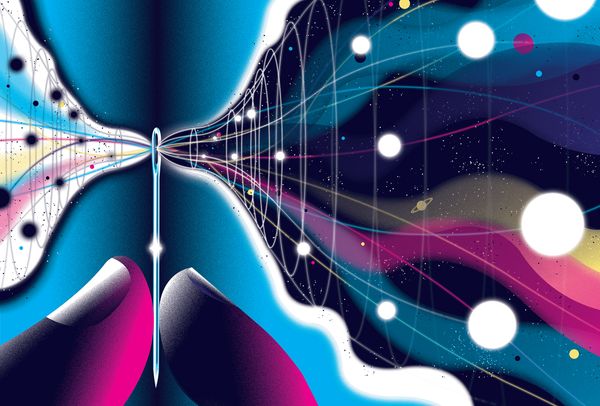
But what if instead of points, these bits of mass and energy are actually something else, like tiny, vibrating strings? Under string theory, a particle’s characteristics would then be determined by the string’s properties and the way it mingles with other strings, all quivering and coiling near the infinitesimal limits of physical size.

Neil Webb
“Think of strings interacting,” says Mirjam Cvetič, a theoretical physicist specializing in string theory at the University of Pennsylvania. “Open strings can combine and split. When they combine, they can make closed strings.” Most elementary particles would be formed by open strings, she says, and closed strings would make up the hypothetical particles that carry the gravitational force, called gravitons.
To accurately explain known physics, these strings must exist across at least 10 dimensions, a geometric structure that is assumed to be accessible only at tiny scales. Opening, closing and thrumming like guitar chords across layers of reality, the strings of the theory are capable of explaining the established laws of physics in literally a quadrillion different ways. To critics, this makes the theory untestable—even worthless. But to proponents, the idea has a certain kind of beauty in its ability to explain facets of the universe. That’s “not a proof,” Cvetič says, “but a compelling feature.”
An alternative idea to string theory is the proposal that spacetime itself is made of tiny loops. Known as loop quantum gravity, this theory proposes that space isn’t smooth; instead it can be broken down into discrete bits.
Under loop quantum gravity, spacetime is a “sea of gravity that is in a tempest,” says Francesca Vidotto, a theoretical physicist at Western University in Ontario. Woven together, these fundamental loops of gravity can mathematically account for the curvature of spacetime.
Vidotto says this scenario is similar to being bathed in light, which is described through the electromagnetic force. “We are immersed in the electromagnetic field,” she says. “And when we try to interact at a quantum level with this electromagnetic field, the only interactions we can have are through these discrete objects, the photons.” The same relation may exist for gravity. “I think for spacetime we should have a similar intuition that we are immersed in the gravitational field,” she says. “And when we try to interact with this field at the smallest possible scale, we discover that there is this quantum spacetime, like grains.”
One tantalizing prediction of loop quantum gravity is that tiny remnants of black holes could coexist with so-called white holes—regions of spacetime that are essentially the opposite of black holes and prohibit light and matter from entering. The two could combine through quantum superposition (the ability of quantum objects to occupy multiple states at once) to form stable particles. These particles are a theoretical candidate for dark matter. “If we are right,” Vidotto says, “it’s as if we had quantum gravity under our nose all these years without realizing.”
If strings or quantum loops exist, physicists believe they would be about the size of the Planck length, which is thought to represent a physical limit to how small something can be, about 1.6 × 10⁻³⁵ meter. According to quantum theory, it is impossible to measure beyond this limit because anything smaller would have physical uncertainties that would prevent it from having a definite size.
To experiment close to the Planck scale, we would need a circular particle collider centered on the sun and reaching “a little past the outer orbit of Neptune,” Beacham says. This grand space accelerator won’t be possible anytime soon, but scientists are working on upgrades at the Large Hadron Collider that are slated to come online in 2030. These modifications will allow the machine to measure even more particles erupting from collisions. The primary objective is to learn more about the Higgs boson, which may actually be multiple types of particles or could be made of composite parts.
“What are the subtle deviations of how this Higgs boson behaves?” wonders Archana Sharma, a physicist at CERN who helped to design, build and operate one of the LHC’s primary detectors. “How does it decay? How does it self-interact? Are there two bosons that can be produced or not?”
Because the Higgs has a quantum spin of zero, it is the only known elementary scalar particle. Learning more about how it behaves is crucial to understanding the ghostly medium responsible for imparting mass in the universe. “The Higgs boson could be the doorway to an entirely new physics,” Sharma says. “It’s unlike any other particle we know.”
With any luck, continuing to up the ante in the LHC could reveal new facets of reality. Whether we will ever fully understand the underpinnings of existence, however, is anyone’s bet. “Some questions may be unanswerable. That’s, of course, very, very important to accept,” Sharma says. “And we need to continue to ask nevertheless.”