
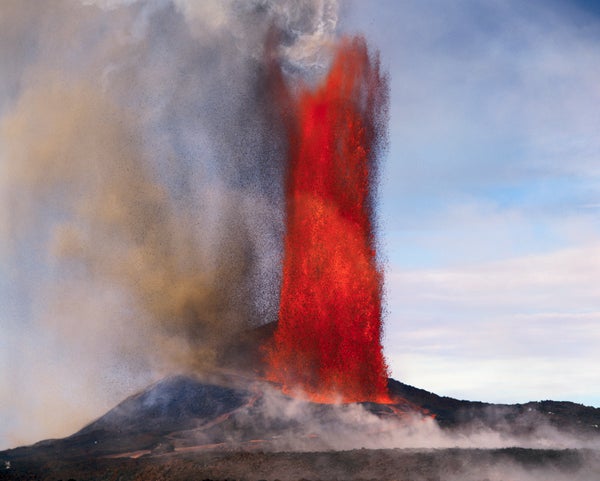
Editor’s Note (6/4/18): This story is being re-posted in light of the deadly eruption of Guatemala’s Fuego volcano on Sunday (June 3), which covered nearby villages in fast-moving ash flows.
Attila Kilinc, head of the geology department at the University of Cincinnati, offers this answer. Most recently, Professor Kilinc has been studying volcanoes in Hawaii and Montserrat.
When a part of the earth's upper mantle or lower crust melts, magma forms. A volcano is essentially an opening or a vent through which this magma and the dissolved gases it contains are discharged. Although there are several factors triggering a volcanic eruption, three predominate: the buoyancy of the magma, the pressure from the exsolved gases in the magma and the injection of a new batch of magma into an already filled magma chamber. What follows is a brief description of these processes.
On supporting science journalism
If you're enjoying this article, consider supporting our award-winning journalism by subscribing. By purchasing a subscription you are helping to ensure the future of impactful stories about the discoveries and ideas shaping our world today.
As rock inside the earth melts, its mass remains the same while its volume increases--producing a melt that is less dense than the surrounding rock. This lighter magma then rises toward the surface by virtue of its buoyancy. If the density of the magma between the zone of its generation and the surface is less than that of the surrounding and overlying rocks, the magma reaches the surface and erupts.
Magmas of so-called andesitic and rhyolitic compositions also contain dissolved volatiles such as water, sulfur dioxide and carbon dioxide. Experiments have shown that the amount of a dissolved gas in magma (its solubility) at atmospheric pressure is zero, but rises with increasing pressure.
For example, in an andesitic magma saturated with water and six kilometers below the surface, about 5 percent of its weight is dissolved water. As this magma moves toward the surface, the solubility of the water in the magma decreases, and so the excess water separates from the magma in the form of bubbles. As the magma moves closer to the surface, more and more water exsolves from the magma, thereby increasing the gas/magma ratio in the conduit. When the volume of bubbles reaches about 75 percent, the magma disintegrates to pyroclasts (partially molten and solid fragments) and erupts explosively.
The third process that causes volcanic eruptions is an injection of new magma into a chamber that is already filled with magma of similar or different composition. This injection forces some of the magma in the chamber to move up in the conduit and erupt at the surface.
Although volcanologists are well aware of these three processes, they cannot yet predict a volcanic eruption. But they have made significant advances in forecasting volcanic eruptions. Forecasting involves probable character and time of an eruption in a monitored volcano. The character of an eruption is based on the prehistoric and historic record of the volcano in question and its volcanic products. For example, a violently erupting volcano that has produced ash fall, ash flow and volcanic mudflows (or lahars) is likely to do the same in the future.
Determining the timing of an eruption in a monitored volcano depends on measuring a number of parameters, including, but not limited to, seismic activity at the volcano (especially depth and frequency of volcanic earthquakes), ground deformations (determined using a tiltmeter and/or GPS, and satellite interferometry), and gas emissions (sampling the amount of sulfur dioxide gas emitted by correlation spectrometer, or COSPEC). An excellent example of successful forecasting occurred in 1991. Volcanologists from the U.S. Geological Survey accurately predicted the June 15 eruption of the Pinatubo Volcano in the Philippines, allowing for the timely evacuation of the Clark Air Base and saving thousands of lives.