
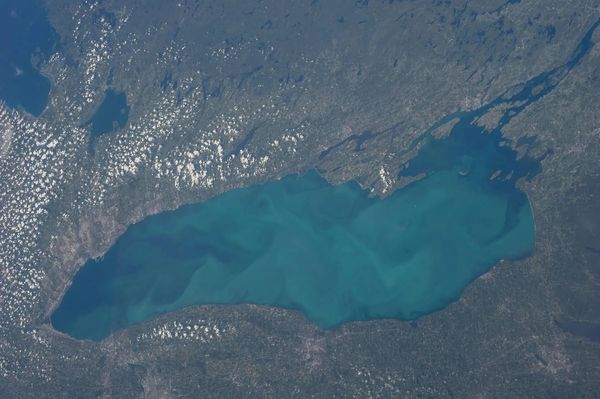
By this time next week, any Arctic cold fronts pushing into northern New York State or lake effect snow dumping on Syracuse, N.Y., will be sweeping in from across Lake America—at least, according to official U.S. government weather maps.
The change from the name “Lake Ontario” to “Lake America” was mandated on August 27 in an executive order by President Donald Trump. What this means is that all executive branch references to the Great Lake, including maps, forecasts and warnings put out by the National Weather Service (NWS) and its parent organization, the National Oceanic and Atmospheric Administration, to read Lake America ASAP. (A previous executive order had similarly decreed that “Gulf of Mexico” would be changed to “Gulf of America” on all government documents.)
The order was met with derisive jokes by late-night talk show hosts and indignation by some Canadian officials. But for the NWS, it’s an assignment that must now be completed fast, with little notice and with many offices short-staffed. The NWS did not immediately respond to a request for comment.
On supporting science journalism
If you're enjoying this article, consider supporting our award-winning journalism by subscribing. By purchasing a subscription you are helping to ensure the future of impactful stories about the discoveries and ideas shaping our world today.
Though name changes to landmarks and geological features such as this do happen from time to time, such revisions generally unfold over months and with significant planning. The crunch in the case of Lake Ontario—as with the renaming of the Gulf of Mexico—means other work will be shunted aside, former NWS employees say.
“Will this impact public safety? Absolutely not,” says Brian LaMarre, who retired as meteorologist in charge of NWS’s Tampa, Fla., office in April 2025. But “there’s naturally people that will be pulled away from their priorities.”
“This is not an efficient use of taxpayer dollars,” he says.
A name change like this needs to be made across myriad systems, programs and websites, LaMarre says, such as in layers of the Geographic Information System used for maps. The code for a computer system called AWIPS that every one of the nation’s 122 forecast offices uses to receive data and transmit forecasts and weather warnings will need to be updated. And documents and products going back to the date that Trump signed the order will need to be changed.
Some of this will happen at the level of NWS national headquarters, but local offices will also have to make changes. Many of these are short-staffed because of both long-standing delays in hiring and major cuts made by the U.S. DOGE Service at the beginning of President Trump’s second term. Not every office has an information technology officer—the person who would take care of this—LaMarre says, meaning such offices may have to lean on other ones for support.
It is likely inevitable that Lake Ontario will keep showing up in federal documents and products for some time, says LaMarre, who now runs the consultancy Inspire Weather. If nothing else, force of habit can lead to mistakes, especially in hastily typed social media alerts, which, LaMarre says, can result in a torrent of backlash.
There’s also the potential for public confusion because state agencies, TV stations and weather apps or websites might not change the lake’s name. And the change could fray relationships with Canada’s agencies—weather doesn’t recognize national borders, after all.
“Name changes like we’ve seen to the Gulf of Mexico and Lake Ontario threaten the ability of meteorologists to communicate the forecast with everybody,” says meteorologist Chris Vagasky, who manages the Wisconsin Environmental Mesonet.
“Whichever name you choose, you’re bound to upset someone who should be paying attention to the forecast instead of the name of a body of water,” he adds. “The forecast or the warning are the important things.”