
CLIMATEWIRE | New York Gov. Kathy Hochul’s last-minute decision to halt congestion pricing in Manhattan will likely hurt similar efforts across the country.
The Democratic governor announced last week in a surprise video that she would indefinitely pause a years-in-the-making congestion pricing plan because it would have “too many unintended consequences.” By then, the Metropolitan Transportation Authority had already begun to hang signs explaining the effort, which would charge drivers $15 to travel into Manhattan below 60th Street on weekdays.
The sudden reversal means MTA can no longer count on more than $1 billion in essential funding. But the greatest impact may be to efforts in other cities, which were waiting to see how the major piece of municipal climate policy played out in the nation's largest city.
On supporting science journalism
If you're enjoying this article, consider supporting our award-winning journalism by subscribing. By purchasing a subscription you are helping to ensure the future of impactful stories about the discoveries and ideas shaping our world today.
Hochul’s decision “absolutely has national implications in that it had been a great motivating factor” in driving other cities to study the issue and figure out a similar plan, said Stuart Cohen, co-founder and senior adviser for TransForm, a California-based public transportation advocacy group. Cohen has consulted for similar efforts in San Francisco and Seattle.
“It was always this sense of well, we'll get to see how New York's going and we'll learn from that as we go to implement our program here,” he said. “And so yeah, this will absolutely take the wind out of the sails of pricing programs across the country, but especially on the West Coast.”
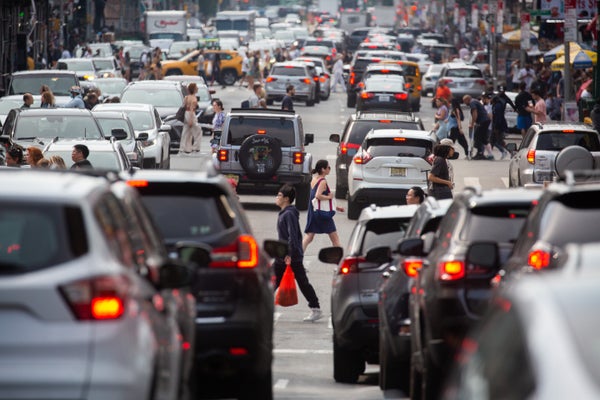
The idea of cutting down the number of suburban drivers who snarl city traffic and pollute the air with exhaust and greenhouse gas emissions has long been politically controversial in the United States. Even the nation’s most progressive cities, where residents are more likely to be motivated by climate concerns and a love of public transportation, have struggled to implement congestion pricing or similar plans.
Portland, Oregon; Seattle; San Francisco; and Los Angeles have all explored congestion pricing policies to fund public transportation and reduce traffic in the urban core. Those efforts followed the successful implementation of anti-congestion plans in London, Singapore and Stockholm.
New York was set to enact the first domestic example of such policies. But powerful and deep-pocketed business interests have opposed the plan.
Many of the congressional districts that cover New York’s suburbs are also highly competitive in November's elections, and Republicans are looking to exploit commuter rage as a campaign issue. New Jersey Gov. Phil Murphy, a Democrat, vehemently opposed New York's plan and sued the U.S. Department of Transportation, the Federal Highway Administration and the MTA in an attempt to block it.
Hochul’s decision immediately drew fire from her allies, not only for its implications in the state, but how it could be used to kill other cities' similar plans.
"The Governor’s reckless decision to effectively kill congestion pricing in New York City — and every other city in America that is considering following New York’s example — is a staggering error,” Democratic state Sen. Liz Krueger of Manhattan said in a statement.
Officials in other states echoed Krueger’s concerns.
Travis Brouwer, an assistant director at the Oregon Department of Transportation, said the state has been closely following the situation in New York for years with the intention of using it as a model.
Oregon recently experienced its own setback in congestion pricing when Democratic Gov. Tina Kotek halted a tolling plan in March. But Brouwer said New York’s example could have helped revive the idea.
“In Oregon, we had somewhat similar dynamics in terms of challenges with suburban legislators and elected officials, particularly in one of the counties in the Portland metro region that was going to have the first implementation of tolling,” he said in an interview. “I think my overall takeaway is: It's really difficult to develop new ways of paying for transportation, particularly when routes that were previously free, or low cost, are now going to cost commuters a lot more.”
David Zipper, a senior fellow at the Massachusetts Institute of Technology Mobility Initiative, said other municipalities can still learn from New York's experience. For example, he said, New York should have front-loaded some of the benefits — such as increased subway trains and new stations — so that people could see some of the projects that would result from congestion pricing.
“I think other cities will keep looking at it no matter what happens in New York,” he said. “But I would say that, if congestion pricing goes forward in New York, that can basically turbocharge efforts in other cities to adopt it.”
The pause on New York's plan will set back U.S. efforts by at least a decade, Cohen said. But it likely won't stop the future of congestion pricing, he said, because the same issues of underfunded public transportation and crippling congestion will remain.
“I think the path forward is now slower, but one of the ways that they may get revived is, most states are now studying and some are starting to implement road user charges that charge on a per-mile fee,” he said. “And some of those as they get off the ground will get people accustomed to pricing.”
Reprinted from E&E News with permission from POLITICO, LLC. Copyright 2024. E&E News provides essential news for energy and environment professionals.