
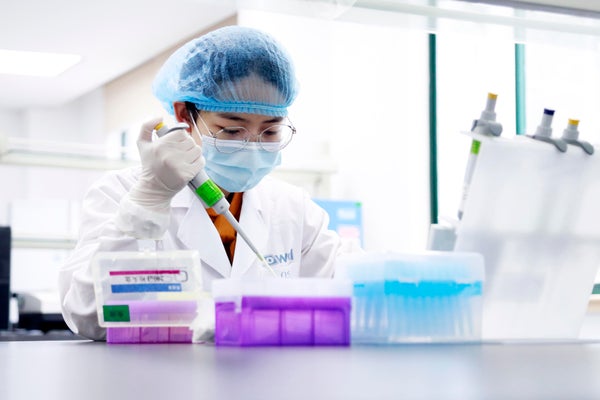
The U.S. Food and Drug Administration recently granted an “emergency use authorization” of a blood test for antibodies against SARS-CoV-2, the novel coronavirus that causes COVID-19. It is the first such test to receive approval for the U.S. market. And it comes at a time when health experts and leaders are embracing immunity as a potential end point to the pandemic. In Colorado, a company that makes a coronavirus antibody test has donated kits to the state’s San Miguel County so that everyone there can be tested if they want to. And in Italy, politicians want to use antibody status to determine which people will get “back to work” passes.
Several ambitious surveys to test for these antibodies have now been launched around the globe. The World Health Organization’s Solidarity II study will pool antibody data from more than half a dozen countries. In the U.S., a collaborative multiyear project aims to provide a picture of nationwide antibody prevalence. Its first phase is already collecting samples from blood donors in six major urban areas, including New York City, Seattle and Minneapolis. And the effort will evolve into three national surveys of donors, supported by the Centers for Disease Control and Prevention and conducted this fall and in the fall of 2021.
Unlike diagnostic tests, which are used to confirm the presence and sometimes load, or amount, of the virus, antibody tests help determine whether or not someone was previously infected—even if that person never showed symptoms. Widespread use of such assays could give scientists greater insight into how deadly the virus is and how widely it has spread throughout the population.
On supporting science journalism
If you're enjoying this article, consider supporting our award-winning journalism by subscribing. By purchasing a subscription you are helping to ensure the future of impactful stories about the discoveries and ideas shaping our world today.
It is less clear what those antibody tests mean for real life, however, because immunity functions on a continuum. With some pathogens, such as the varicella-zoster virus (which causes chicken pox), infection confers near-universal, long-lasting resistance. Natural infection with Clostridium tetani, the bacterium that causes tetanus, on the other hand, offers no protection—and even people getting vaccinated for it require regular booster shots. On the extreme end of this spectrum, individuals infected with HIV often have large amounts of antibodies that do nothing to prevent or clear the disease.
At this early stage of understanding the new coronavirus, it is unclear where COVID-19 falls on the immunity spectrum. Although most people with SARS-CoV-2 seem to produce antibodies, “we simply don’t know yet what it takes to be effectively protected from this infection,” says Dawn Bowdish, a professor of pathology and molecular medicine and Canada Research Chair in Aging and Immunity at McMaster University in Ontario. Researchers are scrambling to answer two questions: How long do SARS-CoV-2 antibodies stick around? And do they protect against reinfection?
Early on, some people—most notably U.K. Prime Minister Boris Johnson (who has the virus and is currently in intensive care) and his government’s scientific adviser Patrick Vallance—touted hopes that herd immunity could be an eventual means for ending the pandemic. And although it appears that recovered COVID-19 patients have antibodies for at least two weeks, long-term data are still lacking. So many scientists are looking to other coronaviruses for answers.
Immunity to seasonal coronaviruses (such as those that cause common colds), for example, starts declining a couple of weeks after infection. And within a year, some people are vulnerable to reinfection. That observation is disconcerting when experts say it is unlikely we will have a vaccine for COVID-19 within 18 months. But studies of SARS-CoV—the virus that causes severe acute respiratory syndrome, or SARS, which shares a considerable amount of its genetic material with SARS-CoV-2—are more promising. Antibody testing shows SARS-CoV immunity peaks at around four months and offers protection for roughly two to three years. As Preeti Malani, chief health officer and a professor of medicine at the University of Michigan, said in a video interview with JAMA Editor in Chief Howard Bauchner,this period presents “a pretty good time line for thinking about vaccines and therapeutics” for COVID-19.
Even if the antibodies stick around in the body, however, it is not yet certain that they will prevent future infection. What we want, Bowdish says, are neutralizing antibodies. These are the proteins that reduce and prevent infection by binding to the part of a virus that connects to and “unlocks” host cells. They are relatively easy to detect, and they are far easier for vaccine developers to generate than the alternative: the immune system’s T cells. In contrast, nonneutralizing antibodies still recognize parts of the pathogen, but they do not bind effectively and so do not prevent it from invading cells.
“If humans naturally make neutralizing antibodies [against SARS-CoV-2], then all we have to do is figure out what [sites they are] binding on the virus and really target that one little piece of protein, and that’s our magic bullet,” Bowdish says. For SARS-CoV-2, that target site is most likely on the so-called receptor-binding domain of its spike glycoprotein—a protein attached to a sugar that the virus uses to enter cells. But, Bowdish says, this spot may present a challenge because human immune systems are not very good at making antibodies against sugar-coated substances.
Nevertheless, a few small studies of cells in laboratory dishes suggest that SARS-CoV-2 infection triggers the production of neutralizing antibodies. And animal studies indicate such antibodies do prevent reinfection, at least for a couple of weeks. Furthermore, because some antibodies seem to recognize and react to the spike proteins on multiple coronaviruses, including SARS-CoV and MERS-CoV (the virus that causes Middle East respiratory syndrome, or MERS), researchers can build on knowledge learned from previous outbreaks.
Research on real-life immunity to SARS-CoV-2 is in its preliminary stages, and uncertainties remain. One study found no correlation between viral load and antibody presence, leading the authors to question the antibodies’ actual role in clearing the virus in humans. In addition, peer-reviewed research on SARS-CoV and preprint studies on SARS-CoV-2 report that some nonneutralizing coronavirus antibodies might trigger a harmful immune response upon reinfection with those pathogens or cross infection with other coronaviruses. Thus, while much of the emerging research is promising, Bowdish cautions against using antibody testing to drive policy until researchers know the proportion of COVID-19 survivors who are producing neutralizing antibodies.
In an ideal world, SARS-CoV-2 immunity would resemble that acquired by children who get chicken pox. Early research suggests we are in for a much more complex scenario but one that time and unprecedented global cooperation might be able to untangle. Eventually antibody tests could be the key to getting our lives and economies back on track. For now, they promise to give experts, officials and citizens a clearer picture of the pandemic.
Read more about the coronavirus outbreak here.