
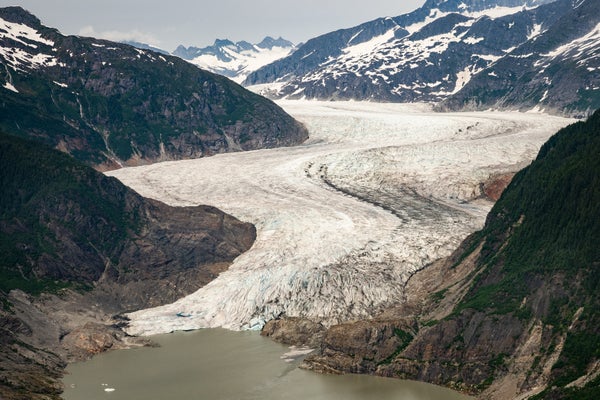
Meltwater from a glacial outburst near Juneau, Alaska, is flooding nearby neighborhoods, and officials are urging some residents of the city of 30,000 to evacuate.
The meltwater is rushing downstream from Suicide Basin, a basin of water dammed in by the Mendenhall Glacier. As of 6:00 A.M. local time on Wednesday morning, the Mendenhall River was in a major flood stage. At 16.17 feet (4.93 meters) and rising, the water level had passed the record flood stage of 15.99 feet (4.87 m) that hit during an August 2024 glacial outburst flood, according to the National Weather Service.
The river and Mendenhall Lake, both of which are downstream from the glacier’s tongue, are under a flood warning. The NWS predicts the Mendenhall River will crest at up to 16.75 feet (5.11 m) around 8 A.M. local time on Wednesday.
On supporting science journalism
If you're enjoying this article, consider supporting our award-winning journalism by subscribing. By purchasing a subscription you are helping to ensure the future of impactful stories about the discoveries and ideas shaping our world today.
Glacial outburst floods happen when the ice dams holding back glacial lakes fail, allowing a sudden release of water. They’re unpredictable and happen without warning. A 2023 study found that, globally, 15 million people live in areas that could flood. More than half of people in at-risk areas are in India, Pakistan, China and Peru. And with a warming climate, ice is becoming more unstable, and glacial lakes are growing—a 2020 study based on satellite imagery found that, between 1990 and 2018, the volume of water dammed in glacial lakes had grown by 48 percent.
Suicide Basin has flooded before. In fact, according to the NWS, the basin has released an outburst flood at least once a year since 2011. These floods have now set a record three years in a row: In 2023 the river crested at 14.97 feet (4.56 m) after an outburst, a record exceeded just a year later in the August 2024 flood. Some residents had to evacuate by inflatable boat in the middle of the night during the 2024 outburst, according to the American Red Cross. Now, only a year after that disaster, the river is setting a new record.
It’s a threat glaciologists in mountainous areas around the world are trying to better understand, said Fabian Walter, now a senior scientist at the Swiss Federal Institute for Forest, Snow and Landscape Research WSL, in an interview with Scientific American in 2020. “These glaciated mountain faces were more or less stable,” Walter said. “And now, with climate change, the whole stability is changing.”