

Narwhals are truly unique. The animals are known for their straight, spiral tusks, which can reach some 10 feet in length. These overgrown teeth are the only tusks in the animal kingdom that are known to grow in a completely straight line. Most male narwhals have one, and so do some females; other narwhals even have two.
Yet every tusk seems to spiral in one direction—left—and scientists have long wondered why. Now researchers are using advanced imaging technology to look at the narwhal’s tusk in unprecedented detail—studying it in the hope of unraveling some of its mysteries.
In a new study published today in the journal Nature Communications, researchers reveal the tusks’ “building blocks”—tiny, threadlike structures of mineralized collagen—grow in a sort of double helix: on the outside of a tusk, the structures follow a left-handed helix, and inside, they grow in a right-handed helix. This is what enables the tusk to grow in such a straight line.
On supporting science journalism
If you're enjoying this article, consider supporting our award-winning journalism by subscribing. By purchasing a subscription you are helping to ensure the future of impactful stories about the discoveries and ideas shaping our world today.

Narwhals swimming in northwestern Greenland.
Carsten Egevang
In nature, it’s common to see such swirling structures going in different directions, even in the same species, explains Henrik Birkedal, the paper’s senior author and a chemistry professor at Aarhus University in Denmark. Some snail shells, for instance, spiral both right and left. But as far as the scientists know, narwhals are the only creatures to have a singularly left-spiraling tusk.
Birkedal and his colleagues imaged narwhal tusks using advanced x-ray scanners, which he describes as “turbocharged” versions of a computed tomography (CT) scanner. “That allowed us to piece together the puzzle of how this structure is reflected in the building blocks of the tusk,” he says.
Those building blocks were bits of collagen. This protein is found in our skin and bones and has a texture like “half-cooked spaghetti,” Birkedal says. It’s firm but flexible. The team found that while the outer layer of the tusk, called the cementum, has a structure that spirals left, the inner part, dentine, spirals right. These two “opposing spirals” help keep the tusk straight, he says.
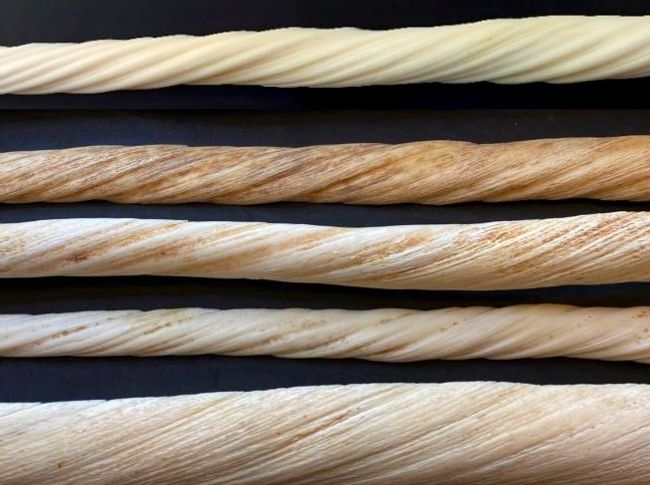
A collection of tusks showing the left-handed helix on the cementum.
It’s unclear why a narwhal needs a straight tusk while other tusked animals, such as elephants, have tusks that bend. The “dominant hypothesis,” Birkedal says, is that the narwhal tusk is for show—to establish social dominance or attract mates, for example—and not for hunting, at least not directly. It could also be that a straight tusk stays out of the way when narwhals “suction feed” on fish and squid, he adds.
Next, the team plans to look deeper into the narwhal’s skull at the chamber where the tusk originates to better understand how it forms.
Birkedal says a narwhal’s tusk functions much like rings on a tree—it grows in bands, and scientists can use it to estimate the animal’s age. But it could also offer clues to narwhals’ lives: If each band of tusk has a slightly different mineral and chemical makeup, “can we actually use that information to say something about the life history of whales?” Birkedal muses.
If that can be gleaned from the tusks, it will be useful information: because narwhals live in the deep Arctic, they’re notoriously difficult to observe—real-life unicorns.