
Like a lot of baby boomers, I find myself gravitating to newspaper obits, cross-checking ages and causes of death with my current health parameters, most notably heart disease (which felled my father and grandfather) and cancer (which slew my mother). And then there is Alzheimer's disease, which a 2015 report by the Alzheimer's Association projects will destroy the brains of more than 28 million baby boomers. Given the importance of family history and genetics for longevity, I plunked down $199 for a 23andMe Health + Ancestry Service kit, spit into the little plastic vial, opted in for every test available for disease gene variants and anxiously awaited my reports. How'd they do?
First, the company captured my ancestry well at 99.7 percent European, primarily French/German (29.9 percent), British/Irish (21.6 percent), Balkan/Greece (16.4 percent) and Scandinavian/Swedish (5.5 percent). My maternal grandmother is German and grandfather Greek; my fraternal great-grandparents were from Sweden and Denmark.
Second, the traits report correctly predicted that I can smell asparagus in my urine, taste bitter and have hazel eyes, ring fingers longer than index fingers, little freckling and straight, light hair.
On supporting science journalism
If you're enjoying this article, consider supporting our award-winning journalism by subscribing. By purchasing a subscription you are helping to ensure the future of impactful stories about the discoveries and ideas shaping our world today.
Third, for the disease reports, my eye lit on the phrase “variants not detected” for Parkinson's disease, cystic fibrosis, muscular dystrophy, sickle cell anemia, Tay-Sachs and, most concernedly, Alzheimer's. “Oh joy, oh rapture unforeseen!” (Thank you, Gilbert and Sullivan.)
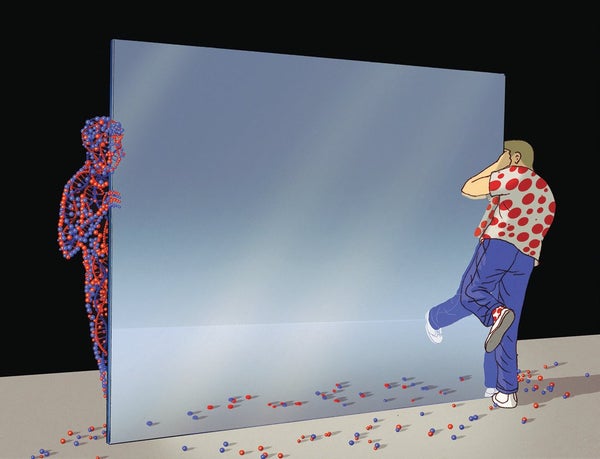
But wait, 23andMe also says I have no bald spot, no cheek dimples, little upper back hair, a slight unibrow, no widow's peak and a longer big toe—all wrong. If a genetic test for such comparatively simple physical features can be mistaken, what does that say about its accuracy for more complex diseases? “Our reports do not include all possible genetic variants that could affect these conditions,” 23andMe disclaims. “Other factors can also affect your risk of developing these conditions, including lifestyle, environment, and family history.” Oh, that.
For toe length, for example, 56 percent of research participants with results like mine (15 genetic markers for a longer big toe, 13 for a longer second toe) have a longer big toe, but I'm in the 44 percent. A prediction barely better than 50–50 isn't terribly expedient. For Alzheimer's, carrying the e4 variant of the APOE (apolipoprotein E) gene increases one's risk of developing Alzheimer's to 1 percent by age 65, 4 to 7 percent by age 75, and 20 to 23 percent by age 85 in men (to the same figure of less than 1 percent, to 5 to 7 percent, and to 27 to 30 percent in women). Having two copies of the gene (one from each parent) moves the needle up to 4 percent (by age 65), 28 percent (age 75) and 51 percent (age 85) in men (2, 28 and 60 percent in women). But the test “does not include all possible variants or genes associated with late-onset Alzheimer's disease,” so, for example, though lacking both e4 variants, I still have a 1 to 2 percent risk of Alzheimer's by age 75 and a 5 to 8 percent chance by age 85.
For further clarity on this tangle of interactive effects, I contacted Rudy Tanzi, a Harvard Medical School neurologist and head of the Alzheimer's Genome Project, who co-discovered many of the genes for Alzheimer's. He admitted that “no one can say with certainty [if] a calculation of the variance of [Alzheimer's is] due to genetics versus lifestyle,” adding that the e4 variant of the APOE gene “is present in 20 percent of the population and in 50 percent of late-onset cases but does not guarantee disease.”
Moreover, “until we identify all (or most) of the actual disease-causing mutations in these 40 genes, any attempts at putting an actual number at genetic variance is futile. In the meantime..., all we can say responsibly is that no more than 5 percent of gene mutations causing [Alzheimer's] are guaranteed to do so. This means that in the remaining cases, most if not all almost certainly involve genetic influences (risk-conferring and protective), but in these cases (95 percent), it is an interplay of gene and environment/lifestyle that determines lifelong risk.”
What should we baby boomers do to shield ourselves against Alzheimer's? “SHIELD” is Tanzi's acronym for Sleep (uninterrupted seven to eight hours), Handle Stress, Interact (be sociable), Exercise (cardiovascular), Learn (“the more synapses you make, the more you can lose before you lose it,” Tanzi says), and Diet (Mediterranean: high in fruits, vegetables, olive oil, whole grains).
As for personal genome service testing, actionable results with measurable outcome differences are still limited. But that is true for most medical knowledge, and yet we absorb everything we can for what ails us, so why not add genetics?