NONFICTION
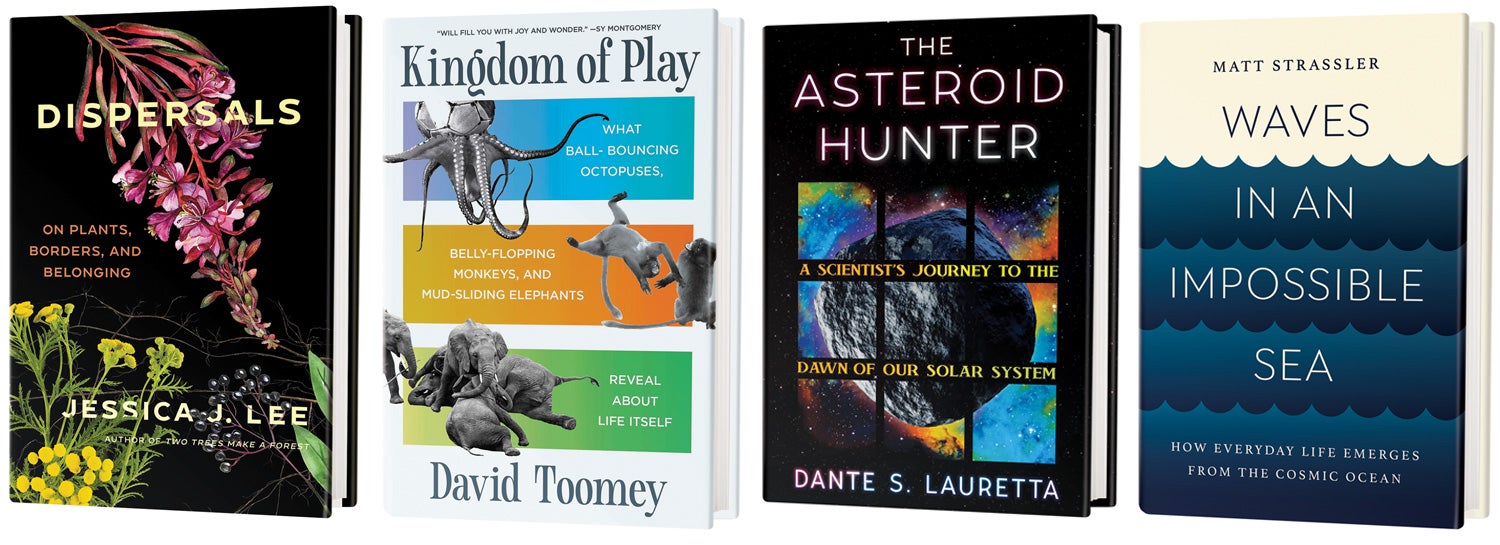
Dispersals: On Plants, Borders, and Belonging
by Jessica J. Lee
Catapult, 2024 ($27)
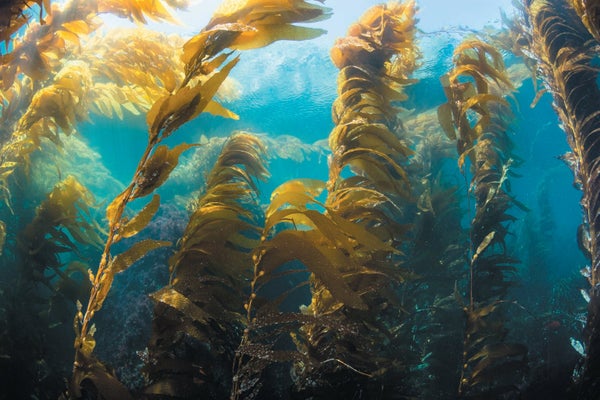
As a child in Canada, Jessica J. Lee squirmed at the kelp her Taiwanese mother sprinkled in sparerib soup and at the laverbread her father's Welsh parents made from pureed boiled seaweed. “How can I love something I remain afraid of?” asks Lee, a memoirist and environmental historian. In this lyrical essay collection, she decides that she needs “to think about seaweeds objectively—hold them out in front of me like ideas.” By rendering them as physical marvels while parsing the ideas we project onto them, Lee makes visible the entanglements between our lives and theirs.
On supporting science journalism
If you're enjoying this article, consider supporting our award-winning journalism by subscribing. By purchasing a subscription you are helping to ensure the future of impactful stories about the discoveries and ideas shaping our world today.
Algae are everywhere, from biofuels to toothpaste, and Lee reveals how much our knowledge of them was shaped by 19th-century female algologists, who were encouraged to study the plant because its nonflowering structure made it “polite” for women to research. “Like seaweeds, how much of their lives went unnoticed?” Lee asks. Dispersals shows us that we cannot view the trajectory of a plant without bumping into trajectories of human power.
Weaving material from literary, personal, scientific and historical sources, Lee examines plants—including seaweed and far beyond it—that broach human borders, exploring their migrations alongside her own. “What is it to be a world citizen amongst species?” she asks. “The natural world presses against our tendency to lay arbitrary geopolitical boundaries upon it—and we, by our own movements, likewise transgress the borders we apply.” Calling something a weed is less about describing a plant than about naming a desire for the world around it, and Lee writes intimately about her own oscillating cravings for movement and rootedness against a backdrop of COVID and new motherhood. She devotes essays to plants encountered in the kitchen, such as soy and tea, as well as often overlooked ones, like the heath star moss: tiny, starlike and one of the world's most invasive species.
Dispersals asks readers to consider how plants challenge not only spatial borders but taxonomic ones. “All the citruses we value were shaped by human hands,” Lee writes. “Are they, too, human descendants?”
IN BRIEF
Kingdom of Play: What Ball-Bouncing Octopuses, Belly-Flopping Monkeys, and Mud-Sliding Elephants Reveal about Life Itself
by David Toomey
Scribner, 2024 ($29)
Although author David Toomey offers delightful examples of animal play—snowboarding crows, tumbling piglets, sharks playing with a ball—he argues that, despite all the apparent whimsy, “nature takes play seriously.” Scholars are using methods as unique as tickling rats and tallying the results of faux fights between meerkats to fill surprising gaps in our understanding of play; in doing so, they deepen our insight into what, exactly, play is. Toomey makes a compelling case that not only does play offer advantages in natural selection and serve as a potential generator of animal evolution, but the innovation it sparks may even help primates like us influence our own evolution. —Dana Dunham
The Asteroid Hunter: A Scientist’s Journey to the Dawn of Our Solar System
by Dante S. Lauretta
Grand Central, 2024 ($30)
It's rare that a book with such an epic premise delivers on the excitement teased by its cinematic title. The Asteroid Hunter joins this elite club with its story of the OSIRIS-REx mission, definitively relayed by Dante S. Lauretta, its principal investigator since 2011. In September 2023 OSIRIS-REx culminated in nasa's first-ever retrieval of samples from an asteroid. Lauretta's at times poetic account relays what's at stake: investigating the origins of life and preventing a calamitous asteroid impact in 2182. Heartbreak and intrigue abound, but what most stands out from Lauretta's career—which has included searching for meteorites in Antarctica, devising OSIRIS-REx's “backronym” and selecting a landing site on the asteroid Bennu—is how joyfully fun science can be. —Maddie Bender
Waves in an Impossible Sea: How Everyday Life Emerges from the Cosmic Ocean
by Matt Strassler
Basic Books, 2024 ($32)
Physicists often struggle to simplify complex concepts for nonexperts, leading to “physics fibs” or “phibs”—straightforward but inaccurate explanations. Writer and theoretical physicist Matt Strassler unveils how fundamental physics and human existence intertwine through an imaginative, piece-by-piece deconstruction of the greatest hits of phibs, from misconceptions about sound-wave vibrations to descriptions likening the Higgs field to a “soup that fills the universe.” Strassler urges readers who want to understand the cosmos to resist the alluring but misleading guides of observation and intuition. Abundant with analogies and anecdotes, this book exemplifies how experts should write about matter, motion and mass for the masses. —Lucy Tu