

The following essay is reprinted with permission from The Conversation, an online publication covering the latest research.
A Soviet-designed “Novichok” chemical is the nerve agent responsible for poisoning a former spy and his daughter, British Prime Minister Theresa May said today.
On supporting science journalism
If you're enjoying this article, consider supporting our award-winning journalism by subscribing. By purchasing a subscription you are helping to ensure the future of impactful stories about the discoveries and ideas shaping our world today.
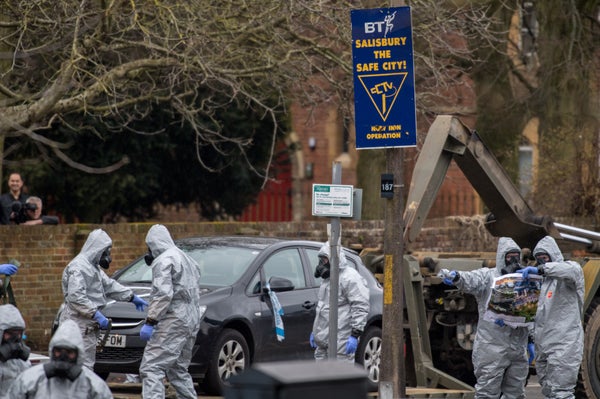
Sergei and Julia Skripal were found collapsed on a park bench on Sunday March 4 in the English town of Salisbury, a few hours after eating lunch and spending time at a restaurant and pub nearby.
As reported by the BBC, May said the UK must stand ready to take “extensive measures” if Russia does not provide an adequate explanation for the use of this agent on British soil.
What are the origins of Novichok?
The Novichok group of molecules are nerve agents developed by the Soviets from the late 1970’s – but never produced on a large scale, at least to the best of public knowledge. They are referred to as third generation nerve agents to indicate their production as a follow-on to the G-series agents such as sarin (also referred to as “GB”) developed in Germany prior to WWII, and the V-series agents (such as VX gas) first developed by the UK in the 1950’s.
The name “Novichok” translates colloquially from Russian as “newbies”.
Scientists who worked on the Novichok project disclosed details from 1992 onwards. They stated that the project goals included developing weapons that:
could not be detected by the then standard NATO chemical weapons detection sensors
have potential to circumvent the Chemical Weapons Convention
would be easier to produce using methods and materials prevalent in pesticides industries
were designed from the outset to be “binary” chemical weapons (where two relatively non-toxic materials are mixed together just before dispersal to minimise the danger to the personnel delivering the weapons).
How would Novichok use be confirmed?
Members of the public said that Julie Skripal appeared passed out on the park bench in Salisbury, and her father was making strange movements with his hand. The two remain in a critical condition in hospital.
Nerve agents like Novichok are all organophosphate compounds, which act by blocking the normal processes that control nerve activity.
Symptoms are given the mnemonic “SLUGEM”:
Salivation—the famous “foaming at the mouth”
Lacrimation—“crying”, or tears pouring from the eyes
Urination, Defecation
Gastrointestinal distress
Emesis (vomiting)—as the body loses control over muscles, particularly those of the sphincters
Miosis—one of the key diagnostics; the muscles that cause the pupil to constrict become fully activated and the pupils become pinpoints in the iris.
The final “‘M” is sometimes given as “muscle spasms”. The type of spasms associated with organophosphate poisoning are somewhat diagnostic.
Although some of these symptoms are common with other nervous system disruptions, doctors are taught to look for these symptoms together as a sign of exposure to organophosphates.
Apart from the physical signs and symptoms, to confirm identity of the agent, police and doctors take blood or other fluid samples, or wipe the patient’s skin with a gauze to pick up any residue of the agent. Those samples are reasonably stable and could be sent to an analytical chemistry laboratory for identification.
The UK has an Organisation for the Prohibition of Chemical Weapons (OPCW) designated laboratory run by the Defence Science and Technology Laboratory, Chemical and Biological Systems. The lab is located at Porton Down, around 10 miles from the scene of the attack.
In Australia, the equivalent OPCW designated laboratory is operated by the Defence Science and Technology Group.
The Handbook of Recommended Operating Procedures for Analysis in the Verification of Chemical Disarmament (also known as “the Blue Book”) does not have a specific method for detecting Novichok agents. However, it would be reasonable to assume that they would be detectable by the methods available to a well equipped defence science laboratory.
How could Novichok have been administered?
Nerve agents such as sarin are typically used in the form of a gas or vapour. But Novichok agents can be made in a solid form, most likely a powder. This would make them a relatively simple agent to be used on a battlefield (as may have been the original design motivation), or to add to food or to be left in a home as may be the case with the Skripals.
Nerve agents are bioavailable from the gut - that is, they can absorb into the body after being eaten. That route of delivery isn’t well studied, but is consistent with the slightly slower onset of symptoms in Sergei and Julia Skripal.
In comparison, nerve agents administered via aerosol or spray are effective very quickly—Kim Jong-Nam died shortly after facial exposure to nerve agent VX in a Malaysian airport.
Novichok agents are said to be particularly effective at penetrating the central nervous system (that is, the brain and spinal column) and causing more severe neurological symptoms than is typical for other nerve agents.
As well as Sergei and Julia Skripal, a policeman has become seriously ill as a result of this incident—it’s not clear whether this was through attending to the sick pair on the bench, or visiting Sergei Skripal’s house.
Furthermore, the UK government has issued a public health advisory notice for people who were in the pub and/or the restaurant at which the Skripals may have been poisoned. For people who may have been exposed to very small amounts of Novichok, the advised washing of clothing would act to dilute or deactivate the compounds.
Will the ex-spy and his daughter survive?
A reported case of accidental exposure of a Russian physicist to Novichok in 1987 described the following events:
He staggered out of the room, his vision seared by brilliant colors and hallucinations. He collapsed, and the KGB took him to a hospital.
By the time he arrived his breathing was labored. In another hour, his heart would have stopped. His entire nervous system was gradually ceasing to function.
The physicist was lucky. The hospital he was taken to, the Sklifosovsky Institute, includes the nation’s top center for poison treatment.
There, Dr. Yevgeny Vedernikov saved his life.
But the scientist was at the edge of death, unaware of his surroundings, for 10 days. He couldn’t walk for six months. He was dogged by depression and an inability to concentrate. He found it difficult even to read. To this day his arms are still weak, and he has never been able to return to work.
Although he survived, the gas left him with permanent disabilities.
This previous incident suggests that while the Skripals could theoretically recover, they may not be in a fit state to act as reliable witnesses to their own attempted murders.
The question of who was responsible will remain—although British Prime Minister May has come to the conclusion that,
Either this was a direct action by the Russian state against our country, or the Russian government lost control of its potentially catastrophically damaging nerve agent and allowed it to get into the hands of others.
We’re waiting for an official Russian response.
This article was originally published on The Conversation. Read the original article.