
According to the Oxford English Dictionary's first definition, a “skeptic” is “one who holds that there are no adequate grounds for certainty as to the truth of any proposition whatever.” This is too nihilistic. There are many propositions for which we have adequate grounds for certainty as to their truth:
There are 84 pages in this issue of Scientific American. True by observation.
Dinosaurs went extinct around 65 million years ago. True by verification and replication of radiometric dating techniques for volcanic eruptions above and below dinosaur fossils.
On supporting science journalism
If you're enjoying this article, consider supporting our award-winning journalism by subscribing. By purchasing a subscription you are helping to ensure the future of impactful stories about the discoveries and ideas shaping our world today.
The universe began with a big bang. True by a convergence of evidence from a wide range of phenomena, such as the cosmic microwave background, the abundance of light elements (such as hydrogen and helium), the distribution of galaxies, the large-scale structure of the cosmos, the redshift of most galaxies and the expansion of space.
These propositions are “true” in the sense that the evidence is so substantial that it would be unreasonable to withhold one's provisional assent. It is not impossible that the dinosaurs died a few thousand years ago (with the universe itself having been created 10,000 years ago), as Young Earth creationists believe, but it is so unlikely we need not waste our time considering it.
Then there are negative truths, such as the null hypothesis in science, which asserts that particular associations do not exist unless proved otherwise. For example, it is telling that among the tens of thousands of government e-mails, documents and files leaked in recent years, there is not one indication of a UFO cover-up or faked moon landing or allegation that 9/11 was an inside job by the Bush administration. Here the absence of evidence is evidence of absence.
Other propositions are true by internal validation only: dark chocolate is better than milk chocolate; Led Zeppelin's “Stairway to Heaven” is the greatest rock song; the meaning of life hinges on the number 42. These types of truth are purely personal and thus unverifiable by others. In science, we need external validation.
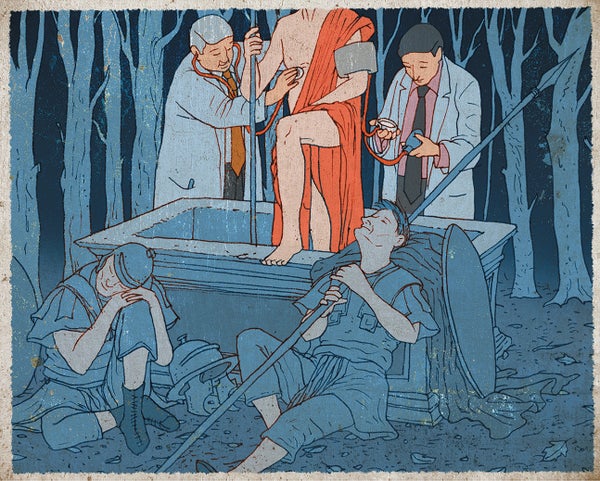
What about religious truths? The proposition that Jesus was crucified may be true by historical validation, inasmuch as a man whom we refer to as Jesus of Nazareth probably existed, the Romans routinely crucified people for even petty crimes, and most biblical scholars—even those who are atheists or agnostics, such as renowned religious studies professor Bart Ehrman of the University of North Carolina at Chapel Hill—assent to this fact. The proposition that Jesus died for our sins, in contrast, is a faith-based claim with no purchase on valid knowledge. In between these is Jesus's Resurrection, which is not impossible but would be a miracle if it were true. Is it?
The principle of proportionality demands extraordinary evidence for extraordinary claims. Of the approximately 100 billion people who have lived before us, all have died and none have returned, so the claim that one (or more) of them rose from the dead is about as extraordinary as one will ever find. Is the evidence commensurate with the conviction? According to philosopher Larry Shapiro of the University of Wisconsin–Madison in his 2016 book The Miracle Myth (Columbia University Press), “evidence for the resurrection is nowhere near as complete or convincing as the evidence on which historians rely to justify belief in other historical events such as the destruction of Pompeii.” Because miracles are far less probable than ordinary historical occurrences, such as volcanic eruptions, “the evidence necessary to justify beliefs about them must be many times better than that which would justify our beliefs in run-of-the-mill historical events. But it isn't.”
What about the eyewitnesses? Maybe they “were superstitious or credulous” and saw what they wanted to see, Shapiro suggests. “Maybe they reported only feeling Jesus ‘in spirit,’ and over the decades their testimony was altered to suggest that they saw Jesus in the flesh. Maybe accounts of the resurrection never appeared in the original gospels and were added in later centuries. Any of these explanations for the gospel descriptions of Jesus's resurrection are far more likely than the possibility that Jesus actually returned to life after being dead for three days.” The principle of proportionality also means we should prefer the more probable explanation over less probable ones, which these alternatives surely are.
Perhaps this is why Jesus was silent when Pontius Pilate asked him (John 18:38), “What is truth?”