
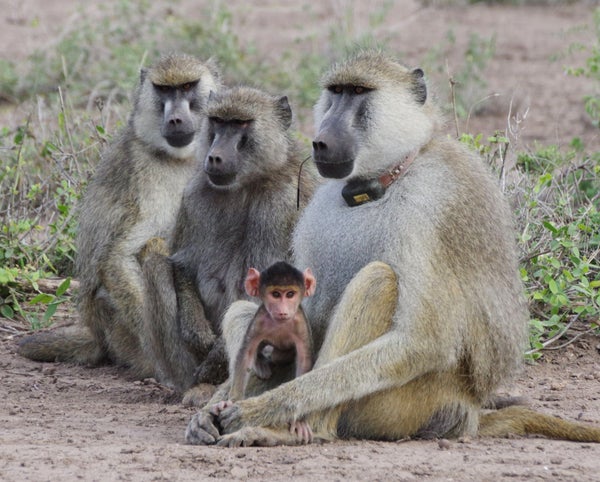
The mammal world is sorely lacking in good dads—at least by human standards. In most mammalian species, males saddle the mother with their offspring while they continue to galavant around and sire more. That’s how male baboons typically operate. But although these primate patriarchs don’t nurse young or gather food (or provide any other essential care), a new study suggests their presence does have a beneficial impact.
In a paper published on Tuesday in Proceedings of the Royal Society B, researchers report that female baboons who have strong relationships with their father—as measured by the amount of time a father-daughter pair spent grooming each other and living together—tend to outlive those who don’t. Of the 216 females in the study (all from Kenya’s Amboseli ecosystem, where the Amboseli Baboon Research Project has been running since 1971), those with an engaged father enjoyed an extra two to four years of life.
This doesn’t necessarily show that father-daughter bonding improves longevity; it may be that healthy young females, already destined for long lives, are more likely to bond with their father. But the paper’s senior author Beth Archie, a behavioral ecologist at the University of Notre Dame, says her instinct is that baboon “dads are more important than they seem at first glance.”
On supporting science journalism
If you're enjoying this article, consider supporting our award-winning journalism by subscribing. By purchasing a subscription you are helping to ensure the future of impactful stories about the discoveries and ideas shaping our world today.
One possible explanation for these results is that fathers create a “zone of safety” around their daughters, intervening to protect them in conflicts. Alternatively, fathers may serve as a gateway to baboon society, allowing young females to establish connections that will benefit them for a lifetime. Whatever the baboon dads are doing, “it does seem to make a difference,” says Robert Seyfarth, a primatologist and emeritus professor at the University of Pennsylvania, who was not involved in the study. The effect is probably similar for sons, Archie says, but they're harder to study because male baboons typically leave the group they were born into when they reach maturity. Researchers have tried to track their lifespan by putting radio collars on them, she adds, “but the batteries died before the males did.”
Why are some baboon fathers more involved in their daughters’ lives than others? The answer may be linked to the studied species’ promiscuous practices: in the Amboseli population, both sexes have multiple mating partners, so paternity isn’t always clear-cut. As expected, the researchers found that males spent more time grooming young females when they were confident they were in fact the father. (That’s a call male baboons can realistically make: females’ genitals swell and turn red during ovulation, so if a male mates with one and fends off competitors until that sign of fertility disappears, he can be reasonably sure that any resulting offspring is his.) In the study, the males also seemed to play a more active parenting role when mating opportunities trailed off. Once you’re too old to compete with the swaggering young bucks for mates, Archie says, “the best strategy is to invest more in your offspring.”
This “dad mode,” as she calls it, is a powerful thing. Its significance in baboons resonates with our intuitions about the value of paternal care in our own species. Indeed, Archie thinks these findings from an evolutionary cousin may reveal something about the roots of human parenting. The big message, she says, is that “having a strong relationship with your parents is important for leading a long, healthy life. That seems to be a primate universal.”