
"Man is a wolf to man," wrote the English philosopher Thomas Hobbes. And given the atrocities we inflict on one another, that certainly can’t be dismissed. Yet many people have a particular fear of nonhuman predators such as wolves, bears or other large carnivores, even though the likelihood of falling victim to them is very low.
A group led by Giulia Bombieri of Trento, Italy’s MUSE Science Museum has evaluated attacks on humans by various large predators around the globe in recent decades, investigating what might have triggered them and how many were fatal. Bombieri and her colleagues published their findings on January 31 in PLOS Biology.
In total, the team compiled more than 5,000 attacks during the past 70 years for which there was reasonably firm evidence. A total of 12 predator species were involved, including several bear species, wolves, coyotes, lions, tigers, leopards, jaguars and cougars (also known as pumas). The scientists also characterized the type of attack—whether it was a targeted attack made by animal hunting for food, an accidental encounter, the result of a mother defending her young or a reaction to the presence of dogs, for example.
On supporting science journalism
If you're enjoying this article, consider supporting our award-winning journalism by subscribing. By purchasing a subscription you are helping to ensure the future of impactful stories about the discoveries and ideas shaping our world today.

Credit: Jade Khatib; Source: “A Worldwide Perspective on Large Carnivore Attacks on Humans,” by Giulia Bombieri, et. al., in PLOS Biology, Vol. 21, No. 1, Article No. e3001946. Published online January 31, 2023
Among the regions studied, South Asia proved to be the most dangerous, recording more than half the attacks. South America, on the other hand, had the lowest number of attacks even though it is home to two potentially dangerous cat species, the jaguar and the puma. Overall, the most deadly attacks occurred when these predators were seeking food: these cases resulted in more than 90 percent of the victims dying. South Asia had the highest number of attacks. In this region, tigers, wolves and leopards hunt humans extremely rarely, but they do prey on them when the opportunity presents itself. The Sundarbans mangroves of India and Bangladesh were a hotspot for tiger attacks on people fishing and gathering forest products.
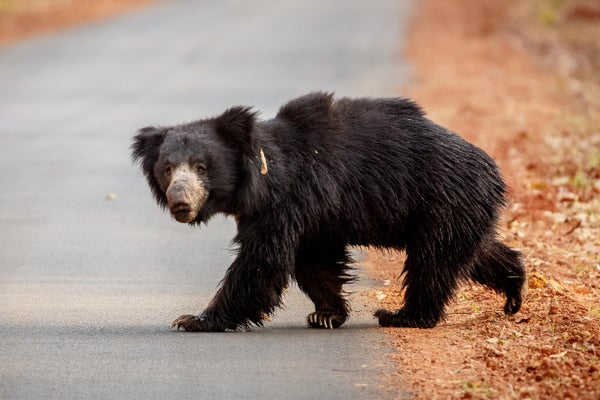
Such unprovoked attacks take place more frequently in poorer countries, the study found. In highly developed countries, people encounter predators mainly during leisure activities: joggers awaken the hunting instinct in cougars, dog-walkers trigger territorial behavior in coyotes, and hikers accidentally get between mother bears and their offspring or surprise male bears as they roam the forest. Unwitting encounters are especially frequent with black bears and sloth bears in South Asia, whereas deliberate attacks by hungry bears are uncommon.
Incidents in Europe also mostly involve bears—in this case, brown bears—while wolf attacks are extremely rare and mostly happen in scenarios involving dogs or wounded animals and in regions where both wolves and dogs are more common. The new study supports an earlier work showing that although predator attacks in North America and Europe have been steadily increasing, nearly half of such incidents were triggered by risky human behavior such as leaving children unattended, letting dogs run loose or tracking dangerous animals after shooting them. (That earlier research also noted that, on a worldwide basis, ungulates, bees, mosquitoes, spiders, snakes, dogs and even snails have accounted for far more human deaths than large carnivores.)
Bombieri and her colleagues point out that attacks in low-income regions—including the numerous incidents in South Asia—are mainly related to people living in close contact with natural areas that also shelter large carnivores. In search of firewood, wild honey or herbs, they accidentally cross paths with wild animals or are deliberately hunted as prey. This risk will increase with population growth in this part of Asia and in Africa.
This article originally appeared in Spektrum der Wissenschaft and was reproduced with permission.