
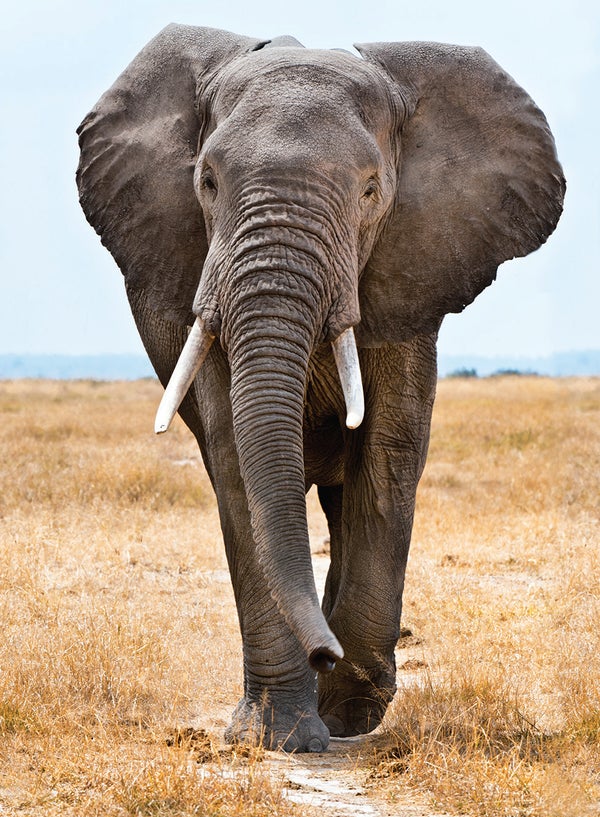
How does one protect elephants from poachers in an African reserve the size of a small country? This daunting task typically falls to park rangers who may spend weeks patrolling the bush on foot, sometimes lacking basic gear such as radios, tents or even socks. They are largely losing to ivory poachers, as attested by the latest available data on Africa's two species of elephant, both threatened: savanna elephant populations fell 30 percent between 2007 and 2014, and those of forest elephants plummeted by 62 percent between 2002 and 2011.
To stem the losses, conservationists are increasingly turning to technology. The latest tool in the arsenal: real-time tracking collars, developed by the Kenya-based nonprofit Save the Elephants and currently being used on more than 325 animals in 10 countries. The organization's researchers wrote algorithms that use signals from the collars to automatically detect when an animal stops moving (indicating it may be dead), slows down (suggesting it may be injured) or heads toward a danger zone, such as an area known for rampant poaching. Experimental accelerometers embedded in the collars detect aberrant behaviors such as “streaking”—sudden, panicked flight that might signal an attack. Unlike traditional tracking collars, many of which send geographical coordinates infrequently or store them onboard for later retrieval, these devices' real-time feeds enable rangers to react quickly. In several cases, they have led to arrests.
The amount of data produced by the new collars quickly became overwhelming, however. So Save the Elephants partnered with Vulcan—a company created by Microsoft co-founder Paul Allen—which engineered an open-source tracking application for iOS and the Web called the Domain Awareness System. The DAS app sends alerts when a potential problem arises—if an elephant bolts, for example, or if field sensors pick up on human intruders. It also integrates a wealth of other information, including the positions of nearby rangers, vehicles and aircraft, as well as detected gunshots, camera trap feeds, arrest and crime-scene records, weather, and more.
On supporting science journalism
If you're enjoying this article, consider supporting our award-winning journalism by subscribing. By purchasing a subscription you are helping to ensure the future of impactful stories about the discoveries and ideas shaping our world today.
Some of the technologies used in the collars—GPS, onboard data storage, phone or satellite receivers—are found in everyday devices, including smartphones. Yet in this case these tools are being applied in an exceptional way, according to Jake Wall, geospatial science adviser for Save the Elephants. It is the first time all the data that DAS uses have been presented in one neat feed and map, he says.
An early version of the program is being tested at four sites in Africa, with a 10-site expansion planned for September. At Lewa Wildlife Conservancy in Kenya, DAS is already seen as a game changer after its launch less than a year ago, says Batian Craig, director of 51 Degrees, a private company that oversees security operations at Lewa: “Being able to visualize all this information in one place and in real time makes a massive difference to protected-area managers.”