New Issue: Orbital Catastrophe Ahead? Read Now

Where Words are Stored: The Brain’s Meaning Map

Semantic information lives all over the cortex

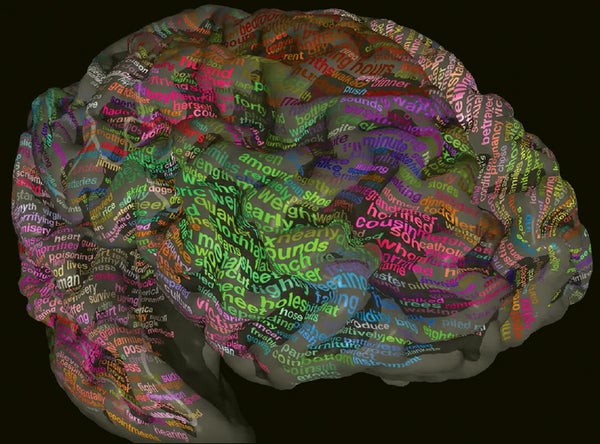
This word map shows which parts of the brain responded as a single subject listened to a storyteller. The words tend to cluster by semantic category, as shown by color (for example, pink words are “social”). For a deeper exploration of the map, watch the video at www.ScientificAmerican.com/video/the-brain-dictionary

© ALEXANDER HUTH, REGENTS OF THE UNIVERSITY OF CALIFORNIA

Join Our Community of Science Lovers!

Listening to speech is so easy for most of us that it is difficult to grasp the neural complexity involved. Previous studies have revealed several brain regions, collectively called the semantic system, that process meaning. Yet such studies have typically focused on specific distinctions, such as abstract versus concrete words, or found discrete areas responsive to groups of related words, such as tools or food. Now a team of neuroscientists in Jack Gallant's laboratory at the University of California, Berkeley, led by Alexander Huth, has generated a comprehensive “atlas” of where different meanings are represented in the human brain.

The researchers played two hours of stories from the Moth Radio Hour, a public broadcast show, to seven participants while recording their brain activity in a functional MRI scanner. They then analyzed the activity in the roughly 50,000 voxels (three-dimensional pixels) that make up the entire brain, creating detailed maps of where different meanings are represented in each individual. This approach contrasts with standard studies, where activity is averaged across many participants to look at similarities across a group while ignoring variations among individuals.

The maps cover much of the cortex, the outermost brain regions controlling higher cognitive functions, extending beyond areas traditionally thought of as language centers. Every meaning appears in multiple locations, and every location contains a cluster of related meanings. Some areas selectively respond to words related to people, for instance, whereas others respond to places or numbers. “This is way more information, and probably way more generalizable to natural narrative comprehension, than any previous study,” Gallant says.


On supporting science journalism

If you're enjoying this article, consider supporting our award-winning journalism by subscribing. By purchasing a subscription you are helping to ensure the future of impactful stories about the discoveries and ideas shaping our world today.


The maps were remarkably similar from one participant to the next, though not identical. The researchers developed a statistical tool that enabled them to produce a general semantic “atlas,” by finding functional areas common to all participants. This technique, improved and extended to other cognitive functions, could ultimately be useful for mapping brain function so as to minimize the impact of surgery or other invasive treatments.

Simon Makin is a freelance science journalist based in the U.K. His work has appeared in New Scientist, the Economist, Scientific American and Nature, among others. He covers the life sciences and specializes in neuroscience, psychology and mental health. Follow Makin on X (formerly Twitter) @SimonMakin

More by Simon Makin
SA Mind Vol 27 Issue 5This article was published with the title “The Brain's Meaning Map” in SA Mind Vol. 27 No. 5 (), p. 17
doi:10.1038/scientificamericanmind0916-17a

Subscribe to Support Independent Journalism

Great science journalism requires human expertise, time, effort and creativity. And it costs money. That’s why I and the journalists here at Scientific American hope you’ll join our community.

When you subscribe, you are supporting staff and freelance journalists who are passionate about telling science stories that are true, important and compelling. Our editors and reporters are often experts in their fields, which means they understand the nuances of big discoveries and can untangle the breakthroughs from the hype. With a subscription, you are also supporting rigorous fact-checking to ensure the words we publish are precise and accurate. And you’re supporting original illustrations, graphics and photos that bring you closer to an advanced laboratory, an ice sheet in Antarctica or a space mission in orbit. You’re helping us craft other types of high-quality journalism as well: Our newsletters are carefully written, edited and curated by staffers you have or will come to know and love. Our Science Quickly podcast is based on original reporting, collaboration with editors and scientists and exacting production.

Subscriptions keep this engine running so we can continue to deliver thoughtful, rigorous and independent science journalism to you. In an era of viral misinformation, this work is crucial. If you value what we do, I hope you’ll consider joining us as a subscriber

Thank you,

Jeanna Bryner, Editor in Chief, Scientific American

Subscribe