
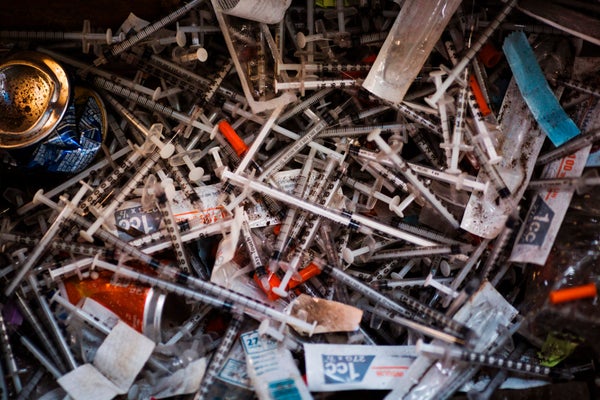
WASHINGTON—The White House’s commission on combating the opioid epidemic has recommended that President Trump declare a federal state of emergency to address the crisis, a potentially significant step for an administration that has repeatedly pledged to take steps to ease the epidemic.
“The first and most urgent recommendation of this Commission is direct and completely within your control. Declare a national emergency under either the Public Health Service Act or the Stafford Act,” the committee wrote in an interim report released Monday.
The declaration would effectively nationalize a move that has already taken place in numerous states. Governors in Florida, Arizona, and Maryland have previously declared states of emergency, granting those governments access to millions of dollars and, in some cases, regulatory leeway in administering their responses.
On supporting science journalism
If you're enjoying this article, consider supporting our award-winning journalism by subscribing. By purchasing a subscription you are helping to ensure the future of impactful stories about the discoveries and ideas shaping our world today.
It was not immediately clear whether or when the president would make such a declaration, and what it would mean for the federal government’s response to the opioid crisis. Half of the roughly $1 billion Congress approved last year to address the opioid crisis as part of the 21st Century Cures Act was awarded in April, with a similar amount expected to be awarded next year.
Most discussions of additional spending on the issue have focused on the Senate’s now-defeated health reform effort.
In a statement, the White House said it would “immediately begin reviewing” the commission’s interim recommendations.
The five-member commission is chaired by Gov. Christie Christie of New Jersey and includes Gov. Charlie Baker of Massachusetts, Gov. Roy Cooper of North Carolina, former Congressman Patrick Kennedy, and Bertha Madras, a psychobiology professor at Harvard University. It was established by an executive order in March, but missed its first two deadlines in issuing the interim report, which was originally due June 27. The final report is due in October.
The commission’s other interim recommendations included:
Reimbursing state Medicaid programs to cover addiction treatment at facilities with more than 16 beds. (The limitation on federal reimbursements for facilities with more than 16 beds was established decades ago so federal tax dollars would not be going to state mental hospitals.)
Requiring doctors who prescribe opioids to take a class in treating pain.
Expanding access to medication-assisted treatment, or MAT. Only 10 percent of drug treatment facilities offer MAT, the commission says, despite the fact that it’s a proven treatment for opioid use disorders
Equipping all law enforcement officials with naloxone, the overdose antidote. In addition, the commission said, states should make naloxone available to all residents with “standing orders” and doctors should prescribe naloxone when prescribing high-risk opioids so patients can have it on hand.
Changing some patient privacy laws to “ensure that information about [substance abuse disorders] be made available to medical professionals treating and prescribing medication to a patient.”
Administration figures involved in health and drug policy issues, like FDA Commissioner Scott Gottlieb and NIH Director Francis Collins, have also played a visible role in conversations about the opioid crisis. But in recent weeks, perceived White House inaction in dealing with the opioid crisis had led some lawmakers on Capitol Hill to air their frustrations publicly.
Rep. Trey Gowdy (R-S.C.), the chair of the House Committee on Oversight and Government Reform, railed against the Office of National Drug Control Policy at a hearing last week for failing to produce a top-down federal strategy to reduce overdose deaths.
“ONDCP has failed to produce a formal national drug control strategy and a national drug control budget, which is supposed to be released no later than Feb. 1 each year,” Gowdy said at a hearing last week.
Despite the pending report and increased attention to the issue, the White House reportedly considered a 95 percent budget cut to ONDCP in May, but restored the funding after widespread and bipartisan outcry.
Other legislators with eyes on the crisis have also expressed doubt that strategies outlined by the commission could impact the crisis response significantly, or at least quickly.
“We don’t really have time to wait on a commission from the White House that hopefully will produce something at some point,” Sen. Joe Donnelly (D-Ind.) said in a recent interview with STAT, referring to himself and senators from other hard-hit states, including Ohio and West Virginia. “We’re losing people every day. … We don’t have time for them to put their report together. We’re trying to get some of our neighbors through next week.”
The report was assembled by the commission independently of ONDCP, though ONDCP did submit a list of policy recommendations for the commission’s consideration.
Andrew Joseph contributed to this story.
Republished with permission from STAT. This article originally appeared on July 31, 2017