
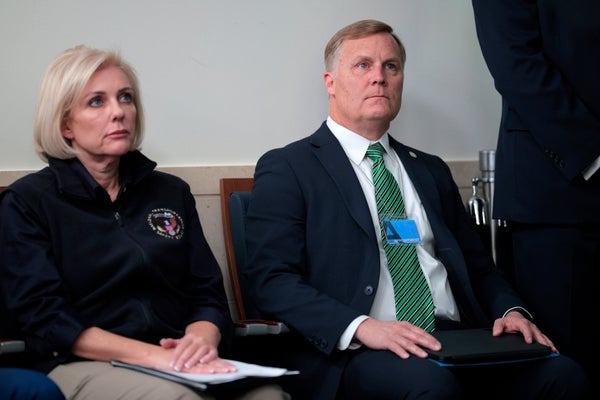
CLIMATEWIRE | President Donald Trump on Thursday tapped an aviation executive with decades of government experience to serve as temporary head of the Federal Aviation Administration. The move was announced hours after a passenger jet collided with an Army helicopter near Ronald Reagan National Airport, killing everyone aboard both aircraft.
Chris Rocheleau has spent nearly three years at the National Business Aviation Association, a trade group. Beforehand, he worked for more than two decades at the FAA and the Transportation Security Administration, where he was involved in responses to other high-profile disasters such as the Sept. 11, 2001, terrorist attacks.
Rocheleau has largely stayed out of the limelight, but in remarks a few years ago, he acknowledged the threat of global warming and the need to address its dangers. The viewpoint could put Rocheleau at odds with other members of the Trump administration; many of them have denied or downplayed the threat of a warming planet.
On supporting science journalism
If you're enjoying this article, consider supporting our award-winning journalism by subscribing. By purchasing a subscription you are helping to ensure the future of impactful stories about the discoveries and ideas shaping our world today.
“Climate recognizes no borders, so our success or failure will depend on all of us coming together to explore global solutions,” he said during video remarks at a 2021 conference of African aviation officials.
The National Business Aviation Association, where Rocheleau served as chief operating officer, lists several issues as its priorities. Those include safety and security, as well as FAA reauthorization and modernization. The group also highlights the need to minimize the aviation industry's environmental impact.
"While aviation emissions are only a tiny fraction of all transportation emissions, and business aircraft emissions are a small portion of those, the industry has continually leveraged technology to minimize emissions, while improving safety and efficiency," the group says.
In response to Rocheleau's selection as acting FAA chief, Ed Bolen, president of the NBAA, said in a statement that the "call to public service resounds deeply with Chris.”
Industry groups praised Rocheleau as a stabilizing force at a difficult time.
“Chris’s proven, solid experience will provide smart leadership at this vital agency, especially during this critical time for our country,” Nicholas Calio, president of Airlines for America, said in a statement.
The FAA’s primary focus is safety, but it’s also involved in environmental aspects of aviation, including the development of sustainable aviation fuel. Experts have said too that modernizing the country’s air traffic control system could save on fuel and cut emissions by allowing planes to fly more directly between destinations.
Rocheleau will take over an agency that’s been strained by a shortage of air traffic controllers and outdated systems, which have contributed to flight delays and capacity restraints at some airports.
Until Wednesday, the U.S. airline industry hadn’t experienced a fatal crash since 2009, but there have been a series of near-misses at large airports over the last few years, which the industry says shows the need to overhaul the system.
Rocheleau was most recently the head of the FAA’s safety office, a job he took in 2021 after the previous department head was forced out over the response to the Boeing 737 Max crashes, the Associated Press reported at the time.
Rocheleau joined the FAA in 1996 after ten years in the Air Force, according to his Linkedin profile, and became a senior policy adviser at TSA in 2002, a few months after the airport security agency was created in the wake of the Sept. 11 terrorist attacks.
After returning to the FAA in 2005, he held a series of management positions. He was in the FAA’s office for foreign affairs when the Covid-19 pandemic shut down worldwide aviation, according to his Linkedin profile.
Rocheleau holds a bachelor's degree from Central Connecticut State University and a masters from the City University of Seattle. He also completed the executive national security program at Harvard’s Kennedy School of Government.
Reprinted from E&E News with permission from POLITICO, LLC. Copyright 2025. E&E News provides essential news for energy and environment professionals.