
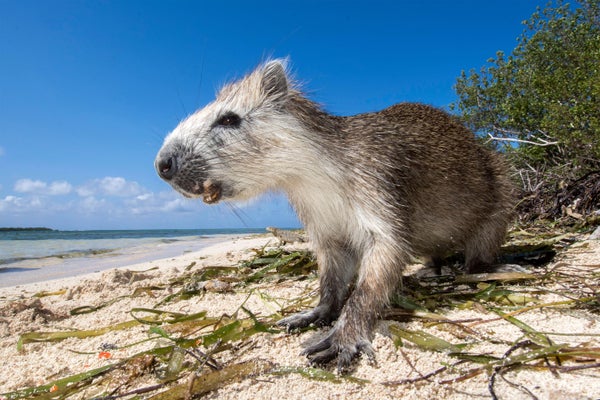
Life tends to move at a slower, more leisurely pace for people who live on islands. It turns out this languidity even extends to island-dwelling animals as well. New research published in Science Advances reveals that many warm-blooded island species evolved a slower metabolic rate compared with their mainland counterparts—a feature that gives them a survival edge in resource-scarce environments but puts them at a heightened risk of extinction when humans are added to the mix.
“When the environment changes or invasive animals come to islands, island species have a low ability to defend themselves,” says co-lead author Ying Xiong, a zoologist at Sichuan Agricultural University in China. “We found a general metabolic rule that helps to explain this.”
The new findings add to what scientists know about “island syndrome,” or the tendency for island-bound species to evolve differences compared with mainlanders in physiology , ecology, and behavior. While some studies have identified metabolic differences as a feature of island syndrome, those previous works tended to be one-offs that focused on a single species or group, says co-lead author Roberto Rozzi, curator of paleontology at the Central Repository of Natural Science Collections at the Martin Luther University Halle-Wittenberg in Germany.
On supporting science journalism
If you're enjoying this article, consider supporting our award-winning journalism by subscribing. By purchasing a subscription you are helping to ensure the future of impactful stories about the discoveries and ideas shaping our world today.
The new study pulls together, for the first time, Rozzi says, a “more or less comprehensive” dataset examining the metabolic rates of warm- and cold-blooded island species. Rozzi, Xiong and their colleagues turned to published papers and existing databases to compile metabolic and ecological information for 2,118 warm-blooded species, including 193 from islands, and 695 cold-blooded species, including 38 from islands.
Using statistical analyses, the authors found that warm-blooded island species—a group that includes both birds and mammals—but not the cold-blooded amphibians and reptiles, tended to have a lower metabolic rate. They compared these findings with conservation status listings from the International Union for Conservation of Nature (IUCN) Red List and found a strong correlation between slower metabolism and an increased risk of extinction.
Many islands lack major predators but have fewer resources available than on the mainland. In such environments, a lower metabolic rate likely gives species a survival edge, Rozzi says. They require less energy on a day-to-day basis, reproduce more slowly and tend to have a longer lifespan. When conditions change, however, this metabolic advantage seems to turn into a disadvantage.
“The shift towards a slow pace of life in parallel impacts species’ resilience by slowing down their recovery after a disturbance,” Rozzi says. “Basically, it’s harder to bounce back.”
Since the late Pleistocene until today, island upheavals tend to come from humans. When people arrive on islands, they often hunt native fauna, alter the habitat and introduce harmful invasive species, such as rats and cats. For island mammals and birds, lower metabolism likely works in concert with other island-syndrome features—including gigantism and dwarfism in mammals, and flightlessness in some birds—to predispose species to extinction, Rozzi says.
The new research “fits previous expectation of island species evolving slower pace-of-life strategies, such as living longer and reproducing more slowly,” says Kevin Healy, a macroecologist at the University of Galway in Ireland, who was not involved in the work. He adds, however, that while the finding about increased extinction risk is “interesting,” it should be treated with caution because of the “highly patchy” nature of the IUCN Red List data. It could be, he says, that island species with a slower metabolism are actually at a lower risk of extinction than the authors found—or at an even higher one.