
Say you accidentally cut the tip of your finger off. Especially if this happened to you as a child, there’s a good chance it would regrow—skin, nail and all. The same is true for other mammals such as monkeys and mice. Unfortunately, however, our regenerative abilities stop there. While some other creatures, most notably salamanders and starfish, can regenerate entire limbs, mammals don’t have this evolutionary superpower.
“The big question is: Why are mammals limited?” says Jessica Whited, an associate professor of stem cell and regenerative biology at Harvard University.
Part of the reason why our cells only have a limited ability to regenerate may have to do with our genes. But according to new research, two key environmental mechanisms may be at play, too.
On supporting science journalism
If you're enjoying this article, consider supporting our award-winning journalism by subscribing. By purchasing a subscription you are helping to ensure the future of impactful stories about the discoveries and ideas shaping our world today.
How rich a tissue is in hyaluronic acid and how well it can sense oxygen may affect its ability to regrow and heal, a pair of new studies published in Science on Thursday suggest. The results could lead to better wound treatments and possibly the ability to one day regrow larger pieces of human tissue—even limbs.
In one study, researchers investigated what might makes the mammalian fingertip special: Why can only the tip of the finger regrow, whereas the rest of it can’t? “Same finger, two entirely different outcomes,” says Byron Mui, lead author of the study and a postdoctoral fellow at the Stanford University School of Medicine.
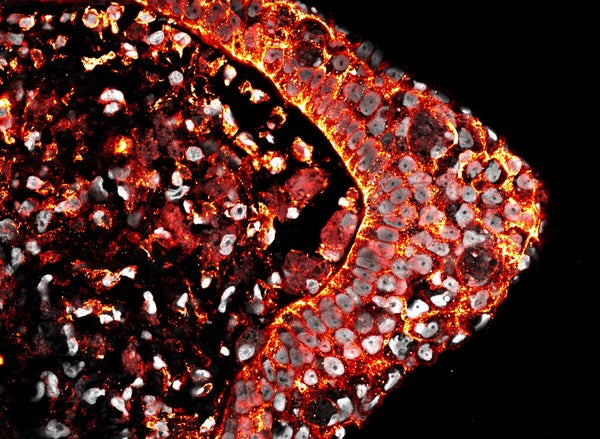
The researchers found that mice with a partial finger amputation could regrow part of their finger more easily and with less scarring when there were higher levels of hyaluronic acid in the animals’ “extracellular matrix”—the material between cells. Hyaluronic acid may be familiar to some readers: it is a common ingredient in face creams and moisturizers that claim to reduce wrinkles.
The study “elegantly challenges” the idea that scarring is a given in mammals that have lost a limb or digit, according to a related commentary in Science that was co-authored by Whited, who was not involved with either study.
In the other study, researchers compared two species: African clawed frog tadpoles and embryonic mice. Tadpoles can regenerate their limbs; embryonic mice can’t.
The researchers subjected amputated tissues from tadpoles and embryonic mice to various laboratory tests, explains molecular biologist Georgios Tsissios, the study’s lead author. In a low-oxygen environment—similar to that of tadpoles’ usual aquatic habitat—mice tissue healed better than when it was exposed to more oxygen.
“These experiments showed that lowering oxygen in embryonic mouse limbs can make them mimic frog tadpole limbs, enabling them to activate the very early regenerative responses,” Tsissios says.
Tsissios and his colleagues found, however, that tadpole cells appear to be worse at sensing oxygen than embryonic mice cells do—suggesting that tissue regeneration may be influenced by both levels of oxygen and the animals’ ability to sense it.
The results are preliminary: in neither study did the researchers regrow entire mammalian limbs. And any kind of tissue regeneration therapy for humans based on these findings is a long way off, Whited says. But the studies do offer hope for human research because they offer clues to what factors—both in the animals’ biology and their environment—may determine their tissue’s regenerative powers.
“As a field, the way that we piece all of these puzzle pieces together will eventually lead to human limb regeneration,” Whited predicts.