
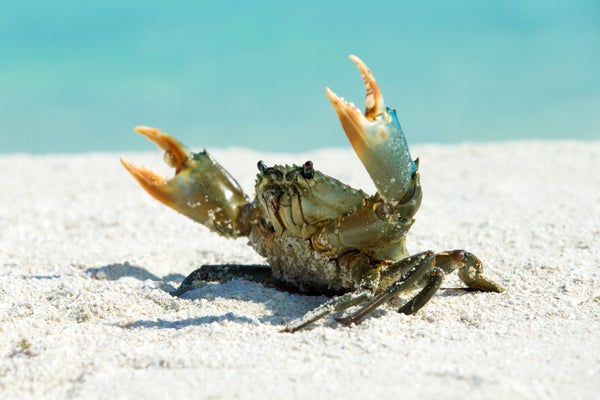
A flat, rounded shell. A tail that's folded under the body. This is what a crab looks like, and apparently what peak performance might look like — at least according to evolution. A crab-like body plan has evolved at least five separate times among decapod crustaceans, a group that includes crabs, lobsters and shrimp. In fact, it's happened so often that there's a name for it: carcinization.
So why do animals keep evolving into crab-like forms? Scientists don't know for sure, but they have lots of ideas.
Carcinization is an example of a phenomenon called convergent evolution, which is when different groups independently evolve the same traits. It's the same reason both bats and birds have wings. But intriguingly, the crab-like body plan has emerged many times among very closely related animals.
On supporting science journalism
If you're enjoying this article, consider supporting our award-winning journalism by subscribing. By purchasing a subscription you are helping to ensure the future of impactful stories about the discoveries and ideas shaping our world today.
The fact that it's happening at such a fine scale "means that evolution is flexible and dynamic," Javier Luque, a senior research associate in the Department of Zoology at the University of Cambridge, told Live Science.
Crustaceans have repeatedly gone from having a cylindrical body plan with a big tail — characteristic of a shrimp or a lobster — to a flatter, rounder, crabbier look, with a much less prominent tail. The result is that many crustaceans that resemble crabs, like the tasty king crab that's coveted as a seafood delicacy, aren't even technically "true crabs." They've adopted a crab-like body plan, but actually belong to a closely related group of crustaceans called "false crabs."
When a trait appears in an animal and sticks around through generations, it's a sign that the trait is advantageous for the species — that's the basic principle of natural selection. Animals with crabby forms come in many sizes and thrive in a wide array of habitats, from mountains to the deep sea. Their diversity makes it tricky to pin down a single common benefit for their body plan, said Joanna Wolfe, a research associate in organismic and evolutionary biology at Harvard University.
Wolfe and colleagues laid out a few possibilities in a 2021 paper in the journal BioEssays. For example, crabs' tucked-in tail, versus the lobster's much more prominent one, could reduce the amount of vulnerable flesh that's accessible to predators. And the flat, rounded shell could help a crab scuttle sideways more effectively than a cylindrical lobster body would allow.
But more research is needed to test those hypotheses, Wolfe said. She is also trying to use genetic data to better understand the relationships among different decapod crustaceans, to more accurately pinpoint when various "crabby" lineages evolved, and pick apart the factors driving carcinization.
There's another possible explanation: "It's possible that having a crab body isn't necessarily advantageous, and maybe it's a consequence of something else in the organism," Wolfe said. For example, the crab body plan might be so successful not because of the shell or tail shape itself, but because of the possibilities that this shape opens up for other parts of the body, said Luque, who is a co-author of the 2021 paper with Wolfe.
For example, a lobster's giant tail can propel the animal through the water and help it crush prey. But it can also get in the way and constrain other features, Luque said. The crab body shape might leave more flexibility for animals to evolve specialized roles for their legs beyond walking, allowing crabs to easily adapt to new habitats. Some crabs have adapted their legs for digging under sediment or paddling through water.
"We think that the crab body plan has evolved so many times independently because of the versatility that the animals have," Luque said. "That allows them to go places that no other crustaceans have been able to go."
The crab-like body plan also has been lost multiple times over evolutionary time — a process known as decarcinization.
"Crabs are flexible and versatile," Luque explained. "They can do a lot of things back and forth."
Wolfe thinks of crabs and other crustaceans like Lego creations: They have many different components that can be swapped out without dramatically changing other features. So it's relatively straightforward for a cylindrical body to flatten out, or vice versa. But for better or worse, humans won't be turning into crabs anytime soon. "Our body isn't modular like that," Wolfe said. "[Crustaceans] already have the right building blocks."
Copyright 2023 LiveScience, a Future company. All rights reserved. This material may not be published, broadcast, rewritten or redistributed.