
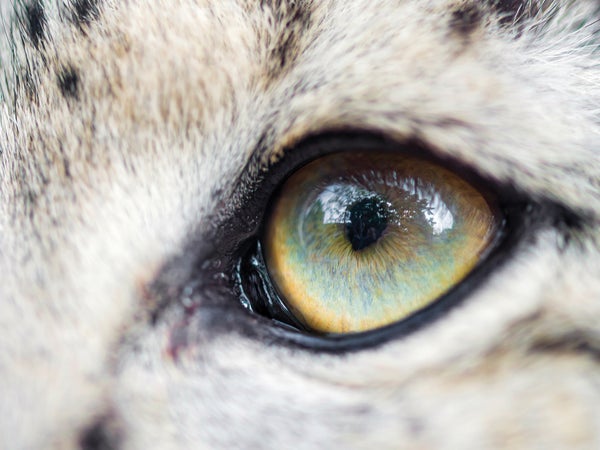
Wild cats showcase a stunning diversity of eye colors, proving a mystery for researchers because most wild species are known to have narrow eye color schemes (usually black, brown or yellow). Eye color’s evolution is notoriously hard to track: fossils don’t preserve it, taxidermy specimens have fabricated eyes, and most books illustrate only one example per species. Now scientists have harnessed the Internet’s abundant wild cat photographs to chart the transition from brown eyes to colors such as green and blue—and found something of a gray area.
Any animal’s eye color is determined by its levels of two melanin pigments: eumelanin, which makes brown-black, and pheomelanin, which makes red-yellow. Eye colors vary according to the amounts of each, with different combinations leading to colors such as blue, green and gray.
For a paper in iScience, Harvard University biology graduate student Julius Tabin and his co-author, Katherine Chiasson, used a process called ancestral state reconstruction to determine the eye colors of extinct wild cat species based on those of their living descendants. The authors analyzed the clearest images submitted to the database iNaturalist.org, then classified each cat’s eye color and mapped the data to the cat family tree, using an algorithm to find each common ancestor’s possible eye colors. The algorithm accounted for the likelihood of certain changes and figured in the time since species diverged in order to generate the likeliest colors at every split.
On supporting science journalism
If you're enjoying this article, consider supporting our award-winning journalism by subscribing. By purchasing a subscription you are helping to ensure the future of impactful stories about the discoveries and ideas shaping our world today.
“It’s a way we can actually look into the eyes of the felid ancestor,” Tabin says. “The ancestor develops gray eyes, and then the eye color diversity just explodes.” Once an eye with moderate amounts of both eumelanin and pheomelanin appeared (producing gray eyes), blue and green were not far behind.
The scientists next tried to connect the discovered eye colors with numerous factors, including habitat, fur color and hunting behavior, to help explain why those shades had evolved. But they found little correlation. “Huskies have those bright blue eyes because we wanted them to” and bred them accordingly, Tabin says, but in wild cats, “I have no idea what’s going on here.” Sexual selection is plausible—perhaps cats prefer particular eye colors in mates—but it would be challenging to test.
Eye color is “a very overlooked trait, and it’s a pity because it’s probably important ecologically and evolutionarily,” says University of Glasgow evolutionary biologist Arianna Passarotto, who is not affiliated with the new study. She is skeptical of using photos taken in uncontrolled conditions, but she describes the study as “ambitious” and “absolutely very novel.”
As Juan José Negro, an ecologist at the Spanish National Research Council also not affiliated with the study, puts it, “the eye is the last frontier for [studying] coloration.”