
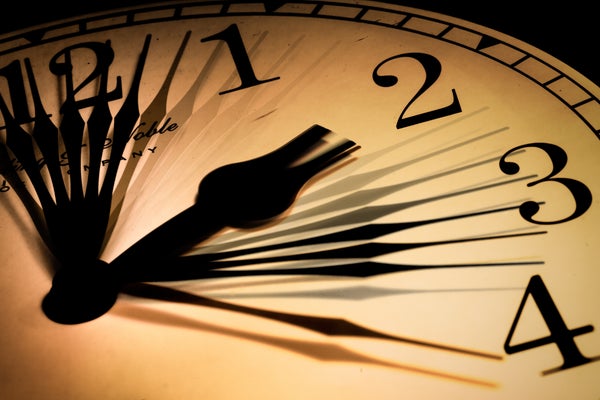
“Where did the time go?” middle-aged and older adults often remark. Many of us feel that time passes more quickly as we age, a perception that can lead to regrets. According to psychologist and BBC columnist Claudia Hammond, “the sensation that time speeds up as you get older is one of the biggest mysteries of the experience of time.” Fortunately, our attempts to unravel this mystery have yielded some intriguing findings.
In 2005, for instance, psychologists Marc Wittmann and Sandra Lenhoff, both then at Ludwig Maximilian University of Munich, surveyed 499 participants, ranging in age from 14 to 94 years, about the pace at which they felt time moving—from “very slowly” to “very fast.” For shorter durations—a week, a month, even a year—the subjects' perception of time did not appear to increase with age. Most participants felt that the clock ticked by quickly. But for longer durations, such as a decade, a pattern emerged: older people tended to perceive time as moving faster. When asked to reflect on their lives, the participants older than 40 felt that time elapsed slowly in their childhood but then accelerated steadily through their teenage years into early adulthood.
There are good reasons why older people may feel that way. When it comes to how we perceive time, humans can estimate the length of an event from two very different perspectives: a prospective vantage, while an event is still occurring, or a retrospective one, after it has ended. In addition, our experience of time varies with whatever we are doing and how we feel about it. In fact, time does fly when we are having fun. Engaging in a novel exploit makes time appear to pass more quickly in the moment. But if we remember that activity later on, it will seem to have lasted longer than more mundane experiences.
On supporting science journalism
If you're enjoying this article, consider supporting our award-winning journalism by subscribing. By purchasing a subscription you are helping to ensure the future of impactful stories about the discoveries and ideas shaping our world today.
The reason? Our brain encodes new experiences, but not familiar ones, into memory, and our retrospective judgment of time is based on how many new memories we create over a certain period. In other words, the more new memories we build on a weekend getaway, the longer that trip will seem in hindsight.
This phenomenon, which Hammond has dubbed the holiday paradox, seems to present one of the best clues as to why, in retrospect, time seems to pass more quickly the older we get. From childhood to early adulthood, we have many fresh experiences and learn countless new skills. As adults, though, our lives become more routine, and we experience fewer unfamiliar moments. As a result, our early years tend to be relatively overrepresented in our autobiographical memory and, on reflection, seem to have lasted longer. Of course, this means we can also slow time down later in life. We can alter our perceptions by keeping our brain active, continually learning skills and ideas, and exploring new places.
Question submitted by Esther Robison, New York City
Do you have a question about the brain you would like an expert to answer? Send it to MindEditors@sciam.com