
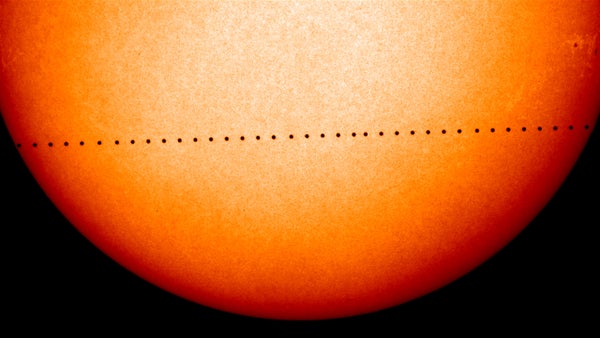
Mercury will cross the sun's face from Earth's perspective on Monday (May 9) in the first such "transit" since 2006, and the last until 2019.
Most of the world will be in position to witness Monday's Mercury transit, weather permitting, though observers will need a telescope to see it well. But remember: NEVER look directly at the sun without a solar filter or other appropriate eye protection; blindness can result.
Mercury transits occur just 13 times per century, on average. They're so rare because the innermost planet's orbit is inclined by about 7 degrees compared to that of Earth, so Mercury, the sun and our home planet just don't line up all that often. [Mercury’s 2016 Transit of the Sun: A Rare Sight (Video)]
On supporting science journalism
If you're enjoying this article, consider supporting our award-winning journalism by subscribing. By purchasing a subscription you are helping to ensure the future of impactful stories about the discoveries and ideas shaping our world today.
Mercury completes one lap around the sun every 88 days, so the little planet crosses the plane of Earth's orbit every 44 days — once while moving "up" and again while coming back "down." These points of intersection are called nodes.
These nodes line up with the sun from Earth's point of view just twice per year, once in May and once in November. If Mercury happens to be at the node at either of these times, Earth observers see a transit. (All Mercury transits occur within a few days of May 8 and Nov. 10.)
Mercury's orbit is elliptical, so May transits and November transits are different beasts.
"During November transits, Mercury is near perihelion and exhibits a disk only 10 arcseconds in diameter," NASA officials wrote in a description of planetary transits, which are basically just mini-eclipses. (Perihelion refers to an orbiting planet's closest approach to the sun; aphelion is its most distant position from the star.)
"By comparison, the planet is near aphelion during May transits and appears 12 arcseconds across," the officials added. "However, the probability of a May transit is smaller by a factor of almost two. Mercury's slower orbital motion at aphelion makes it less likely to cross the node during the critical period."
Venus also transits, because, like Mercury, it lies closer to the sun than Earth does. But because Venus circles the sun much more slowly than Mercury does — once every 225 days, compared to once every 88 days — Venus transits are much rarer; only eight such events have occurred since the invention of the telescope in the early 1600s. (Venus' orbital plane is also out of alignment with Earth's, by about 3 degrees.)
Venus transits happen in pairs eight years apart, with each pair separated from the previous pair by more than 100 years. For example, the last eight occurred in 1631, 1639, 1761, 1769, 1874, 1882, 2004 and 2012. The next Venus transit won't come until 2117.
Planetary transits beyond our solar system are visible as well, with the aid of powerful instruments such as NASA's Kepler space telescope. Indeed, Kepler has discovered more than 1,000 exoplanets (and an additional 3,600 planet "candidates") by noticing the tiny brightness dips these worlds cause when they cross their parent stars' faces from the spacecraft's perspective.
Astronomers can also learn about the composition of exoplanet atmospheres by studying the starlight that filters through them during transits.
Copyright 2016 SPACE.com, a Purch company. All rights reserved. This material may not be published, broadcast, rewritten or redistributed.