

It is no secret that we all have secrets. Maintaining them can be draining, but not for the reason most researchers have long assumed. A new study redefines “secrecy” itself and offers a novel explanation for its known link to depression, anxiety and poor overall health. The researchers suggest that secrecy is primarily the intention to conceal information, regardless of any active concealment around others. And that hurts us by making us feel inauthentic, even when we are alone.
Michael Slepian, a psychologist at Columbia Business School, and his colleagues recently reported their findings in a paper published online in the Journal of Personality and Social Psychology. In six studies, they queried a total of 1,200 Americans via the Internet—as well as 312 people picnicking in New York City’s Central Park—regarding 38 categories of behavior or identity that are often kept secret. For five of these studies, respondents said they were currently hiding information in about 13 of these categories on average (including about five for which they had a secret they were keeping from everyone). The most common secrets were extrarelational thoughts (thinking about having relations with another person while already in a relationship), romantic desire (while being single) and sexual behavior (consumption of pornography, fantasies, and so on). The graphic presents a full breakdown of the most common secrets; additional data are available at www.keepingsecrets.org.
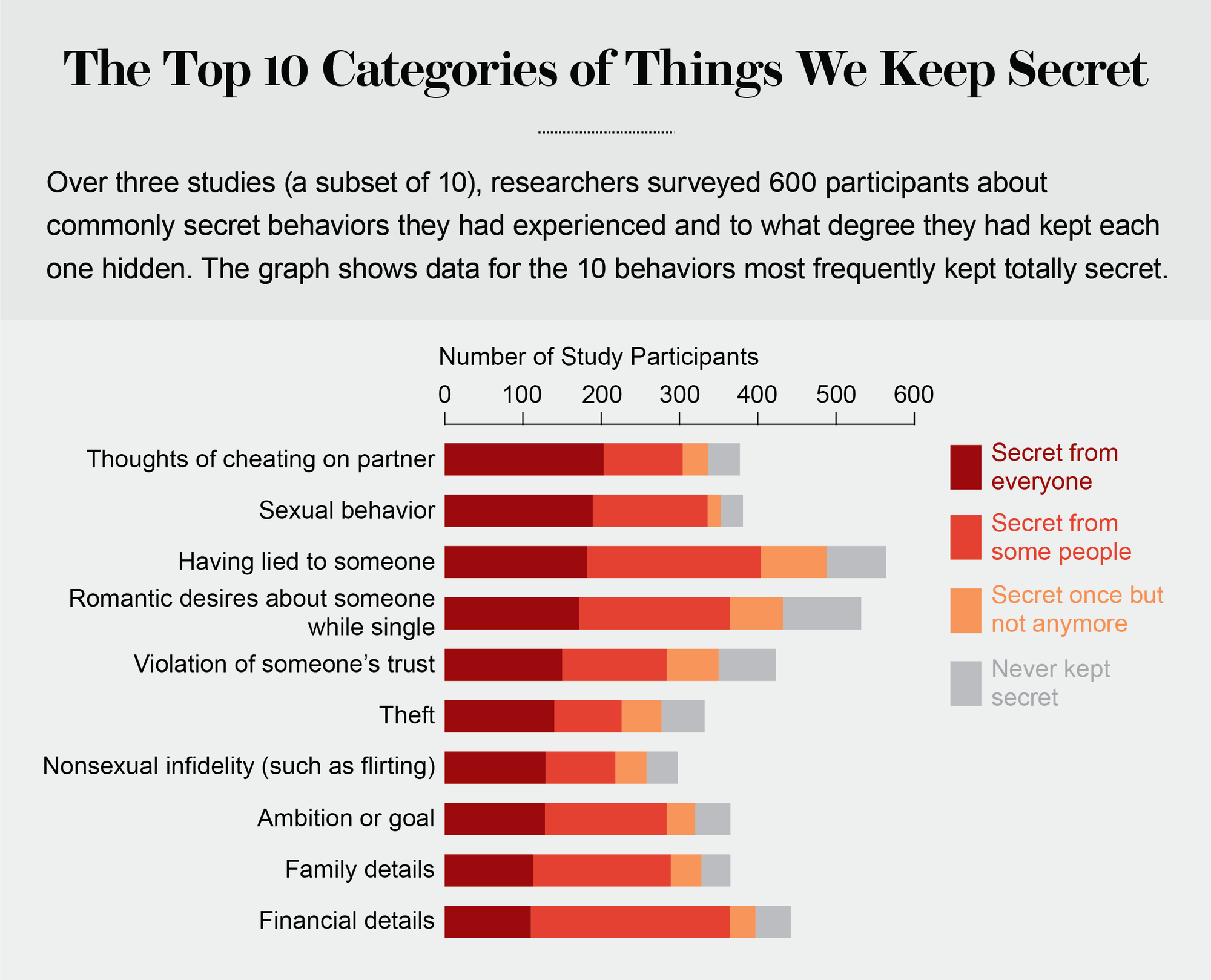
Credit: Amanda Montañez; Source: “The Experience of Secrecy,” by Michael L. Slepian et al., in Journal of Personality and Social Psychology. Published online May 8, 2017
On supporting science journalism
If you're enjoying this article, consider supporting our award-winning journalism by subscribing. By purchasing a subscription you are helping to ensure the future of impactful stories about the discoveries and ideas shaping our world today.
People said that when they were not interacting with anyone, they thought about their secrets about twice as often as they actively concealed them in conversation. The more often their mind wandered to a secret, the more they reported that it damaged their well-being and the less healthy they said they were. Surprisingly, active concealment did not affect well-being at all—in contrast to previous assumptions. Four additional studies, all involving couples and conducted online, produced similar findings.
If you must keep a secret, Slepian suggests avoiding dwelling on it by practicing mindfulness or by discussing the forbidden topic in anonymous online forums.