
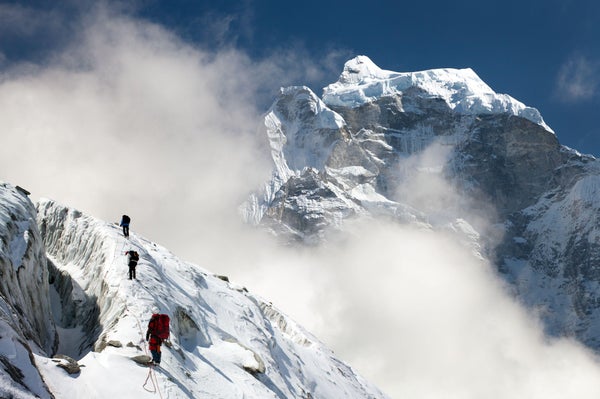
How did Mount Everest come to be the world’s tallest mountain, towering more than 200 metres above the next two highest peaks? Geologists suggest the mountain owes part of its extra height to two ancient rivers that flowed through the Himalayas and merged about 89,000 years ago. The resulting erosion removed so much rock and soil that Everest has rebounded upwards by as much as 50 metres, they say.
The outer crust of Earth responds to the removal of mass by slowly rising, says co-author Matt Fox, a geologist at University College London. “This has increased the elevation of Everest.”
Everest, also known as Chomolungma and Sagarmāthā, stands 8,849 metres above sea level, in the Himalayan mountain chain, which also contains the world’s third-highest peak, Kanchenjunga (8,586 metres) and is not far from the second-highest, K2 (8,611 metres). The Himalayas have been driven up by the ongoing collision of India with the rest of Asia.
On supporting science journalism
If you're enjoying this article, consider supporting our award-winning journalism by subscribing. By purchasing a subscription you are helping to ensure the future of impactful stories about the discoveries and ideas shaping our world today.
Fox and his colleagues argue, in a study published in Nature Geoscience today, that part of the explanation for Everest’s extreme height lies in the nearby Arun River.
Ancient stream
The Arun rises north of the Himalayas but its course quickly turns south, cutting a gorge through the mountains before joining the huge Kosi River. “For 100 years, people have wondered why this river cuts through the tallest mountain ranges,” says Fox.
One possibility is that the Arun was like that before the Himalayas formed. However, many geologists suspect the Himalayas were there first. They think that the Arun once had a different course, and that it eroded its way through the mountains until it merged with a northerly river. This kind of event is known as river capture or river piracy, says Fox.
“It could have been quite a dramatic event,” says Fox. “It might have happened during a time of flooding.”
Fox, working with colleagues including Jin-Gen Dai, a geologist at the China University of Geosciences in Beijing, found that the Arun is a dramatic gorge with near-vertical sides compared to neighbouring rivers, suggesting it is relatively young. They used models to simulate the possible capture event, and found that it would have increased erosion along the river’s path, explaining the unusual channel.
The arguments for capture are pretty strong, says geologist Peter van der Beek at the University of Potsdam in Germany. “They clearly show it’s different from the other rivers,” he says, “and you wouldn’t see that if it was a pre-existing river.” Previous studies have pointed to instances of river piracy elsewhere in the Himalayas, and to erosion along the Arun affecting nearby mountains.
The team’s best-fit model suggests that the Arun capture event happened 89,000 years ago. Since then, the Arun has rapidly eroded its channel, carrying away vast amounts of sediment. Released from this mass, the crust could bob slowly upwards. The team estimates that this ‘isostatic rebound’ has added between 15 and 50 metres to Everest’s elevation. Similar mechanisms have been described before, including in the Himalayas.
Too simplistic?
Van der Beek is less convinced by these arguments. He says the timing of the river capture is uncertain, because the team used a simple model of river behaviour.
And the estimates of the mountain rising by 15–50 metres depend on the long-term rates of tectonic uplift and erosion, which are not well understood, he adds. That’s partly because measurements of these rates go back for only a few decades: not long enough to include dramatic seismic events. Van der Beek points out that in 2015, a magnitude-7.8 earthquake in Nepal caused many Himalayan mountains to subside by around 1 metre. Over long timescales, multiple big quakes can substantially affect mountain height.
This article is reproduced with permission and was first published on October 1, 2024.