
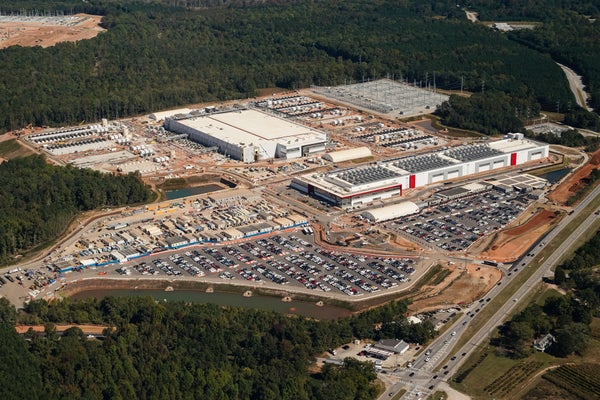
New York State has given itself up to a year to decide how to take the environmental measure of a data center. On July 14 Governor Kathy Hochul ordered the nation’s first statewide moratorium on new hyperscale facilities, putting part of the artificial intelligence boom on hold while the state works out how to measure their enormous electricity and water demands and their effects on surrounding communities.
That could make New York a test case for the rest of the country. Data centers have been around for decades, but the newest facilities are arriving at a scale and speed that many utilities and regulators were not prepared to handle.
The moratorium covers proposed facilities capable of drawing at least 50 megawatts whose applications for certain state permits have not already been deemed complete. Over the next year, the state’s Department of Public Service will prepare an environmental impact statement examining energy demand, water use and quality, air pollution, noise and disproportionate effects on disadvantaged communities. New York’s Department of Environmental Conservation will also review whether the state’s existing water withdrawal rules accurately capture data centers’ demands.
On supporting science journalism
If you're enjoying this article, consider supporting our award-winning journalism by subscribing. By purchasing a subscription you are helping to ensure the future of impactful stories about the discoveries and ideas shaping our world today.
Data centers house thousands of servers that run around the clock to provide digital services that range from chatbot responses to streaming music and video.
Nearly all the electricity that reaches the computing equipment eventually becomes heat. The servers themselves consume most of the power; fans, pumps, chillers and cooling towers add another load while ensuring the servers don’t overheat. Depending on the system, that process may also consume large amounts of water.
Experts say the first and perhaps most difficult step for New York is understanding how much water and energy data centers are using. Right now detailed facility-level figures are often unavailable to the public or reported inconsistently.
Fengqi You, a professor of energy systems engineering at Cornell University, says a solid foundation of data is key to developing a regulatory framework.
“In my view, the data and transparency [are] the hardest part,” he says. “If you get the data, we are very good at using data to make decisions. But if the data are not comprehensive enough or even somehow misleading, there could be a challenge.”
Even if New York can accurately measure data centers’ effects on energy supplies, water resources and air quality, those numbers will not point to one obvious set of rules. Eric Sjöstedt, a postdoctoral fellow at Virginia Tech, warns against a “blanket solution” that overlooks how sharply a facility’s effect can vary with location, power source and cooling system. “When you talk about data centers broadly, it’s important to acknowledge that, yes, there are some general trends that we can pull out of this and how we look at their impacts,” he says, “but they’re very heterogeneous.”
Most data centers draw their electricity from the power grid. At the scale covered by New York’s order, a single facility can use as much power as tens of thousands of homes, and utilities may need to build new infrastructure to serve it. New York’s separate Energize NY Development initiative is examining how to keep those costs from falling on ordinary customers and to instead make data centers “shoulder their own burden,” according to a press release from the governor’s office.
The environmental effect also depends on how that electricity is generated. New York could tell data centers to “BYOP” (bring your own power), You says. But on-site generation could worsen air pollution if the state does not regulate the energy source.
“It really depends on where you generate this energy,” he says. “It could come from natural gas, from coal, from nuclear, solar, wind, etcetera. Their carbon footprints are quite different.”
The diesel generators that most data centers use as backup also raise air pollution concerns, particularly when facilities are located near homes. And generators and cooling equipment can create persistent noise.
Water presents a different accounting problem. Generating the electricity that powers a facility can create an off-site water footprint. On-site, a data center may withdraw water and return much of it to the source or consume it through evaporation. You invokes the old real estate adage: “Location, location, location.”
In southern Nevada, for example, the state’s water authority backed a moratorium on evaporative cooling in new commercial and industrial buildings because of the pressure it places on the region’s limited water supply. But closed-loop cooling can use much more energy, Sjöstedt says, so the trade-offs look different depending on which resources are most constrained locally.
Jonathan Koomey, an energy-efficiency researcher, says siting is the critical question.
“We need some data centers. So, the question is: Where should we put the data centers, and how should their external costs be mitigated so that they have a minimal effect on the surrounding community and on the society as a whole?”
New York will spend the next year trying to answer that question. You says the framework the state develops could become a model for other places confronting the same rush of data center construction.