
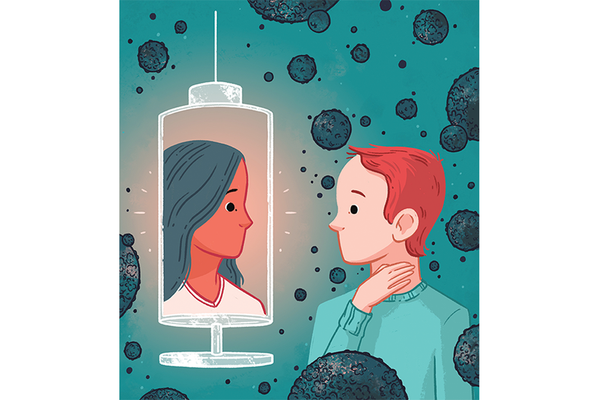
Back in 2006, when the vaccine for human papillomavirus (HPV) was introduced, I rushed to get my teenage daughters immunized. Here, amazingly, was a vaccine that could actually prevent cancer. By blocking HPV infection, it protects girls from the leading cause of cervical malignancies. I didn't give much thought to my son, and neither did the medical establishment. It wasn't until 2011 that health authorities recommended the vaccine for boys.
In hindsight, that delay was a mistake, though perfectly understandable: the vaccine was developed with cervical cancer in mind and initially tested only in girls. Today, however, we see a rising tide of cancers in the back of the throat caused by HPV, especially in men, who are three to five times more vulnerable than women. This surge of oropharyngeal cancers, occurring in many developed nations, took doctors by surprise. Oral cancers were expected to decline as a result of the drop in smoking that began in the 1960s.
Smoking-related oropharyngeal cancers are, in fact, down. But making up the difference, particularly in men, are those related to HPV, which have more than doubled over the past two decades. With cervical cancer waning (thanks to screening and prevention), this oral disease is now the leading HPV-related cancer in the U.S. Nearly 19,000 cases were reported in 2015, according to a recent report by the Centers for Disease Control and Prevention. Roughly nine out of 10 involve a nasty strain called HPV-16.
On supporting science journalism
If you're enjoying this article, consider supporting our award-winning journalism by subscribing. By purchasing a subscription you are helping to ensure the future of impactful stories about the discoveries and ideas shaping our world today.
Researchers link the rise of these cancers to changing sexual practices, perhaps dating back to the 1970s. “People have more partners than they had in the past, and they initiate oral sex at an earlier age than previous generations did,” says Gypsyamber D'Souza, associate professor of epidemiology at the Johns Hopkins Bloomberg School of Public Health. Greater exposure to oral sex means that the nearly ubiquitous virus gets transferred from the genitals to the mouth.
Studies suggest that most women develop protective antibodies to HPV after having a few sexual partners, but for men, it may take more than 10 partners. A likely reason for the difference, says oncologist Maura Gillison of the University of Texas MD Anderson Cancer Center, is that “in women, the infection is vaginal-mucosal; in men, it's entirely on the skin,” where it is much less likely to trigger an antibody response. Males can get an active infection again and again, and it lingers longer than in women, making them the “Typhoid Marys of HPV,” as Gillison puts it. The path from infection to cancer may take decades and is not well understood.
Fortunately, the HPV vaccine should prevent these oral cancers, just as it protects against cervical cancer (as well as virus-related cancers of the vulva, labia, penis and anus). After lagging for years, U.S. rates of vaccination of boys are catching up with that of girls. New CDC data show that in 2017, 68.6 percent of girls and 62.6 percent of boys, ages 13 to 17, had received at least one dose of the vaccine—up from 65.1 and 56 percent, respectively, in 2016. If the trend continues, HPV-related cancers will ultimately become a scourge of the past in the U.S.
The tough question is what to do in the meantime for the large number of people, especially at-risk men, who have never been immunized. The CDC recommends the vaccine for children as young as nine and up to age 21 for boys and 26 for girls. Merck, which makes the only HPV vaccine now used in the U.S., is seeking approval to make it available up to age 45, but the $130-a-dose vaccine is less cost-effective in older populations. “It's best given before people are sexually active,” explains Lauri Markowitz, team lead and associate director of science for HPV at the CDC. “The vaccine is not therapeutic; it's prophylactic.” A vaccine advisory committee meeting this fall will weigh whether to revise current recommendations. One possibility, she says, is raising the upper age for boys to 26, matching that for girls.*
D'Souza, Gillison and others are investigating ways to identify and screen people who may be at an especially high risk for oral HPV cancers—a significant challenge. There is no Pap-smear equivalent for this devastating disease, no reliable way to spot precancerous or early-stage lesions. And research by D'Souza and her colleague Carole Fakhry shows that even if you focus on a high-risk group such as men in their 50s—8 percent of whom are infected with one of the noxious HPV strains—only 0.7 percent will go on to develop the cancer. There's little point in terrifying people about the small odds of a bad cancer, D'Souza says, so “we're working on understanding which tests would be useful.”
*Editor's Note (11/6/18): On October 5, the Food and Drug Administration approved use of the vaccine for both men and women up to age 45.