New Issue: Orbital Catastrophe Ahead? Read Now

Why Temperatures Swung by 90 Degrees F in Parts of U.S.

Much of the U.S. has swung from temperatures in the –30s and –40s Fahrenheit to balmy weather in the 60s and 70s F

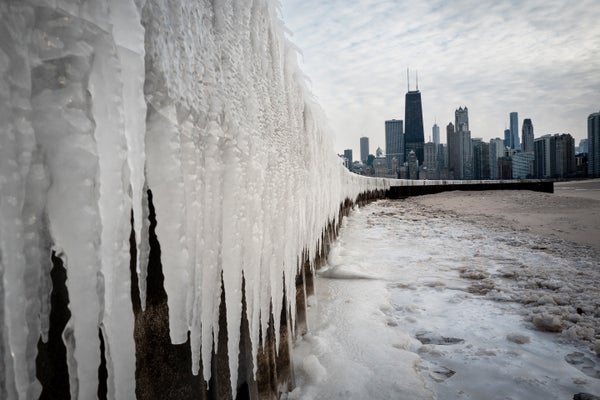
Ice collected along the shore of Lake Michigan with large icicles hanging on the side of a wall and the Chicago skyline in the distance

Ice collects along the shore of Lake Michigan as temperatures were in the single-digits for most of the day on February 17, 2025, in Chicago, Ill.

Scott Olson/Getty Images

Join Our Community of Science Lovers!

Last week people in eastern Nebraska experienced freezing temperatures in the –30s Fahrenheit and wind chills in the –60s F. Schools were cancelled because of the extreme Arctic chill. Then, on Sunday, “I walked around the lake, and it was 57 degrees [F], and people were in shorts and T-shirts,” says Van DeWald, a lead meteorologist at the National Weather Service’s (NWS’s) office in Omaha.

For Omaha and other places in and around the High Plains, temperatures have swung by 75 to 100-plus degrees F in just under a week. Other parts of the central and eastern U.S. have also seen a substantial warm-up, though more on the order of 20 to 30 degrees F.

Last week’s big freeze came courtesy of an air mass moving southward from Canada, bringing with it extreme cold and high winds. Several places set daily temperature records: Bismarck, N.D., set a record of –39 degrees F on February 18 (besting one of –37 degrees F set in 1910). And on the same day Minot, N.D., saw a record of –33 degrees F (breaking one of –27 degrees F set in 1903). Temperatures in the High Plains were 30 to 40 degrees F below normal, says Matthew Johnson, a meteorologist at the NWS’s Bismarck office. Outbreaks of extremely cold Arctic air aren’t unusual in the region. “That happens every one to two years, that we get that cold,” DeWald says.


On supporting science journalism

If you're enjoying this article, consider supporting our award-winning journalism by subscribing. By purchasing a subscription you are helping to ensure the future of impactful stories about the discoveries and ideas shaping our world today.


Now the area is seeing temperatures in the 60s and even the 70s F, “a good 25 to 30 degrees [F] above normal,” says Brian Hurley, a senior meteorologist at the NWS’s Weather Prediction Center. He explains that the meteorological seesaw is linked to a change in air patterns higher in the atmosphere: there a region of lower pressure that brought winds from the northwest has retreated, allowing a flow of warmer air from the south and southwest.

Though the temperatures swings are sizable, they’re not entirely unexpected at this time of year: weather generally becomes more changeable during meteorological spring, which begins on March 1. “We can kind of fluctuate pretty violently during this transition season,” Johnson says.

Andrea Thompson is senior editor for Earth and environment at Scientific American, covering the environment, energy and Earth sciences. She has been covering these topics for nearly two decades. Prior to joining Scientific American, she was a senior writer covering climate science at Climate Central and a reporter and editor at Live Science, where she primarily covered earth science and the environment. She has moderated panels, including as part of the United Nations Sustainable Development Media Zone, and appeared in radio and television interviews on major networks. She holds a graduate degree in science, health and environmental reporting from New York University, as well as a B.S. and an M.S. in atmospheric chemistry from the Georgia Institute of Technology. Follow Thompson on Bluesky @andreatweather.bsky.social

More by Andrea Thompson

Subscribe to Support Independent Journalism

Great science journalism requires human expertise, time, effort and creativity. And it costs money. That’s why I and the journalists here at Scientific American hope you’ll join our community.

When you subscribe, you are supporting staff and freelance journalists who are passionate about telling science stories that are true, important and compelling. Our editors and reporters are often experts in their fields, which means they understand the nuances of big discoveries and can untangle the breakthroughs from the hype. With a subscription, you are also supporting rigorous fact-checking to ensure the words we publish are precise and accurate. And you’re supporting original illustrations, graphics and photos that bring you closer to an advanced laboratory, an ice sheet in Antarctica or a space mission in orbit. You’re helping us craft other types of high-quality journalism as well: Our newsletters are carefully written, edited and curated by staffers you have or will come to know and love. Our Science Quickly podcast is based on original reporting, collaboration with editors and scientists and exacting production.

Subscriptions keep this engine running so we can continue to deliver thoughtful, rigorous and independent science journalism to you. In an era of viral misinformation, this work is crucial. If you value what we do, I hope you’ll consider joining us as a subscriber

Thank you,

Jeanna Bryner, Editor in Chief, Scientific American

Subscribe