
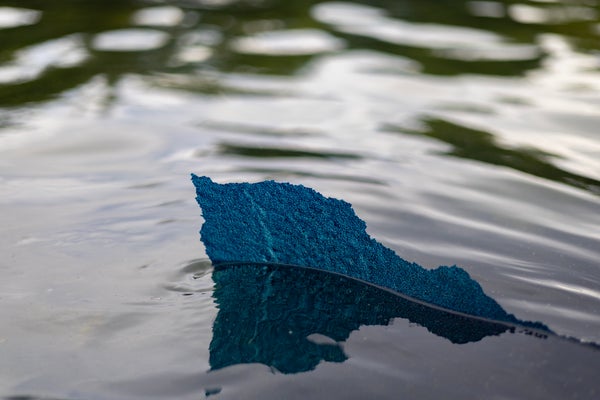
The Lincoln Memorial Reflecting Pool’s makeover was supposed to inspire patriotism, but chunks of material peeling off the pool’s surface have instead garnered more puzzlement and speculation.
President Donald Trump ordered the pool’s renovation in April, and that order included painting its floor and walls blue. Yet within weeks of the work’s completion, photographs and videos of floating chunks of a cerulean material that appears to have detached from the pool’s walls have gone viral. This material is polyurea coating—a fast-curing and durable surface membrane that can seal in water and is often used to coat swimming pools.
We spoke to engineering and pool experts to find out what could be going wrong at the beleaguered monument.
On supporting science journalism
If you're enjoying this article, consider supporting our award-winning journalism by subscribing. By purchasing a subscription you are helping to ensure the future of impactful stories about the discoveries and ideas shaping our world today.
For one, the blue material likely has no direct relation to the large algal blooms that are also plaguing the monument, according to Tim Auerhahn, chairman of the Aquatic Council. Nor is it merely a reaction to the hydrogen peroxide that the National Park Service (NPS) dumped into the water in an apparent effort to kill the algae—although that likely didn’t help, either.
At this point, pinning the blame for the floating coating on any one factor would be premature, says David McFayden, CEO of the paint and coating inspection company KTA-Tator.
Auerhahn agrees: “The failure of the adhesion to the substrate of that product probably could have been caused by many factors,” he says. Still, based on the videos of workers dumping hydrogen peroxide from the edges of the pool, he says that “it could have contributed to the issue, but it’s probably not the only cause.” The Department of the Interior, which oversees the NPS, did not respond to a request for comment.
Hydrogen peroxide can be used as a paint stripper, but the water in the pool would likely dilute it to the point that it couldn’t cause the current level of damage, he adds.
“It was immediately diluted when it’s being added to the water, and there’s just so many other factors that could contribute to delamination of a polyurea coating on a surface like this,” he says. “It was very much likely that this was multifactorial. When investigating engineering failures, we’re rarely going to see one single cause. There was a lot of different stressors to that coating, and they probably all had some level of contribution.”
Another key factor would have been how the pool’s walls and floor were prepared before they were painted “American flag blue” during the renovation. The cost of that renovation, originally estimated at less than $2 million, has since ballooned to almost $15 million.
“It’s actually a really specific process to add a coating like this to any basin,” Auerhahn says.
When applying coats of polyurea, workers need to make sure they paint on a new coat within 24 hours, or less, of the last layer, depending on the specific type of the substance being used. That ensures the polyurea layers adhere to one another and form a solid mass, blocking water from seeping through. And different methods of application can result in stronger or weaker molecular bonds. Given the renovation’s short timeline—around eight weeks—it’s possible the material wasn’t applied adequately to prevent damage. The bottom of the pool may also have been affected by the presence of heavy equipment and trucks—and a presidential motorcade that drove through at one point—while the coating was being prepared and applied.
The decision to use polyurea in the first place will also require investigation, Auerhahn notes. “The material that you’re adhering that polyurea coating to is questionable,” he says. “They were adhering it to granite.”
The precise material in question, Rhino Linings’ Pipeliner 5000, can bond to “virtually all substrates,” according to the company's commercial data sheet, but granite is not specifically listed. Rhino Linings was not the contractor that applied the coating to the Reflecting Pool. The company did not immediately respond to a request for comment.
“There’s a big question mark as to whether or not there was some compatibility there for the adhesion with granite,” says Auerhahn, adding that questions also remain as to how the substance might react to the high levels of ultraviolet exposure and hot temperatures of the Washington, D.C., summer. The company that carried out the renovation is Atlantic Industrial Coatings (AIC), which did not immediately respond to a request for comment. In a statement posted to its website, the company said it, along with the NPS, has identified areas of the pool that need repairs.
“These areas are a very small part of the massive 7 acre project, and do not indicate a failure of the liner,” the company wrote. “These repairs can not be made until the pool is drained. As soon as its feasible for the Park, the pool will be drained and AIC will be back to make those needed repairs as part of the warranty.”
The Trump administration has not made an official statement as to what has caused the peeling, although at least five people have been arrested for alleged vandalism of the pool. On June 20 President Trump said in a social media post that the pool would likely need to be drained for repairs to take place and claimed that unnamed vandals had put a “250 foot long gash” into the pool’s facade.
To determine exactly what happened, a full failure analysis would need to be conducted, McFayden says. That would include an examination of the pool’s pH levels, as well as investigations into whether there were mistakes made in preparing the surface to be coated and whether an improper material was selected, among many other variables.
The number of things that can possibly go wrong in a piece of work like this, McFayden observes, are far too numerous to rule anything out at this point.
“If you’ve met one coating failure, you’ve met one coating failure,” he says. “They’re all very different. There’s probably a lot of water chemistry involved in this situation. I can’t say that we’ve ever been involved in anything exactly like this before, to be honest with you.”