
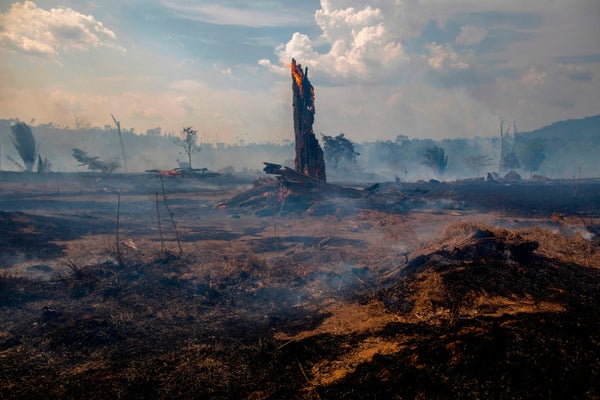
The world watched in horror last summer as vast swaths of the Amazon went up in flames.
While wildfires are commonplace in the world’s largest rainforest, scientists say last August alone saw about three times as many blazes as the previous year. In total, tens of thousands of fires were recorded across the region in 2019, according to Brazilian data.
The fires smoldered for weeks, propelling thick plumes of smoke into the air—and pumping tons of climate-warming carbon dioxide into the atmosphere in the process.
On supporting science journalism
If you're enjoying this article, consider supporting our award-winning journalism by subscribing. By purchasing a subscription you are helping to ensure the future of impactful stories about the discoveries and ideas shaping our world today.
This kind of devastation is likely to worsen in the coming decades, scientists say.
As temperatures rise and droughts intensify in the driest parts of the rainforest, wildfires are likely to burn more land and release more CO2. And if deforestation continues to rise, as well, the outcomes will be even worse.
A new study, out Friday in the journal Science Advances, helps put the issue into perspective.
As Amazon wildfires continue to worsen, it suggests, they threaten to convert the region from a carbon sink—a place that sucks carbon out of the air and stores it away—to a net source of carbon to the atmosphere.
The study, led by researchers in the United States and Brazil, used a special model to examine different scenarios with various levels of future climate change and deforestation. The model predicted both the behavior and spread of wildfires, as well as the ways forest ecosystems would respond to the blazes.
Unsurprisingly, a combination of severe climate change and increased deforestation produced the most dire results. Deforestation tends to divide large patches of forest into smaller fragments—where wildfires are more likely to ignite in the first place. Wildfires often begin at a forest’s edge before spreading deeper into the trees.
In this worst-case scenario—assuming about a 5% decline in forest area over the next few decades due to deforestation—the total amount of burned area increased by about 47% by 2050. Between 2010 and 2050, these fires would release about 17 billion tons of CO2 into the air.
To be sure, this scenario isn’t necessarily a guarantee, or even a realistic look at the future. The severe climate trajectory used in the study assumes a level of warming that many scientists today believe is unlikely for the future.
Still, even mild scenarios—assuming limited future warming and no increase in deforestation—are likely to see an increase in burned area and fire-related CO2 emissions.
That’s partly because even small increases in temperature may increase the risk of a blaze.
But an even bigger factor is the rising risk of drought. Even limited warming scenarios are likely to cause the driest parts of the Amazon to become even drier—and that means more fuel for fires.
At the same time, the study suggests Amazon trees in a warmer, drier climate may store less carbon as they grow.
Put together, the results point to an Amazon that removes less carbon from the atmosphere than before, and one that also releases more carbon.
This means, even with stringent climate action in the coming decades, the Amazon likely will experience some serious changes.
The study notes that curbing deforestation may have a substantial impact on future wildfires—enough to reduce potential greenhouse gas emissions by as much as 50%. It wouldn’t be enough to completely offset the increase in CO2 driven by climate change. But it would help mitigate some of the consequences.
Research suggests last year’s catastrophic blazes were heavily influenced by deforestation. In fact, much of the burned area likely occurred on recently deforested swaths of land—as opposed to inside the standing forests.
As a whole, the study points to curbing deforestation, enforcing protected areas and minimizing future climate warming as the key strategies for reducing impacts in the Amazon.
It’s not the only recent paper to warn of the need for quick action to protect the world’s largest rainforest. A December editorial in Science Advances, published by Amazon experts Thomas Lovejoy and Carlos Nobre, warned that the region may be approaching an irreversible “tipping point.”
The researchers suggest deforestation and global warming are altering the region’s hydrology, affecting the amount of moisture in the air and the amount of precipitation that falls. As a result, large swaths of the region are in danger of shifting from lush rainforest to dry, tropical grassland.
Without major, immediate action, the researchers warn, the Amazon eventually could reach a point of no return—a point they argue is close at hand.
“[T]he precious Amazon is teetering on the edge of functional destruction and, with it, so are we,” they wrote.
Reprinted from Climatewire with permission from E&E News. E&E provides daily coverage of essential energy and environmental news at www.eenews.net.