
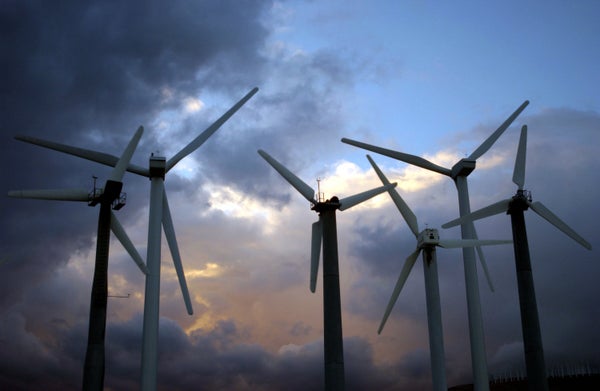
CLIMATEWIRE | Nearly a million bats are killed each year in the United States by colliding with spinning wind turbines, prompting the Energy Department to give scientists millions of dollars to find ways to minimize bat casualties.
As the United States seeks to expand wind energy to reduce carbon emissions and minimize climate impacts, land-based wind turbines are emerging as a threat to several bat species that are crucial to pollinating plants and increasing agricultural yield, said Winifred Frick, a chief scientist at Bat Conservation International, which protects bat species.
“You put these turbines up and it starts raining bats,” Frick said. Her group is one of five organizations that received DOE funding Thursday for bat safety research.
On supporting science journalism
If you're enjoying this article, consider supporting our award-winning journalism by subscribing. By purchasing a subscription you are helping to ensure the future of impactful stories about the discoveries and ideas shaping our world today.
In 2022, wind power generated about 10 percent of U.S. energy and accounted for half of the electricity from renewables. DOE projects U.S. wind capacity to nearly triple by 2050, adding 260 gigawatts, though some of the increase will come from offshore wind farms, which are less harmful to bats. One gigawatt can power about 400,000 homes.
The 880,000 bats killed every year in the United States is “a shockingly large number,” Frick said. Scientists calculated bat deaths by picking up carcasses under turbines and estimating that each wind tower kills up to 150 bats a year. The United States has more than 71,000 onshore wind turbines and is adding about 3,000 a year.
Turbine blades weigh as much as 24,000 pounds and spin at up to 450 mph.
The death count suggests many bat species could become endangered in the next few years, Frick said. A study from 2021 found the hoary bat population in North America could be cut in half by 2028 without “rapid adoption” of measures that reduce deaths from wind turbines.
The value of bats goes beyond benefits that farmers get from pest control, Frick said. Bats also could help scientists understand aging and death better because the small mammals have relatively longer lifespans.
But the scientific community currently has no idea why wind turbines attract bats or how to deter the flying mammals from the turbines whose blades reach 200 feet.
The new DOE funding aims to address the knowledge gap. The $7.5 million comes from the infrastructure law Congress passed in 2021 and is going to scientists who will test untried methods of bat protection.
The goal, Frick said, is to “find solutions that can maximize energy production while minimizing the number of bats killed.”
Currently, wind farms can turn off turbines temporarily after detecting a flock of incoming bats, but that comes at the price of lost power output.
Frick’s team received $2.5 million to test whether the bright lights installed on turbines to warn aircraft pilots are attracting bats. If that is the case, wind farms can put up aircraft detection systems that will turn on blinking warning lights only when an airplane is nearby and reduce bat deaths, Frick said.
Another team of scientists will examine if ultraviolet lights could deter bats, said Christian Newman, a technical executive at Electric Power Research Institute, which received $2.3 million in DOE funding.
A small-scale study by the U.S. Geological Survey has shown that bats stay away from wind towers radiating UV lights. The new DOE funding will allow researchers at the nonprofit research institute to run tests on a bigger scale, Newman said.
This story also appears in Energywire.
Reprinted from E&E News with permission from POLITICO, LLC. Copyright 2023. E&E News provides essential news for energy and environment professionals.