
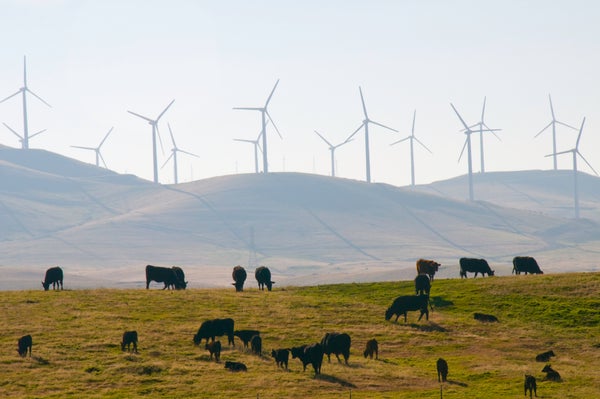
CLIMATEWIRE | What scientists call the Wind Belt may soon expand with the arrival of taller wind turbines and new construction techniques that could result in an 80 percent increase in U.S. land-based clean energy over the next 10 years.
“This could go a long way toward helping the nation meet its clean energy goals,” researchers with the National Renewable Energy Laboratory (NREL) found in a recent study.
Lead author Owen Roberts said the possibility of additional wind power is an “unexpected opportunity” brought about by cost reductions in the construction and operation of wind turbines.
On supporting science journalism
If you're enjoying this article, consider supporting our award-winning journalism by subscribing. By purchasing a subscription you are helping to ensure the future of impactful stories about the discoveries and ideas shaping our world today.
But he cautioned that not all parts of the U.S. may welcome the evolving turbines.
“The politics of this will be a balancing act,” Roberts said in an interview, noting that some areas of the country have not been widely exposed to wind farms, including regions in the Southeast and Gulf coasts.
The addition of new bigger turbines — which are built to reach higher wind formations — may come as a surprise to some people in those areas, he said. Larger offshore turbines also come with their own challenges.
The equipment comes with risks to species of birds and bats. The visual impacts of taller turbines is another consideration. Roberts noted that officials in North Caroline and Tennessee have approved restrictions on the proximity that wind turbines might be built near communities.
The study shows that the towers that hold the rotating turbine blades have grown from 98 feet to 295 feet tall since the 1980s, and the reach of the blades has expanded more than fourfold. Towers matching the size of the Washington Monument (554 feet tall) are now possible, holding a blade diameter of 492 feet.
The study by NREL, which is part of the Department of Energy, outlines how construction cost reductions could encourage the use of taller towers. They include “mobile cranes” that take factory-made tower segments and climb on top of them to lift up the next segment, rising with the towers as they are assembled on site.
That advancement comes as conventional cranes, called crawler cranes, increased in size and are more difficult to move around a wind farm, Roberts said. Ease of construction and the lower assembly and transportation costs of components and machinery is expected to cut the costs of building new wind farms, the study says.
Their additional height could also address challenging characteristics of the Wind Belt created by the Rocky Mountains, Roberts explained. The mountain range causes wind patterns flowing over them from the west to temporarily drop — which is good for smaller turbines — before climbing higher as they approach the East Coast, requiring the taller towers to harvest power.
Prevailing winds in eastern Kansas can be almost 1 1/2 times stronger than those in central Georgia.
So building taller towers in Georgia could help offset those power losses. That's where politics comes in. The study indicates that utilities and political leaders may have to explain the benefits of reducing greenhouse gas emissions to help gain support for wind farms — and bigger turbines.
“We’re talking about bringing a new industry and new technology to parts of the United States that have hardly seen wind energy,” Roberts explained. “The more we can show there’s potential, the more people will understand the opportunity.”
Reprinted from E&E News with permission from POLITICO, LLC. Copyright 2023. E&E News provides essential news for energy and environment professionals.