
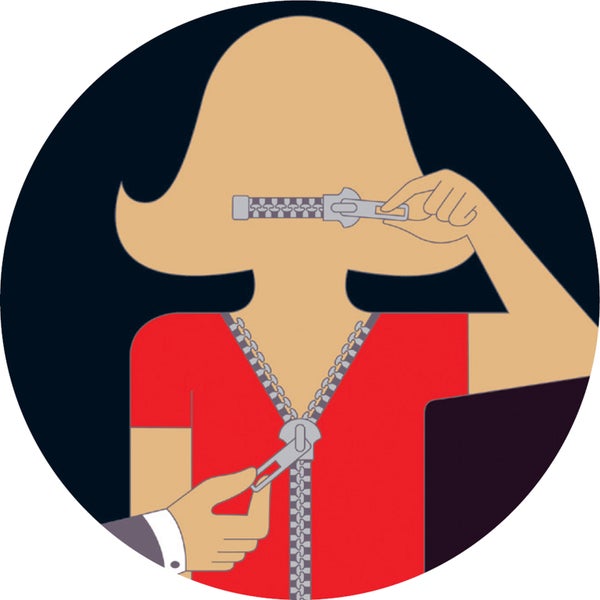
Despite the gains of the #MeToo movement, women still hesitate to file work-related sexual harassment complaints for fear of repercussions. Now a study suggests people may indeed penalize female employees for self-reporting such experiences.
Chloe Grace Hart, a doctoral candidate in sociology at Stanford University, ran an experiment five times between late 2017 and early 2018, each time involving about 200 people who identified as male, female or another gender. Hart asked participants to imagine they were the manager of a company considering a fictional female sales associate, named Sarah, for promotion. Each participant was assigned to one of five groups. Four groups received an employee file that contained information about harassment—either sexual or nonsexual—that Sarah had experienced from a male co-worker. Each incident was either self-reported or reported by a colleague. A fifth group received the same file without any record of harassment.
Hart then asked the participants to rate how inclined they were to recommend Sarah for promotion on a scale from 1 (“extremely unlikely”) to 7 (“extremely likely”). Hart found that on average participants were 0.37 points less likely to recommend Sarah for promotion if she self-reported her sexual harassment than if her colleague reported it. They were also 0.16 points less likely to recommend her than if she self-reported nonsexual harassment. Finally, the participants were 0.11 points less likely to recommend her than if her employment file made no mention of any harassment. The study was published online in May in Gender & Society.
On supporting science journalism
If you're enjoying this article, consider supporting our award-winning journalism by subscribing. By purchasing a subscription you are helping to ensure the future of impactful stories about the discoveries and ideas shaping our world today.
It serves as a reminder that barriers to reporting sexual harassment “have not gone away,” says Nancy Hauserman, professor emeritus of management and entrepreneurship at the University of Iowa, who was not involved in the study. “I think it is important to keep sexual harassment in the scholarly gaze.”
The findings are bolstered by a 2018 report that analyzed 46,210 Title VII sexual harassment discrimination charges filed with the U.S. Equal Employment Opportunity Commission and state Fair Employment Practices Agencies. The report found that 65 percent of women who filed such charges between 2012 and 2016 said they lost their jobs after making their complaints.
But Hart's research did find a silver lining. The participants in her most recent study group were significantly more likely to promote Sarah when she self-reported sexual harassment as compared with those in the earliest group—which may be linked to the momentum of the #MeToo movement, Hart says. “I don't think that the study indicates that the problem is solved,” she says. “But if nothing else, it indicates that we are able to shift our social perceptions of people in a position of experiencing sexual harassment.”