
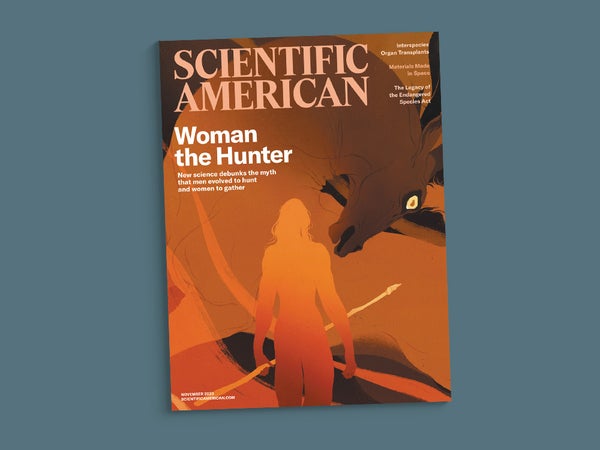
Don't you love it when a paradigm shifts? When people realize that they've been looking at something all wrong and that there's a better way? My favorite example is plate tectonics. The notion that continents (continents!) could move across the surface of the planet was simply unthinkable for most of human history. It took a lot of research and, even more important, a lot of rethinking for people to accept that plate tectonics was real and could explain earthquakes and volcanoes and why South America and Africa look like they could snuggle together. We're proud that Scientific American published some of the first popular articles about plate tectonics and helped us look at the world in a new way.
In our cover story, human biologist Cara Ocobock and biological anthropologist Sarah Lacy upend a long-dominant theory of human evolution: that men alone evolved to hunt. Drawing on research from physiology, paleoanthropology, archaeology, and more, they show that women have always hunted and are better adapted to some endurance tests than men.
Apologies in advance, but our article on organ transplants may well bring tears to your eyes (it did mine). Tanya Lewis, a Scientific American senior health editor, shares the technological and medical advances that are saving more lives—potentially many more. The generosity of donors and their families, the personal history of the surgeon at the center of the story, and Tanya's own family experiences make this one of our most touching articles of the year.
On supporting science journalism
If you're enjoying this article, consider supporting our award-winning journalism by subscribing. By purchasing a subscription you are helping to ensure the future of impactful stories about the discoveries and ideas shaping our world today.
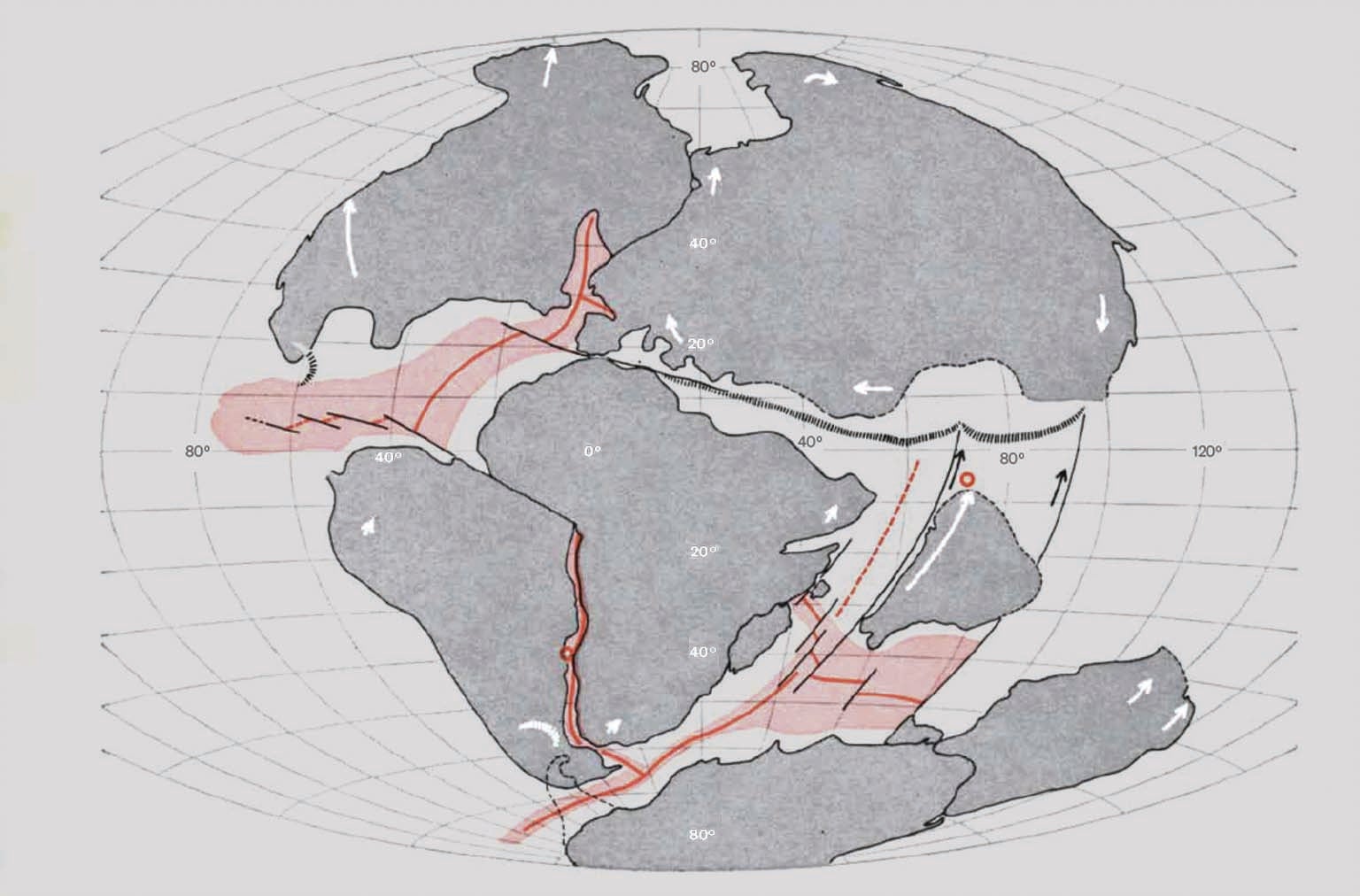
Map of global tectonics from the October 1970 issue of Scientific American. Credit: Scientific American, Vol. 223, No. 4; 1970
The Endangered Species Act is 50 years old. Have you seen any Bald Eagles lately? That used to be almost impossible throughout most of the U.S., but now they're thriving, and many species that could have gone extinct are still with us. Robert Kunzig, a former Scientific American editor, evaluates the impact of the ESA and what wildlife needs from the next conservation laws.
Materials scientist and aeronautics expert Debbie G. Senesky designs electronics resilient enough to work on Venus—where the surface is hot enough to melt lead, and the skies rain sulfuric acid. As she describes, she's been running experiments on the International Space Station to grow materials that could serve as sensors, batteries, or other devices on future missions.
The Murrinhpatha language, spoken by some Aboriginal people in Australia, has a very different structure than English does. Words can occur in any order in a sentence, and a single word can have many pieces added on to express actions and intentions. As author Christine Kenneally writes, linguists have recently found that Murrinhpatha speakers prepare to speak in a previously unknown way, which adds to evidence that language influences our perceptions.
Why do so many people enjoy haunted houses, monster movies, horror books and true crime podcasts? In a spookily pictorialized story, behavioral scientists Athena Aktipis and Coltan Scrivner present some delightful research about morbid curiosity and scary play. Happy Halloween!
Contributors to Scientific American’s November 2023 Issue
Writers, artists, photographers and researchers share the stories behind the stories
June Minju Kim Can We Protect Every Species?
During the height of the COVID-19 pandemic, graphs of hospitalization and infection rates dominated the news, catching the eye of June Minju Kim, then a producer for a South Korean broadcast news network. Now a recent graduate of Columbia University's master's program in data journalism, Kim spent the summer as an intern with Scientific American's graphics team and designed this issue's spread on the 50-year history of the Endangered Species Act. She wanted to avoid collapsing the individuality of the species—from flowers to birds to lichen—while capturing the immense scope of the policy. “These are living things, and every species really deserves your attention,” she says. Kim's work often focuses on the technology being used to quell climate change. She has reported on the tension between lithium mining in Nevada (which proponents say will power electric vehicles) and the preservation of an endangered flower. These complex stories “encourage more thinking,” she says. “There's so much room for exploration.”
Credit: James Brickwood/Oculi
David Maurice Smith How Grammar Changes Perception
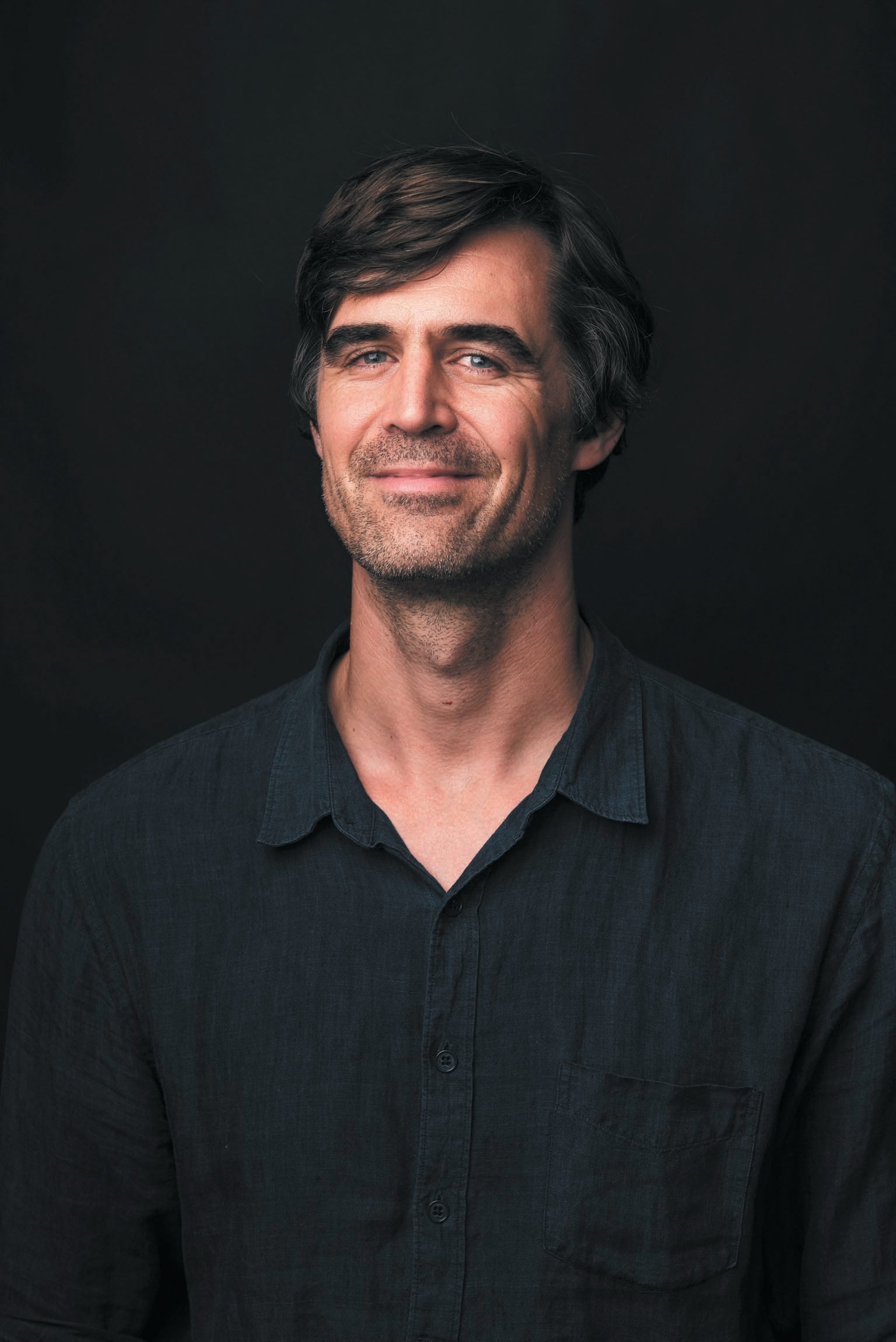
Photojournalist David Maurice Smith (above), who is based in Australia's Gold Coast, traveled to the other end of that continent this past July to photograph speakers of an Aboriginal language called Murrinhpatha. He describes it as “incredibly sophisticated—really, really next level.” Smith, originally from Vancouver, Canada, says he doesn't have an ear for learning languages but has always been drawn to learning from people from different cultural backgrounds. He previously worked in social services, often with First Nations communities, and pursued photography as a more creative outlet with a similar purpose. At 6′7″ tall, Smith knows he's rarely a fly on the wall when he arrives in a community with a camera. Instead, he says, the most genuine photos come from listening to and engaging with the folks he's there to photograph. “You're always going to influence what's happening around you,” he says, “but you can minimize that by just taking the time to connect with people.”
Credit: Tanya Lewis
Tanya Lewis Gift of Life
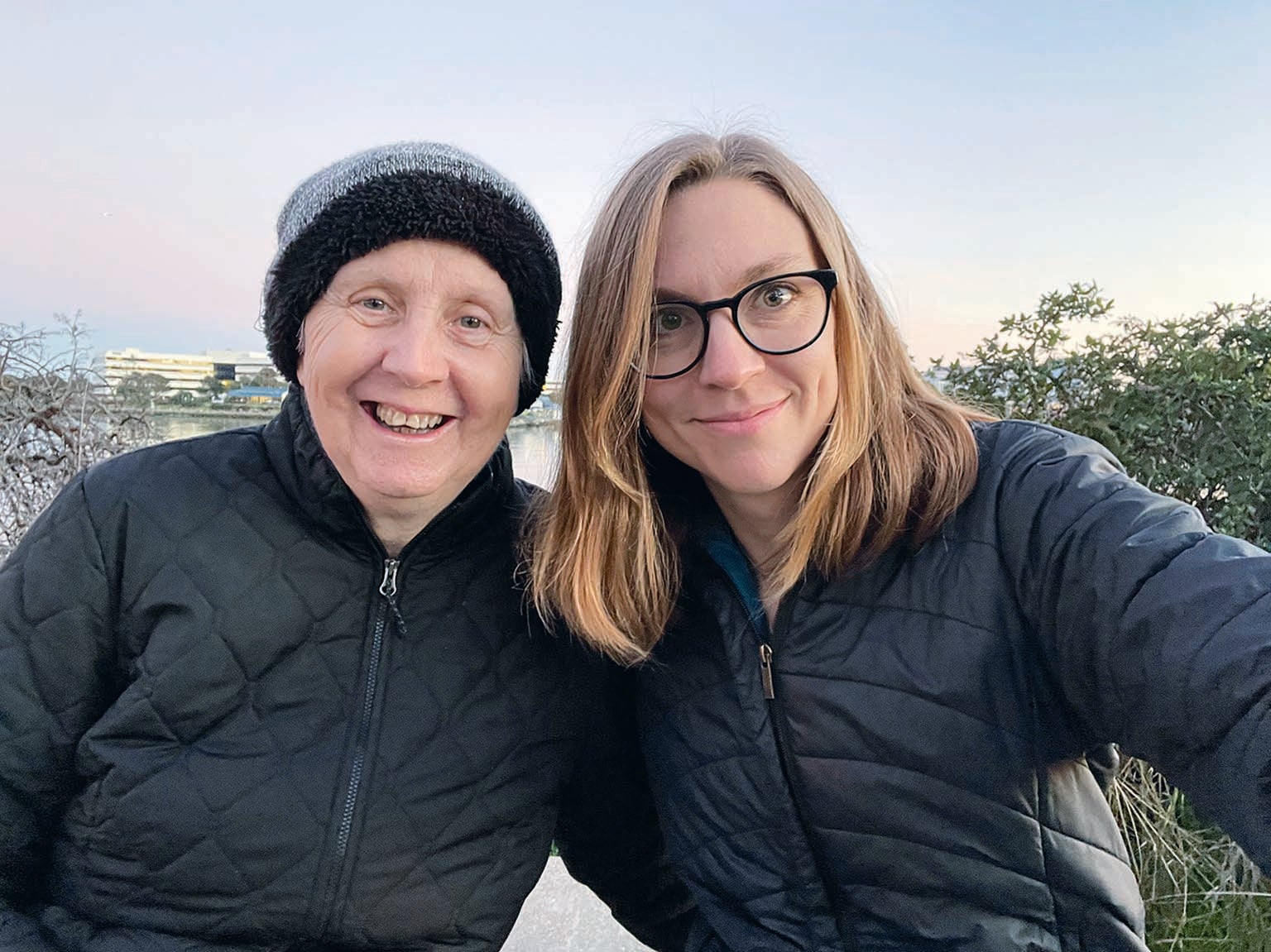
In 2021 Tanya Lewis's mother, Gail (above left), moved from Hawaii to California in the hopes of receiving a lung transplant. Her condition worsened as nearly four months on the waiting list passed. Then she got the call. Lewis, Scientific American's senior health and medicine news editor, moved from her home in Brooklyn to care for her mother as she recovered. The surgery was successful, and the recovery was grueling. For months afterward, Lewis didn't want to even think about transplants. “I've just lived this whole experience,” she recalls. But suddenly, transplant medicine was in the news. Doctors had performed the first pig heart and pig kidney transplants into humans, or “xenotransplants,” and Lewis felt compelled to understand how we got to this point. These pioneering techniques might change the grim calculus of organ transplants in a way that no previous advances could, she writes in her feature story this month. “The fact that we have the technology and the know-how to do this is what's so compelling about it to me.”
Debbie G. Senesky The Right Stuff
Venus is one of our closest planetary neighbors, but probes visited its surface only briefly in the 1970s and 1980s and haven't gone back since. “It's hard! It's too hard,” says Debbie G. Senesky, an aerospace engineer at Stanford University, who is developing technology for a return trip to the inhospitable planet. “Think of your cell phone working at 600 degrees Celsius. That's a challenge.” In this issue, Senesky shares an unconventional approach she's exploring: creating materials with unique properties that can be manufactured in space. Making things that work in impossible conditions is her favorite kind of puzzle. She traces this passion to a formative moment in her childhood when she fixed her broken cassette player by fiddling with the gear train. Some of Senesky's latest materials—so light they can sit on a flower petal without bending it—recently returned from the International Space Station.