
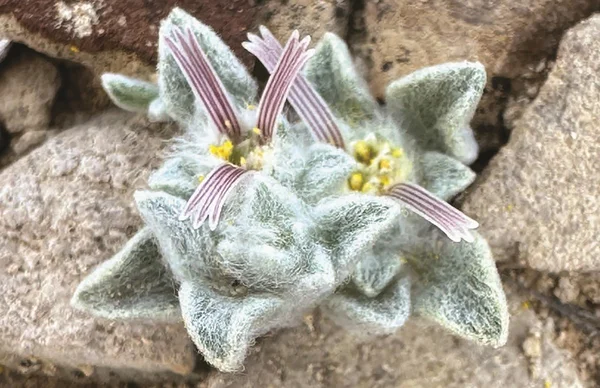
There’s a new sunflower in town. But it isn’t your stereotypical sunflower with cheery yellow petals.
The so-called “woolly devil” is tiny, pale and well camouflaged amid limestone-rich rocks and look-alike plants in Texas’s Big Bend National Park, where it was discovered. “When we found it, we didn’t realize it was something new,” says Deb Manley, a park volunteer, who, with a colleague, was the first to spot the little plant. “I just figured it was another small annual that was going to be difficult to look up.”
And indeed, it was quite difficult to look up; it didn’t quite match anything in the guides for tiny, fuzzy wildflower plants. But that turned out to be for a very good reason—the flower was a species not yet known to scientists. “It was so unique that it actually needed to have its own genus, and that’s a very rare thing,” says Isaac Lichter Marck, an evolutionary biologist and a daisy taxonomist at the California Academy of Sciences. Like Manley, he’s a member of the team who published the discovery of the woolly devil in February in PhytoKeys.
On supporting science journalism
If you're enjoying this article, consider supporting our award-winning journalism by subscribing. By purchasing a subscription you are helping to ensure the future of impactful stories about the discoveries and ideas shaping our world today.
Sunflowers are the part of the most diverse family among flowering plants, Asteraceae, which contains more than 30,000 formally described species. This includes, of course, the iconic, bright yellow “common sunflower,” or Helianthus annuus. All sunflower species have a strange trait in common: any one of their blooms, called a capitulum, is actually made up of two varieties of flowers—ray flowers, which make up the sunflower’s characteristic halo of petals, and disc flowers that fill the inner ring of the flower head. The woolly devil follows this plan in miniature: it sports two or three ray flowers that are white with maroon stripes, with a few unremarkable disk flowers between them.

Big Bend National Park botanist Carolyn Whiting photographs the tiny woolly devil sunflower.
NPS/C. Hoyt
Wild sunflowers tend to thrive in harsh environments, such as the desert conditions that characterize Big Bend National Park: lots of sunshine, extreme heat and occasional sudden summer storms. “That’s made them really successful in the last 15 to 20 million years, in which the Earth has undergone a lot of cooling and drying,” Lichter Marck says.
The new find is formally known as Ovicula biradiata. Ovicula means “little sheep” in Latin, and the name not only describes the plant but also honors the iconic bighorn sheep that used to roam Big Bend before they were killed by hunters and diseases. (Texas began to reintroduce sheep to the region in 2010). Meanwhile the common name “woolly devil” reflects the plant’s discovery near a canyon called Devil’s Den, Manley says, as well as the hornlike appearance of plants with two ray florets—and, she admits, the frustration of distinguishing it from other tiny, fuzzy plants.
And these plants really are woolly, Lichter Marck says. Thousands of hairs fully cover the stems and leaves. “In order to extract DNA from the plant, we actually had to give the leaves a little shave,” he says. The hairs likely protect the plant from hungry animals, he notes. “Imagine you’re an herbivore—you come to chew on these leaves, but you just get a mouthful of wool,” Lichter Marck says.
This feature is surprisingly common among sunflowers in such harsh environments. It likely also protects the plant from damaging ultraviolet light or the dry desert air that sucks moisture from plants. And right now the region is in a severe drought, so woolly devils need all the protection they can get, Manley says.
The drought also makes keeping tabs on the woolly devil a challenge for Manley and anyone else looking to spot it. The plant is difficult to distinguish when not in flower—and it only flowers after it rains. “It’s frustrating,” Manley says, noting that not even she can track down the plant right now, much less newcomers to the park who have heard about the discovery. “There is not much going on in the park right now, botanically—the main event right now is there’s a lot of plants dying,” she says.
Even if the drought eases up, Lichter Marck worries about the fate of the woolly devil, which Manley and other park representatives identified last year in only a few patches of the park. “We may have documented this plant as it’s on its way out, and we’re lucky to do so,” he says. “It’s almost an urgent type of science. We need to document these things before they go extinct.”